Categories
Crime Other

Are all Henning Mankell books similar?

Faceless Killers (Kurt Wallander Mystery)

Scandinavian crime fiction seems to be everywhere at the moment. All the authors are compared to each other, despite the fact their books are very different in style. Henning Mankell has been on my radar for a long time and I was interested to see how his books would compare to the likes of Larsson and Nesbo. Unfortunately, I have the feeling that his books are the weakest of the three, but having only read a small section of his writing I wanted to check that I wasn’t missing out on his best work.

I started to read Faceless Killers (the first of the Wallander books) over the weekend, but I quickly became frustrated and abandoned it after 70 pages. Wallander appeared to be a stereotypical cardboard cutout detective and no attempts were made to bring him to life. There was no atmosphere and the plot seemed implausible.

I also struggled with the poor quality of the writing. The simplicity was almost child-like in places.

Overall, I wasn’t very impressed with the section I read.

Does Faceless Killers have a good ending?

Does the Wallander series improve as it progresses?

Are any of Mankell’s other books worth reading?

Or, should I forget the books and stick to the Wallander DVDs?

Categories
2010 Books in Translation

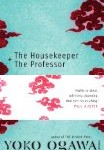
The Housekeeper and The Professor – Yoko Ogawa

The Housekeeper and the Professor Translated from the Japanese by Stephen Snyder

Five words from the blurb: maths, memory, affection, riddles, past

People have raved about The Housekeeper and The Professor ever since its release last year, but although I enjoyed reading it I wasn’t bowled over in the way most other readers have been.

The book centres on a maths professor with a short-term memory only eighty minutes long. He vividly remembers events from his past, but all new information is quickly forgotten. This means that the professor never recognises his housekeeper and she must reintroduce herself each morning. Despite this fact she becomes enchanted by him. He shows her the beauty of numbers and forms a strong bond with her son.

This is a beautiful little book, but I think its main charm is the way that it introduces a love for mathematics.

I ran my fingers over the lines of the formula, a long chain of numbers and symbols that flowed from one page to the next. As I followed the chain, link by link, the room faded and I found myself in a dark, silent place of numbers. But I felt no fear, certain in the knowledge that the Professor would guide me toward eternal, unchangeable truths.

The professor introduces prime numbers, perfect numbers, amicable numbers and many other basic mathematical concepts. The problem was that I was already aware of most of them and so they didn’t produce the magical sense of wonder that they have clearly induced in others.

The writing was simple and engaging, but it wasn’t as emotional as I was expecting. The overall feeling was one of tenderness and I think this is the type of book that you should read if you are in the mood something gentle and heartwarming.

If you can’t imagine enjoying a novel containing mathematics then I urge you to give this book a try, but if you already have a love of numbers it may be a bit too basic.

.

The thoughts of other bloggers:

Characters, themes and a gently developing plot are perfectly blended. Fleur Fisher in her World

I would never have believed that mathematics could be so seamlessly woven into fiction that I hardly questioned its presence there. Erin Reads

The Housekeeper and the Professor is a very quiet, very subtle book. At the same time, it’s a page-turner, a book you just don’t want to put down. How often do you come across books like this? su [shu]

Categories
2011 Booker Prize YA

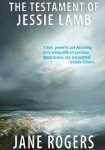
The Testament of Jessie Lamb – Jane Rogers

The Testament of Jessie Lamb Long listed for 2011 Booker Prize

Five words from the blurb: women, dying, girl, innocent, heroism

The Testament of Jessie Lamb is one of the most frustrating books I’ve ever read. I was gripped by the fast paced plot, but internally screaming at the frustrating actions of the narrator, the unlikely global events and the numerous bizarre plot twists.

The Testament of Jessie Lamb is set in the near future, at a time when an act of biological terrorism has caused all women to die during pregnancy. This leads the human race into imaging a time when there will no longer be any children, when the aging population will have to support themselves and when they will eventually have to face the extinction of the human race. The premise appealed to me greatly, but unfortunately the book concentrated on a seemingly bizarre solution to this problem (minor spoiler – highlight to read) – teenage girls who don’t see any point of living if they can’t have children (roll-eyes) decide to sacrifice themselves to create a new generation. ARRRGGHH!!

It is hard to explain what frustrated me most about this book, but I’ll try my best! In a similar way to The Unit, I had problems with the basic premise of the story and I was unable to suspend my disbelief because there were so many holes in the plot. I don’t want to spoil anything for those who haven’t read the book so I’ll just give a couple of examples from the first section: Why would terrorists want to wipe out the entire human race? Normally terrorists just want to kill a certain group of society. Why couldn’t they save the women by using contraception/the morning after pill/hysterectomies?  

The most annoying aspect of this book was the narrator, Jessie Lamb. Her teenage outlook on life had me internally screaming at the pages. Everything problem had a simple solution and she seemed to think she had the power to save the world by herself. Her ideas were one-dimensional and failed to take into account the complexity of the adult world. I have had similar issues with teenage protagonists in the past (eg. The Stars in the Bright Sky, Pigeon English) and can see that people like this exist, but they drive me nuts. Reading about them is not an enjoyable experience. (Also note the awkward sentence structure in this passage).

We had spent hours discussing it. Why shouldn’t anyone over 10 should be able to elect representatives and have them stand up for us in parliament? How else could kids have power? But Nat and Lisa said why would you want to join in their stupid system. And Lisa said why did Iain  care, he already had the vote and it’d done a fat lot of good.

I’d describe this as a good YA book – one that allows teenagers to think about a few issues relevant to them. I admit to being dragged along by the pace of the plot, but as an adult reader I was unsatisfied. My negative reaction to this book proves that it has affected me on some level and that is surely better than the boredom/indifference produced by others. I’d therefore recommend it as the perfect book group choice – I guarantee it will create a lively debate!

If you enjoy reading about life from the perspective of teenagers then I’m sure you’ll appreciate this book, but I can’t understand why it made the Booker long list.

.

Categories
2010 Books in Translation Other Prizes

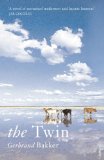
The Twin – Gerbrand Bakker

The Twin Translated from the Dutch by David Colmer

Winner of 2010 International IMPAC Dublin Literary Award

Five words from the blurb: remote, Dutch, twin, death, choices

The Twin is a quiet, tender story about one man learning to cope with the loss of his twin brother. Helmer lives on a remote Dutch farm with his dying father. He never wanted to be a farmer, but the death of his twin forced him to return to the family home. Helmer’s isolated existence is brought to an end by the sudden arrival of his twin’s fiancee.

Very little actually happens in this book, but I was captivated its emotional intensity. I quickly felt that I understood Helmer and his frustration at the way his life had unfolded. 

‘You never said anything,’ Father says. ‘You never said you didn’t want to.’

‘You didn’t have much choice.’ I walk back to the window and follow the line of the dyke until I can see the lighthouse again.

‘No.’

The writing was simple, but allowed subtle emotion to bubble through to the surface of every page.

From the description you’d expect this to be a depressing book, but while there were a few sad moments, I found that the tone always lifted before I had a chance to shed a tear.

This book won’t be for everyone, but if you’re in the mood for a book that investigates the inevitability of life then this is the perfect choice.

.

The thoughts of other bloggers:

As painful as it is, it’s a wonderous experience to dwell with them for a time. The Mookse and the Gripes

This simple book surprised me. I will read it again. Page247

The scenery is wonderfully described you get the feeling of isolation and strangeness of platteland… Winstonsdad’s Blog

Categories
1950s Chunkster Fantasy

Gormenghast – Mervyn Peake

Gormenghast (Gormenghast Trilogy (Book Two))


SPOILER FREE REVIEW

Gormenghast is the sequel to the wonderful Titus Groan and it doesn’t disappoint. The writing is just as vivid and the story is, if anything, even more compelling. 

The two books are slightly different in style and it took me a while to adjust to the more intimate feel of Gormenghast. As the book progresses the plot becomes increasingly gripping and for the last 40 pages I was unable to put the book down, totally engrossed in the action. 

It is hard to imagine a book with more complex characters – each one so alive they seem to breathe on the page. The setting is just as good – it is atmospheric and there are many creepy moments.

It is impossible to review this book without giving spoilers for Titus Groan, so I’ll reveal nothing about the plot, other than to say that it is filled with surprises.  

I am enjoying these books so much that I don’t want the experience to end.

All I can do is suggest that you try these outstanding books yourself.

SPOILER DISCUSSION FOR READ-ALONG

Fifty-Nine – Eighty (p659 – p752)

I can’t believe we’ve made it to the end of Gormenghast! I’m so glad that I took the time to read it slowly and have wonderful discussions along the way. I’m feeling a bit sad at finishing Gormenghast as I suspect that the next two books will not be quite as good – the setting of Gormenghast Castle makes these books special and I can’t see how they will work without it dominating proceedings.

What did you think of the way Gormenghast ended?

I was interested to discover that I was rooting for Steerpike’s death. I loved him in the beginning, but his evil had gone too far by the end. This change in compassion for a character was quite an unusual experience and the fact that all the characters underwent similar transformations shows Peake’s skill as an author.

I don’t think I’ve ever read a book where the central character changes from one stage of a book to the next. Not knowing which character would play a major role and which would never be seen again added to the intrigue of the narrative. I was also impressed by the way Peake chose to kill off almost all the main characters. It was brave to create such a wealth of amazingly vivid characters and then risk upsetting readers by removing them.

The only thing that I didn’t like in the books was Keda and her daughter. I had expected them to play a greater role and so was baffled by the sudden death of “the Thing”. Do you think the books would have been better without Keda and her child?

It was good to have such a hopeful ending. With all that death it could easily have become depressing, but I loved the way that Titus looked to the future and wanted to risk everything to better his life experience. I found myself warming to Titus towards the end of Gormenghast and am looking forward to seeing what happens to him next. Are you looking forward to Titus Alone?

Gormenghast Read-along Schedule

Categories
1950s Chunkster Classics Other

Gormenghast Read-along: Week 7

Gormenghast (Gormenghast Trilogy (Book Two))

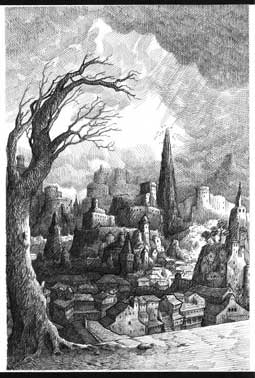
Gormenghast

Thirty-Eight – Fitfty-Eight (p565 – p659)

.

.

.This week’s Gormenghast discussion is written by Falaise from 2606 Books and Counting. He is a blogger who, given the average life expectancy of a British man, realised that he will probably only manage to read 2606 books in the rest of his life. He is prioritising the important ones by working his way through 1001 Books: You Must Read Before You Die.

Jackie has very kindly allowed me to barge into her blog to share some thoughts on this third week of the Gormenghast segment of the Gormenghast Read-along. It’s a good week to have this opportunity as it’s been spectacularly eventful in the book, with Steerpike taking centre stage once again.

I’ve always pictured him as being pale, sinuous, almost serpentine in appearance but, over the past couple of weeks, another image has been elbowing its way into my mind.  You see, I am starting to have these flashes of seeing Steerpike as a villain from the days of silent movies, the kind who wears an opera hat, black cloak and an outré moustache.  I know it’s wrong.  I know he is far more evil and complex than that, but his journey from ambition to Technicolor sadist has been so dramatic and complete that I just can’t help it.

When we first met him in Titus Groan, Steerpike was an escapee from Swelter’s hellish kitchens, characterised more by a strong survival instinct than by anything else.  Now, however, with the slayings of Barquentine and Flay, his treatment of the twins and his twisted pursuit of Fuchsia, his descent into evil is complete.  Fortunately, this has also coincided with his unmasking as a traitor and Fuchsia’s realisation of his true nature.

All this seems quite straightforward, inasmuch as anything in Gormenghast Castle can be straightforward, but there are a few nagging questions that I haven’t quite got my head around.  Firstly, the death of Cora and Clarice doesn’t seem to be quiet as clear cut as I had originally thought it.  We are told that Steerpike stops visiting and that they starve to death, with only their final wails and screams heard by Flay.  It’s shockingly cruel and the implication is obvious.  Steerpike has murdered them.  But, hold on.  We later find out that Steerpike has been sick in bed for weeks, after his killing of Barquentine.  So, maybe he hadn’t really intended them to die, even though they only succumbed to starvation a couple of days after he was up and about.  I still think he is ultimately responsible but am not sure whether this was a cowardly crime of omission (by failing to alert anyone to their predicament) or a cruel crime of commission (locking them away, intending that they should starve).

What do you think about this?  Did Steerpike want them dead? Or was he just indifferent to their fate?  And, if so, does it make any difference to our view of him?
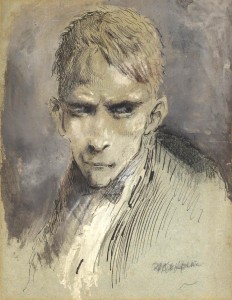
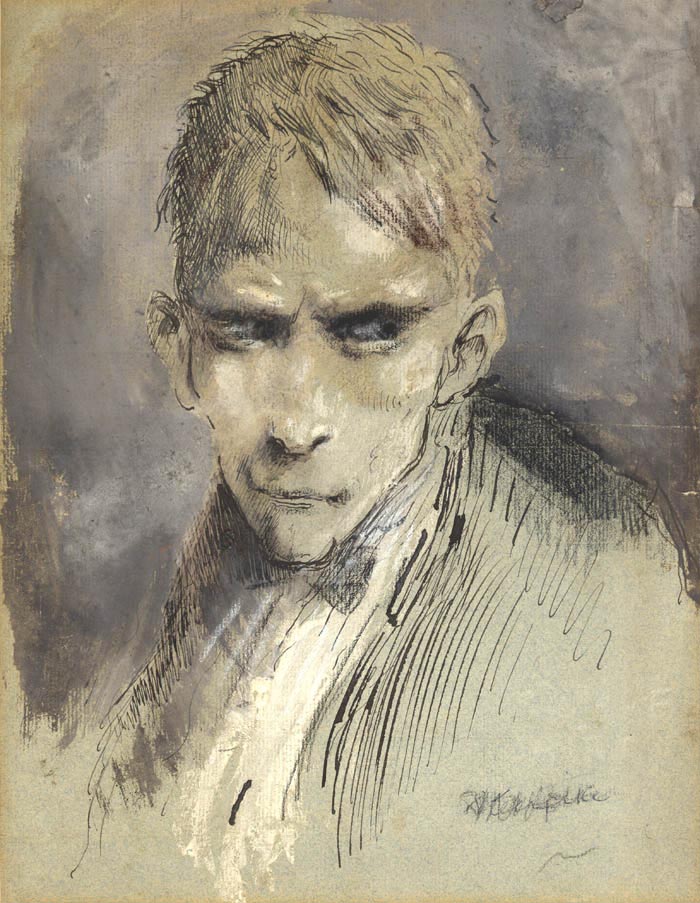
There’s also the question of Steerpike’s physical appearance and emotional state and whether there is a relationship between them and his level of moral turpitude.  At the beginning of Titus Groan, Steerpike is a flatterer, a manipulator, even an arsonist by proxy, but not a killer.  During this phase of his career, he is described as being strong and lithe, almost an athlete.  His killing of Sourdust was accidental, although he was quick to capitalise on it but, after his murder of Barquentine and of the twins, his appearance has been terribly damaged by fire, he is scarred both physically but also emotionally, as his reaction to Fuchsia’s candle shows.  I can’t help but think of Oscar Wilde’s The Picture of Dorian Gray here and the decay of Dorian’s picture as his character is degraded.

Do you think there is a conscious relationship between Peake’s description of Steerpike’s physical and emotional well-being and his moral condition or am I reading waaay too much into it?

I’m not going to dwell too much on the underlying themes of ritual and tradition versus change and freedom this week, save to point out the very different ways in which Steerpike and Titus embody the tension between them.  Both are seeking to break out of the confines in which Gormenghastian law would bind them but in very different ways.  Steerpike wants to bend and rework tradition to his aims to increase his power and to break into the privileged part of traditional society to usurp the legitimate rulers.  By contrast, the actual ruler, Titus, is beginning to realise that he is no different to his class mates and to resent the rules that will govern his life.  He wants to overthrow tradition to find personal freedom and to cast off responsibility.

Leaving aside Steerpike’s methodology for achieving his ends, are Titus’ aims really any better than Steerpike’s?  Is it right that he should want to abdicate responsibility for the people of Gormenghast?  Is this “just” a phase of childhood and a sign of growing up?

I am finding Gormenghast to be an even more enjoyable read than Titus Groan and can see why it is generally accepted to be Peake’s masterpiece.  The castle, which, arguably, was the star of the first book, has stepped back to be a rich backdrop to the central drama of the castle’s inhabitants.  Unlike many authors, Peake is definitely not scared of killing off key characters and is deft at rounding out and developing other characters, notably the Countess.  It is rapidly becoming one of my favourite reads for a very long time.

I do have one issue with it though and an admission to make.  I can see the point of having some school scenes in the book.  I find Irma Prunesquallor amusing comic relief, especially in Doctor Prunesquallor’s reactions to her.  I am, however, struggling to see any meaning in the Bellgrove-Prunesquallor romance and marriage, other than as part of Peake’s surprising comedic tendencies.

Am I missing something here?  What do you think Peake was trying to do with this strand of the novel?  Have you been surprised at the amount of humour in an otherwise dark book?

Many thanks to Falaise for creating such a thought provoking discussion!