Categories
2009 Chick Lit Orange Prize

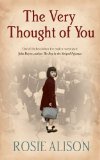
The Very Thought of You – Rosie Alison


Short listed for Orange Prize 2010, Short listed for Amazon’s Rising Stars award 2009, Long listed for the RNA Romantic novel of the year 2010, Long listed for the Le Prince Maurice Prize for Literary Love Stories 2010

The Very Thought of You is set during WWII and follows eight-year-old Anna as she is evacuated to a large country house in Yorkshire. The house belongs to a childless couple, Thomas and Elizabeth Ashton, who decided to covert their home into a school in the hope that children will bring some happiness back into their lives. Unfortunately the children only seem to exacerbate their problems and their marriage falls apart.

The theme of the book appears to be loving someone that you can’t have. All the characters seem to be in love with someone that they cannot be with; whether that is due to being separated by war or yearning to be with someone already in a relationship.

The Very Thought of You was very readable and I finished it quite quickly, but it left no lasting impression on me. There were too many characters and so each one failed to develop its own identity, all seeming to have the same voice.

The book also lacked atmosphere – I couldn’t picture the places mentioned or feel the emotions each character experienced.

Overall I’d describe it as a light romance book, similar in style to The Morning Gift by Eva Ibbotson.  I have no idea why it was short listed for the Orange prize.

Opinions seem to be divided on this one:

…it is intelligently written with an eye for detail… The Truth About Lies

It is the narratorial voice that kills it stone-dead for me. Eve’s Alexandria

This is an impressive book, particularly as a debut novel. Pursewarden

Categories
2010 Booker Prize

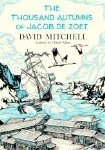
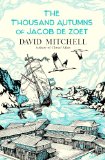
The Thousand Autumns of Jacob de Zoet – David Mitchell

David Mitchell is one of my favourite authors, so I was very excited about the release of this new book. Unfortunately I think that David Mitchell has matured as an author very quickly and so this book will disappoint much of his broad fan base.

The Thousand Autumns of Jacob de Zoet is set on the island of Dejima at the beginning of the 19th Century. Dejima is the Japanese trading post, the only place where Europeans are allowed to exchange goods with the Japanese. The small island is inhabited only by translators, prostitutes and traders; with access to mainland Japan over a small fiercely guarded bridge. To Buying or reselling authorized user trade Jacob de Zoet is a Dutch clerk trying to prevent corruption on the island, but his life is changed when he falls in love with Orito, a young midwife.

The first chapter is a gripping, but graphic account of a childbirth in which Orito breathes the life back into a seemingly dead baby. Unfortunately the next 150 pages of the book lack this vivid story telling and I found it very hard to understand what was happening. New characters seemed to be added on every page, their names changing based on who referred to them.  The added problem of the Dutch and Japanese misunderstanding each other only compounded my confusion.

As a piece of historical fiction this book is a masterpiece. It is very well researched, but at times I felt the accuracy was its downfall. It took me six weeks to read the first section as I had to re-read it several times. If I hadn’t been a massive David Mitchell fan then I admit that I might have given up at this point, but I am pleased I made the effort.

The next 200 pages were a big improvement. The story of Orito’s imprisonment in a monastery and the shocking baby farm that existed there was a satisfying read. I loved Orito and wish the whole book had concentrated on her.

I was quite disappointed by the ending, but I’m afraid I can’t let you know about that without giving things away. All I can say is that I wasn’t a big fan of any section including Jacob de Zoet. The complexity of the text meant that  I couldn’t generate an emotional response and so I didn’t connect with him. I found all his sections confusing and almost impossible to follow with a single reading.

Overall this is an impressive book which deserves to win the Booker prize, but I think the complexity will put off all but the most determined reader.

Are you a big David Mitchell fan?

Do you hope this wins the Booker prize?


Categories
2009 2010 Orange Prize Recommended books

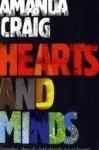
Hearts and Minds – Amanda Craig

 Long listed for the Orange Prize 2010

Hearts and Minds seems to be one of the most praised books on the Orange long list this year. It’s London setting appealed to me and so I decided to read it, despite the fact it didn’t make the short list.

Hearts and Minds gives a snap-shot of life in London today. Its range of characters shows the diversity of people living in the capital city and the problems faced by them. We see asylum seekers, teachers, prostitutes, taxi-drivers and a whole range of other people. I normally struggle to cope with this many characters, but the vividness of the writing meant that each one jumped off the page and I had no trouble keeping track of them all.

The book impressively manages to combine a murder mystery with literary fiction. In many ways it reminded me of The Road Home by Rose Tremain, but I actually think that Hearts and Minds is the better book.

The story is split into several narratives which at first seem independent, but as it progresses connections are made until everything comes together in the final poignant chapters.

This isn’t a pleasant read; we witness the worst of London society, but the power of the words had me gripped from beginning to end.

He thinks about how, all along the street, there must be flats like this one in which other girls have been raped and beaten, flats that are perhaps now occupied by happy couples or successful professionals or pensioners, all with the same sash windows and lumpy corniced ceilings; and yet this horror has happened here. A sensation of lives layered on top of each other, which he will never know about, overwhelms Ian momentarily.

I have no idea why this book didn’t make the Orange short list. It deserved to be there.

The Thoughts of Other Bloggers

…even more gripping and packs more of a punch than anything I’ve read in 2010 so far. The B Files

It is page after page of unrelenting misery. Books Please

….characters so well-drawn that they become so close to you It’s a Crime!

…somehow Amanda Craig touches on the reality and the truth of this and you really do want to weep. Dovegreyreader

Are you planning to read Hearts and Minds?

Why didn’t this make the Orange short list?

Categories
2010 Book Prizes Chunkster Science Fiction Thriller Uncategorized

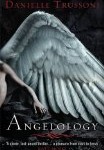
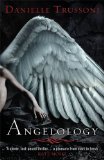
Angelology – Danielle Trussoni

Angelology takes place in a world where angels walk among us. Their wings are tied flat beneath their clothing so you have no way of knowing who they are, but these angels have been breeding with humans to create dangerous hybrids called Nephilims. Unlike the immortal angels these nephilims are dying and so are trying to do everything within their power to get hold of the angelogogist’s research in the hope it will reveal a cure for their disease.

Angelology is a fast paced thriller, which I’d describe as a well written hybrid of The Da Vinci Code, The Historian and Twilight – so if you enjoyed these three books then you are bound to love this one.

I loved the atmospheric descriptions:

The angelologists examined the body. It was intact, without decay, the skin as smooth and as white as parchment. The lifeless aquamarine eyes gazed heavenward. Pale curls fell against a high forehead and sculptural shoulders, forming a halo of golden hair. Even the robes-the cloth woven of a white shimmering metallic material that none of them could identify exactly-remained pristine, as if the creature had died in a hospital room in Paris and not a cavern deep below the earth.

This initial scene setting was quite slow, but the pace soon sped up. I enjoyed the beginning, but about 100 pages in I began to lose interest. The plot was convoluted, meandering and never reached any real conclusion. There was a lot of history added to the book, but as most of it was made up this didn’t hold the same appeal as other pieces of historical fiction.

The central character in the book is a young nun called Evangeline, but she never really engaged me. I felt as though I was carried along by the fast flow of the words, rather than any real desire to know what happened.

The book is being made into a film by Sony and I am sure that this will be a  much better medium for the story – especially once the plot has been condensed into a two hour time slot!

The lack of a fully resolved ending means that I’m sure there will be a sequel, but I’m in no rush to read it – I am happy to wait until its inevitable DVD release!

Overall I found it to be a fast paced, inventive book, but I just didn’t care what those fictional angel-hybrids were doing.

This book is getting very mixed reviews, but I am sure it will be a massive hit – especially after its release in paperback.

…an incredible novel that I can’t recommend highly enough. S. Krishna’s Books

….in the end Angelology falls far short of its potential. Muse Books Review

…too many weak points to the overall story for me to end up really invested in the story. Fantasy & SciFi Lovin’ News and Reviews

I loved the world Trussoni has created with its mixture of the esoteric, history and myth and not least for Trussoni’s quality prose. Chasing Bawa

Do you think you’ll enjoy Angelology?

Categories
2009 Books in Translation Chunkster Historical Fiction Other Prizes Recommended books

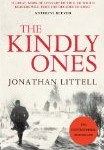
The Kindly Ones – Jonathan Littell


Translated from the French by Charlotte Mandell

Winner of 2006 Prix Goncourt and the grand prix du roman of Académie française, Literary Review’s bad sex in fiction award 2009, 2010 Best Translated Book Award: Fiction Longlist, 2010 long list Independent Foreign Fiction Prize

The Kindly Ones is one of the most controversial books written in recent years. The book is a fictional biography of Max Aue, a senior SS officer, present during the Holocaust.  His job is to compile recommendations for future Nazi policy and so he travels to see the execution of the Jews, the German front line and finally the concentration camps. The fictional characters are weaved together with real people like Göring, Speer and Hitler; producing a well researched, compelling version of WWII.

The Kindly Ones is the most disturbing book I’ve ever read. I have read a few individual scenes in books like A Fine Balance or Fugitive Pieces that almost equal the horror of the milder sections in this book, but the descriptions of the Holocaust were so intense and prolonged that I found this book very hard to read. There were times when I could only read a page or two before having to put the book down and do something else. Sometimes even that wasn’t enough and so I started skim reading sections. I found this didn’t help much as I was still painfully aware of what was happening, so I reverted to the slow, painful pace I had started with.

The whole book is like driving past a car crash – you know you shouldn’t look, but you do anyway  –  unable to resist the temptation to see how bad things really are.  I was gripped throughout, an amazing feat for a book so long. The prose is easy to read, but I did get a bit confused by some of the German military terms (most of which are explained in the back, but as I don’t really understand the British equivalent that didn’t help much!).

I expected the plot to emphasize the fact that the people involved in these terrible events had no choice in the matter – that it was basically ‘do or die’.

The man posted to a concentration camp, like a man assigned to an Einsatzkommando or a police battalion, most of the time doesn’t reason any differently: he knows that his free will has nothing to do with it, and that chance alone makes him a killer rather than a hero, or a dead man.

I was therefore surprised to see many opportunities for Max Aue to avoid ending up on the path he took. Initially I wondered why the book was written in this way, but then I realised how clever and realistic it was. The events leading up to the atrocities are obvious with hindsight, but to the people involved each step was so small that they were unaware of the final consequences. Many questioned the actions and were given what seemed to them to be reasonable justifications. For this book to change the way I view the Holocaust is an incredible achievement.

The Kindly Ones also contained many poignant scenes. I was particularly touched by this passage:

“I started sobbing: the tears froze on my face, I wept for my childhood, for a time when snow was a pleasure that knew no end, when a city was a wonderful space to live in, and when a forest was not yet a convenient place to kill people.”

Overall I’d describe this book as a ‘must read’ for anyone interested in the Holocaust, but the length and graphic descriptions of human suffering mean that most people should approach this book with caution. I will remember this book for the rest of my life and although I sometimes wish I could erase some scenes from my memory, on the whole I think it is helpful to remember that these events happened.

Do you want to read The Kindly Ones?
Categories
2010 Historical Fiction Orange Prize

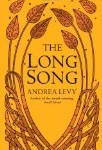
The Long Song – Andrea Levy

 Long listed for Orange Prize 2010 

The Long Song is set on Jamaica and follows July, a young slave girl, during the last few years of slavery and after she is granted freedom. 

The book is very different in style to Andrea Levy’s last book, Orange Prize winning Small Island, but I think they are both good in their own way. 

Much of the speech in The Long Song is written in Jamaican dialect, which adds atmosphere to the book. I think this would be even better on audio, as I’m sure my inner mind doesn’t quite do it justice! It isn’t hard to understand the dialect, in fact the whole book is quick and easy to read. I felt that this was actually one of the negatives of the book – it was so light that it seemed to skim over some very important scenes. The plot was quite simple, but the book covered a reasonably large chunk of time. This speed of events meant that I didn’t fully connect with July or understand which emotions she was experiencing. 

The narrator, July, frequently addresses the reader of the book, adding references to her present day life. 

Reader, my son tells me that this is too indelicate a commencement of any tale. Please pardon me, but your storyteller is a woman possessed of a forthright tongue and a little ink. 

Having read a few other reviews I’ve discovered that this style seems to annoy some people, but I found it a refreshing change to the similarity of many books. 

Overall, it was a light, entertaining read, but I have heard the amazing way Andrea Levy narrates her books and so I recommend getting the audio version of The Long Song.

Did you enjoy The Long Song?

Do you think it will make it onto the Orange short list tomorrow?