Categories
2000 - 2007 Historical Fiction

Year of Wonders – Geraldine Brooks

Five words from the blurb: infected, Plague, village, death, survive

Eyam is a small village in rural Derbyshire. In 1665 the village tailor received a parcel of cloth from London. Unknown to him, fleas harbouring the deadly plague were contained in the package and within a week he was dead. It wasn’t long before other members of the village were struck down and the community made the brave decision to isolate themselves in order to prevent the disease from spreading to the rest of the country. Only 83 of the village’s 350 inhabitants survived. Year of Wonders is a fictional account of what happened during the 14 months that the village was affected by the plague. The exact names and family groups may have been changed, but the fear and grief contained within the pages felt very real to me.

Eyam Village. Photo Credit: Johnson Cameraface, Flickr

This is an intense read; the writing was so powerful that at times I could hardly bear to read on, but I was completely gripped and unable to tear myself away from the tragedy that was unfolding.

He died clutching the bed sheet. Gently, I untangled each hand, straightening his long, limp fingers. They were beautiful hands, save for the one callused place toughened by a lifetime of needle pricks. Remembering the deft way they’d moved in the fire glow, the tears spilled from my eyes. I told myself I was crying for the waste of it; that those fingers that had acquired so much skill would never fashion another lovely thing. In truth, I think I was crying for a different kind of waste; wondering why I had waited until so near this death to feel the touch of those hands. 

This is historical fiction at its very best. I felt as though I knew the people and understood their motivations.

My only problem with this book was the epilogue – I felt it tied everything up too cleanly and I would have preferred the more ambiguous ending that could have been achieved without its presence. This a only a very minor quibble though – the rest of the book was stunning.

This book isn’t for everyone. I know that many will find the contents too distressing, but if you like books that take you on an emotional journey then this is for you.

Highly recommended.

Three words to describe the reading experience: intense, moving, informative.

Many years ago I visited the village of Eyam and I remember reading the signs which detailed the deaths that had occurred in each of the houses. It is only after reading this book that I appreciate the full scale of what happened in that community. The lists are a tragic insight into the way every family in the village was affected. Here is an example of one of the signs – many more can be found on Bowbelle51’s Eyam Flickr set.

Plague House Sign. Photo Credit: Bowbelle51, Flickr


For more information about the plague in the village of Eyam see the Eyam Plague Village website.

This is the first book written by Geraldine Brooks that I have read, but it certainly won’t be the last!

Are all her books as intense as this one?

Which is your favourite?
Categories
2010 Chick Lit Other Prizes

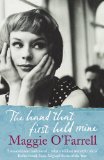
The Hand That First Held Mine – Maggie O’Farrell

 Winner of 2010 Costa Book Award for Fiction

Five words from the blurb: Soho, birth, motherhood, women, connected.

The Hand That First Held Mine has a dual narrative which follows two women who are separated by 50 years in time, but dealing with many of the same issues. The first thread follows Lexie, a 21-year-old girl, who leaves her 1950s Devon home to start a new life in London. She begins a relationship with a married man and struggles to deal with the problems this causes.

The second thread follows Elina, a Finnish woman who has just given birth to her first baby. The traumatic emergency caesarean affected her and her partner, Ted, deeply. As both struggle to come to terms with the near-death experience they also have to learn to look after their demanding new baby. The writing was vivid and packed with emotion – perfectly describing the turmoil that a new baby brings to a household.

Ted registers again how pale she is, how dark and deep are the circles around her eyes, how thin her limbs look. He is possessed with an urge to apologise – for what he isn’t sure. He scans his mind for something to say, something light and perhaps witty, something to take them out of themselves, to remind them that life is not all like this. But he can’t think of anything and now the baby is rearing back, crying, fidgeting, fists flailing, and Elina is having to open her eyes, sit up again, lift him to her shoulder, rub his back, untangle his hands from her hair and Ted cannot bear it.

I connected with Elina’s thread much more than Lexie’s. I think this is a combination of the fact that I have young children and so can relate to the feelings of a new mother, but also because I have little sympathy for someone who has an affair with a married man. Lexie’s thread felt like a well written piece of chick-lit whilst Elina’s thread had a bit more depth than that.

Both threads come together towards the end of the book, but rather than being impressed by the connection it all felt a bit contrived to me.

The book was easy to read and gripping in places, but I wished that the plot had been a bit more complex or thought-provoking. This book reminded me of  Peripheral Vision, but I felt that The Hand That First Held Mine didn’t have the same complexity or depth. I’m still thinking about the issues of motherhood raised in Peripheral Vision, whilst The Hand That First Held Mine offered no new perspective on the subject.

Overall, this was an entertaining diversion, but I don’t expect to remember much about it in a few months time.

The thoughts of other bloggers:

Every word is perfectly chosen, every sentence is perfectly constructed. Fleur Fisher in her World

…it didn’t pack the same punch for me as After You’d Gone… Leafing Through Life

It’s a vivid story of motherhood that honors the whole woman. The Literate Housewife

Categories
2000 - 2007 Books in Translation Other Prizes

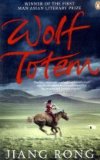
Wolf Totem – Jiang Rong

 Winner 2007 Man Asian Literary Prize

Translated from the Chinese by Howard Goldblatt

I bought a copy of Wolf Totem after I met The Book Whisperer and she raved about it. It is her favourite book of all time and as I love books set in Asia I decided to give it a try.

Wolf Totem is set on the Mongolian grasslands and describes the constant battle that the nomads have with the wolves that live there. The relationship the people have with the wolves is confused when Chen Zhen, an intellectual from Beijing, captures a wolf cub and starts to raise it. The book is based on the real life events of the author, who answered Chairman Mao’s 1969 call for city dwellers to experience life in the mountains.

This book goes some way to explaining what life was like for the Mongolian nomads, but it concentrates on the difficulties that wolves brought to their lives. We witness packs of wolves massacring their animals and the nomad’s attempts to kill the wolves. It was fascinating to learn about the behaviour of wolves, but I suspect the graphic nature of the hunts will be too much for some.

I enjoyed the excitement of the chase, but by the half way stage I began to tire of the endless battle between man and wolf. This book is 500+ pages long and after a while one wolf hunt became much like all the others. I longed to learn about other aspects of life in the grasslands and perhaps witness some of the human relationships.

I also felt that the writing quality was that of great fiction, not literature. There was no depth or poetry to the language – it was simply there to inform.

These things are never easy for the Mongols. Gasmai only has the one son, and still she didn’t stop him from grabbing a wolf’s tail or crawling into a den. The old Chinese saying ‘Don’t fight wolves if you’re unwilling to sacrifice your son’ must have come from the grassland. Don’t forget, the Mongols ruled China for nearly a century. I used to think it meant using your son as wolf bait, believe it or not. Now I realize it means letting your son risk crawling into a wolf’s den to get the cubs. Only a youngster could handle a tunnel this deep and narrow.

I did learn a lot of interesting facts about the wolves and am pleased I read the book, but I wish it had been slightly shorter.

Recommended to anyone who’d like to know more about wolves, in all their gruesome glory.

Categories
1980s Chunkster Historical Fiction Pulitzer Prize

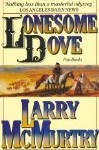
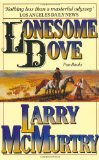
Lonesome Dove – Larry McMurtry

 Winner of the 1985 Pulitzer Prize

What an epic! I am really pleased that after nearly three months I finally made it to the end of this massive book. I originally started reading Lonesome Dove as part of Amy’s readalong, but unfortunately I failed to keep up with everyone else and so had to make do with reading their comments several weeks after I made it to the same spot.

Lonesome Dove is the first Western I’ve ever read. It contained all the elements that I was expecting in a Western (cattle, horses, guns and the big outdoors) but the atmosphere was very different. I was surprised by the gentle humor running all the way through it and, although several people were killed, it never felt dark. 

The story begins in Lonesome Dove, a small town in Texas, and follows a group of men who decide to take some cattle to Montana. We see the dangers that they face from both animals and other men, but also the complex relationships that they have with each other. Lonesome Dove crosses so many genres – it is a romance novel as well as a vivid piece of historical fiction. It is a shame that it is called a Western as I think the term is quite off-putting to some people.

The book started off very slowly – it took me about 300 pages to begin to engage with the characters, but once this happened I found them to be some of the most vivid I’ve ever read about. There was very little forward momentum anywhere in the book, so I never felt compelled to pick it up and start reading again. This made it feel much longer than its already imposing 940 pages.

The characters were very well developed, but there were many points when I wished that the book would stop fleshing out the characters and get on with the story. The plot picked up in the final section, but I was a bit frustrated by the number of loose ends left unresolved.

I’m really pleased that I made it to the end of this classic, but I wish it had more pace and a less meandering plot. There was a lot to enjoy and I do think that it is one of those books everyone should try at some point in their lives. Recommended.

Opinions are divided on this one:

…..both funnier and sadder than I’d ever anticipated. Whimpulsive

…life is too short to spend my reading time in the company of people I don’t like who are doing things I find repulsive. Semicolon

Lonesome Dove is on my all time favorites list. Capricious Reader

Can you recommend any Westerns which have a faster pace?

Categories
2011 Crime Thriller

The Facility – Simon Lelic

Rupture was one of my favourite books of 2010  and I am sad that it didn’t receive the attention it deserved. I was pleased to discover that Simon Lelic’s second book was going to be released so soon after his first and I jumped at the chance to read it.

The Facility is set in the near future and centres on a secret prison which the British Government are using to hold people under their new “Unified Security Act”. Initially created to hold terrorism suspects without charge, the authorities are now using it for questionable purposes. The book follows one man who doesn’t understand why he has been imprisoned and those on the outside who are desperate to discover why he has disappeared.

The book is a fast paced thriller which is gripping throughout. It isn’t for the prudish as there is strong sexual content from the start and I must also warn you that it gets quite dark and violent in places.

Unfortunately I didn’t find it as thought provoking as it could have been – it read like a conventional thriller instead of being a deeper investigation into this complex issue.

It also lost the wonderful one-sided-conversation writing style of Rupture. The writing quality was still high, but there was nothing to make it stand out from the crowd of other thrillers produced each year.

The Facility is a wonderful thriller, but I had hoped it would be so much more than that. I urge you to read Rupture so that you can understand why I had such high hopes for this book. The Facility is worth reading if you are after an absorbing, fast paced read, but I’m hoping that his next book returns to the magic of his first.

Categories
2009 Chick Lit

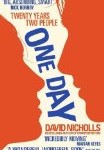
One Day – David Nicholls

I loved Starter for Ten and almost rushed out to read One Day when it was first published. I was stopped by a series of negative reviews and having read the book I now understand why. The two are very different and I think fans of one will be unlikely to love the other.

One Day is essentially a romance story following a couple who have a one night stand at university. We glimpse one day of their lives each year for the next twenty years – seeing their ambitions and accomplishemts develop and change.

I loved the beginning of the book. The characters were very well developed, seemingly coming alive on the page. I found their conversations realistic and, at times, moving. Unfortunately I found that the plot lost a lot of momentum in the middle section. 100 pages of this 400+ page book could easily have been removed without loosing anything. The book regained its magic towards the end and I thought the last few chapters were especially powerful.

One Day had far less humor than Starter for Ten and I also felt the extended time period meant that it lacked the magical remisicing power and sense of place. One Day is basically a very well written piece of chick lit and so will have a much narrower group of fans than Starter for Ten. I did enjoy reading the book, but there were times when I felt the plot was contrived in order to fit everything into that one day each year.

Overall it was an entertaining read that I’d recommend to anyone looking for a well written romance, but I’d encourage you to try Starter for Ten first.

Opinion is divided on this one:

I laughed and cried whilst reading this book in one sitting. Savidge Reads

I was less than impressed. Lucybird’s Book Blog

One Day, is at times moving, funny and sad, and then you’ll turn the page and laugh your face off! Highly, Highly recommended. Bart’s Bookshelf

I failed to be moved by the couple’s blindness to one another — and grew tired of reading about more unhappy choices and bitter affairs. Write Meg!