Categories
1950s Classics

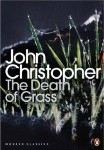
The Death of Grass by John Christopher

The Death of Grass (Penguin Modern Classics)

Five words from the blurb: virus, deadly, grass, starvation, humanity

The Death of Grass was first published in 1956,  just five years after Day of the Triffids. Both books share similar post apocalyptic themes, but for some strange reason The Death of Grass has faded into obscurity, continually overshadowed by those carnivorous triffids. I think this as a real shame as The Death of Grass is equally good; in fact I think its chillingly realistic premise makes it all the more powerful.

The Death of Grass begins with the discovery of a new virus in Asia. This virus kills all the grass that it comes in contact with, including rice and wheat. As it spreads around the world it leaves populations starving, leading to civil unrest and ultimately chaos and carnage.

The book is set in England and follows one family as they travel across the country towards the safety of their brother’s farm. The situation gradually becomes worse and the family find themselves having to fight for survival.

The amazing thing about this book is that, unlike Day of the Triffids, it hasn’t aged at all. There is nothing within the text to suggest that it was written over fifty years ago and the idea that viruses are a threat to our crops is just as relevant today.

The Government’s reaction to the disaster was particularly scary and, as with Blindness, the speed of the degeneration makes you want to move to the country and start stockpiling straight away.

The valley, which had been so green in the old days, now showed predominately black against the browner hills beyond. The stone walls wound their way up the hillsides, marking boundaries grown meaningless. Once John thought he saw sheep on the hillside, and jumped to his feet to make sure. But they were only white boulders. There could be no sheep here now. The Chung-Li virus had done its work with all-embracing thoroughness.

This is a short book that reminds you about the fragility of human society. I was inspired to read this book after a review from Another Cookie Crumbles. She compared the book to The Road, another powerful glimpse into the breakdown of society. If you enjoyed The Road or Day of the Triffids then I guarantee that you’ll love The Death of Grass.

Highly recommended.

.
Categories
2011 Books in Translation

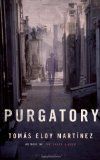
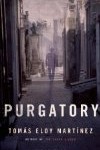
Purgatory by Tomás Eloy Martínez

Purgatory Translated from the Spanish by Frank Wynne

Five words from the blurb: Argentina, history, political, disappearances, love

Tomás Eloy Martínez was one of the most important authors in the Spanish speaking world. He was born in Argentina in 1934 and became a journalist, challenging authority at every opportunity. His provocative journalism forced him into exile during the military dictatorship and he moved to Venezuela, where he wrote several novels. Purgatory was completed shortly before he died from cancer in 2010. It is said to be his most autobiographical work, covering much of Argentina’s recent history. I accepted a review copy of this book because he sounded like such an interesting author, but unfortunately it didn’t quite work for me.

Purgatory has a fantastic opening line:

Simón Cardoso had been dead thirty years when his wife, Emilia Dupuy, spotted him at lunchtime in the lounge bar in Trudy Tuesday.

Human rights groups estimate that 30,000 Argentinians were captured, tortured and killed between 1976 and 1983. This book focused on Simón Cardoso, a cartographer who disappeared during this time period, and the mystery surrounding what happened to him.

Purgatory was very easy to read. The simplicity of the text made it possible to underestimate the talent that this author possesses. Profound statements were sprinkled throughout the novel and there were many passages that could easily stand up against the best writing in the world, but unfortunately I don’t think the book worked very well as a novel. There were many long, dry sections in which little happened. It could be argued that these reflected the endless waiting endured by those who didn’t know if their loved ones were alive or dead, but as a reader I was bored.

This Guardian article indicates that the author wanted to write:

without descriptions of atrocities, without depictions of rape and torture – rather a recreation of what it felt like “to breathe in the contaminated air”

He has definitely achieved this, but I’m afraid I prefer my novels to be more powerful. The absence of violence lead to a very quiet novel that was too subtle for me.

I also think that a lot of the satire went over my head. I only have a limited understanding of the political situation in Argentina and so I’m sure that I missed references to specific people/events.

This is clearly an important book, but it was too subtle for me and I’d only recommend it to those with a strong knowledge of Argentina.

.

Have you read anything written by Tomás Eloy Martínez?

Do any of his earlier books have a stronger narrative drive?


Categories
2011 Thriller

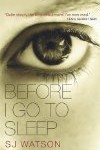
Before I Go To Sleep by SJ Watson

Before I Go To Sleep

Five words from the blurb: identity, past, forgotten, overnight, trust

Before I Go To Sleep centres on Christine, a woman who wakes up every morning unable to recognise her own husband. An accident left her without the ability to memorise new events and so she forgets the previous day every time she goes to sleep. In an effort to understand more about herself she begins a diary, but this leads her to discover that her husband is lying to her. The question is whether he is doing this to protect her or for another, more sinister reason…

The book is so compelling I read it in a single sitting. Desperate to know what happens I sped through the pages so quickly I was practically skim reading. I has been a long time since I’ve read something so compelling and I thoroughly enjoyed the few hours in which it entertained me.

Unfortunately everything began to fall apart afterwards. The more I thought about the book, the more holes I found in it. The reader has to suspend disbelief throughout and there are a lot of things that don’t add up if you start to think about them for any length of time. The numerous flaws make this a great book club choice – it is possible to talk about it for a long time!

On a positive note, this book does bring up some interesting points about identity:

Will I still wake up, in my seventies or eighties, thinking myself to be at the beginning of my life? Will I wake with no idea that my bones are old, my joints stiff and heavy? I can’t imagine how I will cope, when I discover that my life is behind me, has already happened, and I have nothing to show for it. No treasure house of recollection, no wealth of experience, no accumulation of wisdom to pass on. What are we, if not an accumulation of our memories?

Unfortunately they don’t have much depth and are more a springboard for your own thoughts and ideas, rather than providing any real insight.

The addictive nature of this book means that I’ll recommend it to a lot of people, especially those who aren’t keen readers, but stay away if you’re looking for anything more than a couple of hours of entertainment.


This book received a mixed reception from other bloggers:

It’s an original, fast paced, gripping and rather high concept novel. Savidge Reads

It began to get repetitive in the middle of the book… You’ve Gotta Read This!

Why it has been so much more popular than what I consider to be much better suspense books published last year, I don’t know. Petrona

Superb story telling. JoV’s Book Pyramid

My Evening with SJ Watson

I recently went to hear SJ Watson speak at a local library and thought I’d share some interesting snippets from the evening:

  • Inspiration for the book came from a man called Henry Gustav Molaison who had severe epilepsy. An operation to correct his condition left him with the ability to only remember the last 10 – 15 minutes.
  • He once went through a stage where he worried there weren’t enough characters in the book and so inserted a scene where Christine and Ben had a dinner party with friends from his school. It didn’t work and so the scene was quickly deleted.
  • It took him six months to write the first draft and he did so whilst working part time for the NHS.
  • The first draft of the book contained lots of scenes in which Christine did the ironing and made coffee.
  • He toyed with the idea of writing from a male perspective for about a minute and then decided it wouldn’t work.
  • Lots of people assume SJ Watson is female, but when asked about their surprise on finding the author is male he says it is harder for him to get inside the head of a serial killer than to write from the perspective of a woman.
  • His advice for new writers: Don’t write what you know, but if you want to write about something make sure you know about it.
  • In the past SJ Watson tried writing a book based on himself, but it was too boring!

If you ever get the chance to hear SJ Watson speak I recommend it as he is an entertaining public speaker.

Categories
2000 - 2007 Memoirs

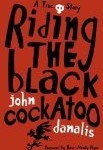
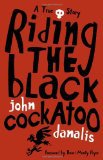
Riding the Black Cockatoo by John Damalis

Riding the Black Cockatoo

Five words from the blurb: Australia, skull, Aboriginal, return, descendants

Riding the Black Cockatoo is the memoir of an Australian man whose family displayed an Aboriginal skull on their mantelpiece for 40 years. He decides to return it to its native home, discovering lots of facts about Aboriginal people along the way.

This book has recently become a set text for GCSE English and I can see why. It is fast paced and easy to read, but effectively manages to capture the author’s changing perspective of Aboriginal society.

The book begins with brutal honesty, recalling the rampant racism of his childhood. The jokes that were in regular circulation are shocking to read now and show how far things have come in just a few decades.

As an Australian of Greek descent who weathered the taunts of ‘wog boy’ throughout my childhood, I remembered the feeling of relief when the bedraggled Vietnamese boat people started washing up onto our shores in the late 1970s. Suddenly the attention shifted from wogs to the newly arrived slopes and geeks. Yet despite the ever-shifting focus of racism in this country, Indigenous Australians have continuously occupied the bottom rung of the ladder.

John Damalis explains how he became ashamed by the presence of the skull and set about researching its origin. Unfortunately, for the reader, the journey of discovery was very short and easy. Everything was over quickly and lacked the depth I’d have liked. I’ve read a few Australian books, but wouldn’t say I know a vast amount about Aboriginal society, so it was disappointing that this book failed to teach me anything of value.

The writing style also began to grate on me after a while. Explanation marks were everywhere! The chatty, informal style will appeal to some, but I’d have preferred a bit more focus as I sometimes felt that the book trivialised events.

I think this is one of those cases where the flaws can be seen as a positive. This book will provoke discussion and is a perfect introduction to cultural studies, especially for teenagers.  But next time I want to learn about the Aborigines I’ll ensure I read a book written by someone who know a bit more about them.

.


I read this book as part of Australian Literature Month at Reading Matters. Head over there to find more Australian fiction recommendations.


Categories
Books in Translation Thriller Uncategorized

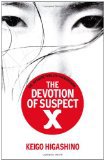
The Devotion of Suspect X – Keigo Higashino

The Devotion Of Suspect X 

Translated from the Japanese by Alexander O. Smith with Elye J. Alexander

Five words from the blurb: Tokyo, ex-husband, shattered, Police, genius

I hadn’t heard of this book until one of my sister’s friends recommended it to me, but I love Japanese thrillers and so decided to give it a try. I’m pleased that I bought a copy because I’ll be recommending this intelligent thriller to everyone.

The Devotion of Suspect X begins with a woman murdering her ex-husband with the help of her daughter. Their neighbour hears the crime and offers to help dispose of the body, beginning a gripping narrative that centres on the question: Will they get away with it?

The premise is very similar to Out by Natsuo Kirino (my favourite thriller), but The Devotion of Suspect X is a much lighter novel. It is quicker and easier to read and doesn’t contain the same level of violence or dark emotion. For this reason I’d recommend it to those trying Japanese fiction for the first time.

The plotting in this book is perfect. There are no unnecessary scenes and the pace is relentlessly intriguing throughout. The main battle of wits is between the neighbour, a maths genius, and a friend of the police officer who happens to be a physics genius. I admit that this scenario is unlikely to occur, but I didn’t care because it led to one of the cleverest series of twists I’ve come across.

The characters were all well formed, with interesting flaws. I didn’t develop an emotional attachment to any of them, but this ended up being a positive as I found myself rooting for both sides equally. This is quite unusual in a police procedural as I normally find myself less interested in one of the plot threads.

The Devotion of Suspect X is a perfect thriller. It isn’t particularly deep or meaningful, but it is endlessly entertaining. I can see why it sold 2 million copies in Japan and I hope that word-of-mouth spreads it around the world.

Highly recommended.


Categories
2012 Thriller

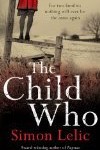
The Child Who by Simon Lelic

The Child Who

Five words from the blurb: murdered, schoolmate, solicitor, defend, dilemna

Simon Lelic’s debut novel, Rupture, is one of my favourite books from the last decade. I wasn’t as impressed with his second, The Facility, but I was still keen to see what his new book would be like. The Child Who falls some where between the two. It is a fast paced, gripping read, but it lacks the depth and originality of Rupture.

The book centres on a solicitor who is called to defend a twelve-year-old boy accused of murdering a girl from his school. His job is made more difficult by the high public profile of the case and the way his family are increasingly affected.

The Child Who has far more commercial appeal than his previous books. It reads like a British version of Jodi Picoult, complete with the moral dilemma and the court room drama.

It was so compelling and easy to read that I read it in a couple of short sittings, but on ending the book I felt a little disappointed. The topic had potential to be thought-provoking, but I came away without feeling my viewpoint had been challenged. Each decision made by the characters seemed easy and the ending felt out of proportion and unrealistic. I wish it had contained a subtler character study instead of just being endless dialogue and action.

‘Well,’ Leo said. ‘There’s no denying it was a terrible crime. But the boy – Daniel – he hasn’t been charged, not officially. He’s barely spoken. And anyway it’s hardly our place – ‘
‘Did he do it, Leo?’ This from Stacie.
‘Surely they wouldn’t have made the fuss they did if they weren’t sure he did it?’
‘Now, Stacie, you know I can’t…’ But already her eyes were leaching disappointment and Leo was loath to let down the crowd twice.
‘Yes,’ He said. ‘I would say he did it. There’s not a doubt, if I’m honest, in my mind.’

I think I’m only disappointed because Simon Lelic has previously set the bar very high. This is an entertaining read and I recommend it to fans of lighter thrillers.

.

The thoughts of other bloggers:

The Child Who is a powerful and heart-wrenching thriller that will keep you on the edge of your seat and drag you, emotionally, into the thick of the plot. This is, without doubt, Lelic’s finest work to date. Reader Dad

I found it hard to become involved in the novel: none of the characters engaged my sympathy, and although the author attempts to create psychological understanding for the crime, I felt this was somewhat superficially treated… Petrona

…Almost a 5 star read for me. I did enjoy it, although the subject matter is dark, but in the end its middle ground between literary fiction & crime fiction made it not quite enough of one or the other for me. Novel Heights