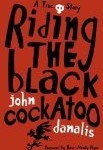
Riding the Black Cockatoo by John Damalis

The BookDepository

Riding the Black Cockatoo

Five words from the blurb: Australia, skull, Aboriginal, return, descendants

Riding the Black Cockatoo is the memoir of an Australian man whose family displayed an Aboriginal skull on their mantelpiece for 40 years. He decides to return it to its native home, discovering lots of facts about Aboriginal people along the way.

This book has recently become a set text for GCSE English and I can see why. It is fast paced and easy to read, but effectively manages to capture the author’s changing perspective of Aboriginal society.

The book begins with brutal honesty, recalling the rampant racism of his childhood. The jokes that were in regular circulation are shocking to read now and show how far things have come in just a few decades.

As an Australian of Greek descent who weathered the taunts of ‘wog boy’ throughout my childhood, I remembered the feeling of relief when the bedraggled Vietnamese boat people started washing up onto our shores in the late 1970s. Suddenly the attention shifted from wogs to the newly arrived slopes and geeks. Yet despite the ever-shifting focus of racism in this country, Indigenous Australians have continuously occupied the bottom rung of the ladder.

John Damalis explains how he became ashamed by the presence of the skull and set about researching its origin. Unfortunately, for the reader, the journey of discovery was very short and easy. Everything was over quickly and lacked the depth I’d have liked. I’ve read a few Australian books, but wouldn’t say I know a vast amount about Aboriginal society, so it was disappointing that this book failed to teach me anything of value.

The writing style also began to grate on me after a while. Explanation marks were everywhere! The chatty, informal style will appeal to some, but I’d have preferred a bit more focus as I sometimes felt that the book trivialised events.

I think this is one of those cases where the flaws can be seen as a positive. This book will provoke discussion and is a perfect introduction to cultural studies, especially for teenagers.  But next time I want to learn about the Aborigines I’ll ensure I read a book written by someone who know a bit more about them.

.
 

I read this book as part of Australian Literature Month at Reading Matters. Head over there to find more Australian fiction recommendations.


.

11 Comments

  1. Andi says:

    I love that you pointed out here that the flaws make this book more discussable! This is a concept my students often struggle with — especially when I bring them controversial or offbeat selections in an online childrens literature class I teach for Education students.

    Great review, Jackie!

    1. Jackie says:

      Andi, Students will gain a lot from discussing this book. The narrator is far from perfect and so they can discuss his thoughts and actions and how they change over the course of the book. As a discussion book it is probably best that things aren’t explained perfectly, allowing the students to fill in the holes. Just a shame that isn’t what I’m looking for in a book. :-(

  2. Jenners says:

    Sounds like an appetizer but not the main course.

    1. Jackie says:

      Jenners, well it is a very quick read so there is plenty of time to move on and read other things.:-)

  3. It interests (worries?) me that a quick and easy book lacking in depth is chosen as a GCSE set text. In my day we studied To Kill a Mockingbird for GCSE, which also covers racism and prejudice, provokes discussion and is a good read for teenagers too.

    1. Jackie says:

      Liz, I take your point and I’d hope that they were also reading other books, including some with lots of depth. I think they can learn a lot from this book though. The author’s honest opinions are a great talking point and I think the teenagers will be able to connect with him more than with authors from earlier in history. I’m sure a comparison of this book with To Kill a Mockingbird would produce some great essays. :-)

  4. Sounds like an interesting read, I might pick this up some time – always good to know what the ‘yoof’ of today is being forced to read :)

    1. Jackie says:

      Matthew, That’s exactly what I thought!

  5. stujallen says:

    oh I ve not heard this book like others it was to kill.. and of mice and men in my days ,after today’s protests in Australia something along this lines would appeal it is a subject I know very little about ,all the best stu

    1. Jackie says:

      Stu, I read Roll of Thunder, Hear My cry in school and that was an amazing book for studying racism. I think that was far better than To Kill a Mockingbird which I read at a similar time. Still haven’t got around to Of Mice and Men :-(

  6. Alice says:

    It is a shame that this book doesn’t go into the depths of the aboriginal culture, I can see why you found that annoying considering the subject matter.

    I am interested in that it has been picked up for G.C.S.E study (if it hadn’t been for school I would have never appreciated a good book, thank you John Steinbeck) so I think I will give this book a go. I have also never read an Australian set novel (which sounds shocking now i’ve typed it out), this sounds like a good start to get me out of my comfort zone reading wise.

Leave a Reply