Categories
2008 Science Fiction YA

The Knife of Never Letting Go – Patrick Ness

< ?php echo amazonim('1406320757'); ?>


I picked up this book after reading a powerful endorsement at Jenny’s Books. I have since seen many more rave reviews, so was expecting good things. Unfortunately, it just wasn’t for me.

< ?php echo amazon('1406320757','The Knife of Never Letting Go’); ?>  has one of the most original premises I’ve seen for a long time. The basic idea is that all the residents of Prentisstown have been affected by a virus which killed all the women and enabled the men to hear each other’s thoughts and those of the animals around them. The problem is that being able to hear every-one’s thoughts leads to a constant background noise which drove me mad – I guess this is the idea, but I found it very frustrating to read. 

The pace of the book is incredibly fast, in fact I don’t think I’ve ever read a book which encourages speed reading so much! The problem with this was that there was never any break from the action – you were swept along so quickly that was hard to build a picture of the characters or their surroundings.

I also found it quite confusing at times. It took a while for me to work out exactly what was happening – again I think this was due to the speed of the narrative. Nothing is really explained properly and so you have to grab snatches of information whenever it is dropped in the book.

The dialect in the book is annoying, but on top of that, I don’t understand why words like selecshun, expanshun and recognishun were mis-spelled – it just drove me mad!

Overall, I didn’t find anything good in this book, apart from the premise and I won’t be reading the rest of the trilogy.

Most other people seem to love it though, so don’t take my word for it!

stars21


Is Patrick Ness one of your favourite authors?

Can you explain why this is so good?

Categories
2009 Recommended books

The Island at the End of the World – Sam Taylor

.
I had heard many great things about The Island at the End of the World, with several people stating it was their favourite book published in 2009. I was very excited about reading it, especially after the wonderful author, Sam Taylor, offered to send me a signed copy of his book. I wasn’t disappointed – it was a fabulous little book.

The Island at the End of the World‘); ?> follows a father and his three children, living on a small island after surviving a great flood. Pa tells the children stories about the great deluge, which drowned everyone else on Earth, but the children begin to become suspicious of his tales when a strange boy washes up on the shore. 

I had worried about the language, as I had heard that most of it was written in dialect, but I found it easy to read. I felt that it added to the atmosphere of the book and helped to slow down the pace by forcing me to concentrate on every word.

Memrys of the talk tween her an Pa come to me as I dig. I try to blank em a way but I cant stop see-ing Pas face wen Alice askt him bout the No-ing Tree. Wat wer his spression zactly. His eyes wer like looking down into no where his brows a V an the lines round his mouth all tight an deep. I make the same spression with my face an try to feel wat comes. The big black bird slowly flaps its wings.

Once I began reading I became immersed in their island world – I was gripped from beginning to end. The plot was original and contained some great twists. All the characters were vividly described and their strange circumstance quickly became normal.

This book also raised many great discussion points about the evils of modern day society and the lengths parents should go to to protect their children. Due to the number of topics raised this short, quirky book would make a great book group choice.

Highly recommended.

stars4h

.

.
Did you love this book as much as I did?
Have you read any of his other books?

Categories
2000 - 2007 Other Prizes

De Niro’s Game – Rawi Hage

 
Winner of the 2008 International IMPAC Literary Award, Shortlisted for the Giller Prize 2008

I picked up De Niro\’s Game‘); ?> after a recommendation from Claire at Kiss a Cloud, but I’m afraid that I didn’t love it as much as she did.

The book follows Bassam and George, childhood friends growing up in war-torn Beirut. As you can imagine it isn’t a pleasant read – graphic scenes of death and destruction fill every chapter.  The whole atmosphere of the book is one of helplessness and depression. I appreciate that this is probably a very realistic picture of what life is like for people living with war, but it meant that I found it a very difficult book to read. There didn’t seem to be any spark of hope, only choices between two equally terrible outcomes. I found it difficult to bond with the characters and their violent, vulgar attitude further distanced me from them.

I can see why Claire loved this book – the scenes were described vividly, and the story was both shocking and compelling.

That night, through the flames of a million candles that brawled inside the neighbourhood houses, I walked. Under those lights, hazy behind nylon sheets that covered our broken windows, I walked the streets with no dogs. I walked, and the candles danced inside a city with injured walls, a city void of light, a broken city wrapped in plastic, and plastered with bullet holes.

At times I became annoyed by the repetition. I realise that it was a powerful means to describe the situation the people were faced with, but if I read the words “Ten thousand bombs had fallen” one more time I think I’ll scream!

Overall, this is a beautifully written book, but the futility was too much for me.

stars3h


Have you read De Niro’s Game?

Can you enjoy a book which deals only with devastation?

Categories
1990s Orange Prize

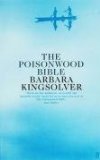
The Poisonwood Bible – Barbara Kingsolver

 Shortlisted for the Orange Prize 1999

The Poisonwood Bible is a book I had been wanting to read for a long time, but for some reason, I kept putting it off. It wasn’t until the wonderful Michelle offered to send a copy to me, that I was given the push I needed to finally pick it up.

The Poisonwood Bible focuses on a Baptist family who move from America to the Belgian Congo in 1959 with the aim of converting the African people to the Christian faith. The family quickly realise that life in Africa will not be as simple as they imagined. They have to learn to cope with the hardships brought on by both the wildlife and the political instability of the region.

Initially I loved the rich detail of the prose, each of the characters was beautifully crafted and life in the Congo was vividly depicted, but after a couple of hundred pages I began to become frustrated with it. I was expecting the story to take hold once the characters had been introduced, but this didn’t happen. The pace of the book remained incredibly slow, which meant that it often failed to hold my attention. There was no momentum to drive the plot forward, so the 600+ pages seemed to drag more than they should have done.

Despite this criticism it was a very good book; there were a lot of touching scenes and I loved following the family over several decades. This book contained some great messages about which things in society are important and the attitude of Nathan, the fierce minister, will promote some interesting discussions.

And so he continues ministering to the lepers and outcasts. By pure mistake, his implementation is sometimes more pure than his intentions. But mostly it is the other way around. Mostly he shouts, ‘Praise be!’ while the back of his hand knocks you flat.

Recommended to anyone with the patience to read a long, slow novel.

stars41

Did you enjoy The Poisonwood Bible?

Are you looking forward to her next novel, The Lacuna, being released in November?

Categories
1940s Books in Translation Historical Fiction Nobel Prize

The Dwarf – Pär Lagerkvist

 Pär Lagerkvist won the Nobel Prize for Literature in 1951

Translated from the Swedish by Alexandra Dick

Regular readers of my blog may remember the wonderful post, Recommendations from a non-blogger, written by Heidi. In the post Heidi recommended  The Dwarf  by Pär Lagerkvist, which I have never seen mentioned in the blogging world, so was keen to give it a try.

The Dwarf  is set in an Italian City during the Renaissance. The central character is just 26 inches high and is a servant to the Prince. The story follows them as they are drawn in to war and have to deal with death, disease and betrayal.

The Dwarf is probably the most miserable, bitter and twisted character I have ever read about. He seems to be dissatisfied with every aspect of his life – his anger bubbling through onto every page.

It is my fate that I hate my own people. My race is detestable to me. But I hate myself too. I eat my own splenetic flesh. I drink my own poisoned blood.

This made it very different from any other book I’ve read. His bleak outlook on the world meant that he was a very hard character to like and I had little sympathy for him, but despite this I was fascinated by his story. I loved the historical detail about life in an Italian court and found the attitudes of the people really interesting.

This is a quick, easy book to read, but it is packed with messages about the nature of society and the evil that is lurking within us all.

Recommended.

stars41

Have you read any books written by Pär Lagerkvist?

Categories
1800s Short Story

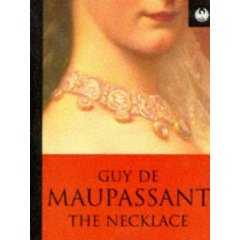
The Necklace – Guy de Maupassant (Short Story)

41A8X85T6RL__SL500_AA240_Rob from RobAroundBooks is a big fan of short stories, and was disappointed to learn that I don’t like them. He suggested I try The Necklace by Guy de Maupassant, claiming it would “touch my heart and soul”. I happened to have a copy in the house and so had no reason to refuse his suggestion – especially since The Necklace is only 8 pages long! If you’d like to read the story for yourself then just follow the link at the beginning of the post.

WARNING SPOILERS!!

Unfortunately The Necklace didn’t come close to “touching my heart and soul.” It only confirmed all the major problems I have with short stories.

Let me explain the problems I had with this story by working through the plot.

  • Couple receive invitation to a party. It’s all going well so far.
  • Woman whinges about how she has nothing to wear. I’m beginning to go off it.
  • Woman begs husband for lots of money to buy a new dress and the husband gives in. The plot continues to cause me minor irritation.
  • The woman then begins to moan about not having any jewelry to wear for the night out. I become increasingly irritated by her shallowness.

“I am vexed not to have a jewel, not one stone, nothing to adorn myself with. I shall such a poverty-laden look. I would prefer not to go to this party.”

  • They decide to borrow a necklace from a friend. Can you guess what happens next?
  • She loses the necklace. You see with a short story there is no time for the plot to develop properly – you can see everything coming a mile off.
  • Instead of owning up to losing it she buys another one, ruining 10 years of her life to pay it off. Do they not have any insurance?
  • It turns out the necklace was a fake, so she has wasted all that time/money on nothing. Stupid woman. I have no sympathy at all.

The problem with short stories is that there is no time for any proper character development. To enjoy reading something I need to become emotionally involved with them. The characters in short stories almost always come across as shallow individuals. This is because there isn’t the time to allow all sides of their character to be revealed. In just a few pages it isn’t possible to show all their flaws and explain the history behind them.

The plot in a short story is always very simple. I can normally see it coming a mile away. I like my plots to be complex and preferably surprising too.

Sorry Rob! This one just didn’t do it for me!

Do you have similar problems with short stories?

Did you enjoy The Necklace?