Categories
1960s Other Prizes Recommended books Science Fiction

Flowers for Algernon – Daniel Keyes

 < ?php echo amazonim('1857989384'); ?>Winner of the Nebula Award 1966

< ?php echo amazon('1857989384','Flowers for Algernon ‘); ?> was originally published as a short story which won the 1960 Hugo Award for best short fiction. It was later expanded to produce this fantastic piece of science fiction.

The book introduces us to Charlie, a 30-year-old man with a very low IQ. He is mocked by society, but his intelligence is such that he is unaware of the cruelty. Charlie yearns to be like everyone else – to able to read and write fluently, and to be successful. One day he is given the chance to make this happen when he is offered a place on a groundbreaking new experiment, which has the potential to turn him into a genius.

The book is written in the form of Charlie’s diary, so we are able to follow the changes in his intelligence by noting the quality of his spelling, grammar and comprehension. I thought that this showed an outstanding quality of writing. I found myself studying the differences in text on neighbouring pages and being very impressed by the subtle changes that were taking place. The personal nature of the diary also meant that it was easy to connect with Charlie – he is such a fantastic character that it was impossible not to fall in love with him

This is an amazing book and I was gripped from beginning to end. It was thought-provoking throughout, covering issues from the importance of intelligence, to what is needed to be happy. There was the odd occasion when I felt the text over-stepped the mark and lectured the reader, telling me things that I should have been shown, but I’m willing to forgive this, as the quality of the rest of the book was so high, and the messages that the text was conveying were very important.

How strange it is that people of honest feelings and sensibility, who would not take advantage of a man born without arms or legs or eyes – how such people think nothing of abusing a man born with low intelligence.

The book takes you on an emotional roller coaster, which left me thinking about it for hours. I am sure that the powerful, original plot will remain with me for many years to come.

If you think that you don’t enjoy science fiction, then I challenge you to read this book and still say that.

Flowers for Algernon has just become one of my all-time favourite reads and I highly recommend it.

stars51


I chose this book for our London book group. We all loved it! Savidge Reads, Reading Matters and Novel Insights have also written wonderful reviews.

Categories
2009 Memoirs Orange Prize

An Equal Stillness – Francesca Kay

< ?php echo amazonim('0297855492'); ?>

Winner of the Orange Award for New Writers, 2009

< ?php echo amazon('0297855492','An Equal Stillness ‘); ?>is the biography of a fictional artist. It is a simple book about the life of a painter, her family and her passion for art.

Unfortunately this book just wasn’t for me – I’m not a big art lover and rarely read biographies. If this had been a real biography then it would have been OK, but I just don’t see the point of a fictional one – I was bored throughout. Very little happened and her life seemed very ordinary to me.

The fact it was written in the style of a biography meant that I was distanced from the character and so failed to develop any emotional connection with her. Any attempt to guess at her feelings just annoyed me, as I don’t think it is really possible to know what someone else is thinking and so I’m afraid this book went further downhill, the more I read.

It was a quick, easy read and the writing was poetic in places, but I’m afraid I just didn’t care.

The final years of Jennet Mallow’s life were fruitful. After the colour blocks she returned to the more nearly monochrome, making seven large pictures which are untitled, but again evocative of air and water.

If you love art and gentle prose then I’m sure you’ll love this book, but it was just too ‘still’ for me.

stars21


I have seen lots of positive reviews for this book, so if you’ve read it:

Why did you love it?

Do you enjoy fictional biographies?

Categories
1940s Classics

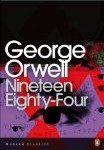
Nineteen Eighty-Four (1984) – George Orwell

Nineteen Eighty-Four is a modern classic which has added an impressive number of words to our language. Big Brother and Room 101 are two such words, but it is the ideas and impressively accurate prediction of the future that makes this book so special for me.

The book was first published in 1949 and gives a grim prediction of what the future will be like 50 years on. It describes a totalitarian régime in a world dominated by war and fear.

I first read (and studied) Nineteen Eighty-Four at school, but re-read it recently for my book group.  I remember loving the book as a teenager; being impressed by the number and ingenuity of ideas present. There were so many different themes to discuss that it made the perfect book to study.

Unfortunately I didn’t enjoy re-reading it. I remembered the basic plot and a large number of the ideas from my teenage years, but although it was easy to read, I found it quite dull. The pace of the book was slow and I found myself becoming bogged down in the political descriptions. The book-within-the-book was a particular low point, with every word being a struggle to complete.

Some scenes were beautiful, but overall it was a dark, depressing book. The ending is shocking and I still remember it clearly, 17 years after first reading it –  the sign of a powerful book.

Nineteen Eighty-Four  is a classic, which deserves to be read and admired, but re-reading it in adulthood threw up more flaws than genius for me.

stars41

Have you read Nineteen Eighty-Four?

Did you enjoy it?

Categories
2009 Crime

The Brutal Telling – Louise Penny


The Brutal Telling‘); ?> is set in a remote, artistic community surrounded by the forests of Quebec. The book begins with the discovery of an unknown hermit’s body in the town’s bistro. Chief Inspector Gamache is called in to investigate the crime, in this, the fifth book in the series.

I haven’t read any books written by Loiuse Penny before, but I am always on the look out for a great new crime series to follow. Unfortunately this book failed to live up to my expectations.

The pace of the book was very fast, as a high percentage of it was dialogue. I wanted to know what the characters were thinking and feeling, but instead I only witnessed a string of events.

I found the writing to be quite passive and the characters failed to engage me. My problem in connecting with the characters could be due to the fact that this is the fifth in the series, but I was assured that this book would work as a stand alone novel, and many other people have enjoyed it with out having read the first four books.

The title implies that this will be a very dark novel, but it felt more like a cozy mystery to me, with very little menace. The plot itself was quite basic and lacked the cunning twists and turns that I love in crime fiction. I guessed the murderer quite early on and was disappointed to discover that I was correct.

The writing was of a high standard and there were many good sections in the book, but overall it failed to impress me.

Recommended to people who enjoy fast paced, simple cozy mysteries.

stars3

I seem to be one of the only people who didn’t enjoy with this book though: Kittling Books, Ms Bookish and Bibliophile by the Sea all loved it.

Did you enjoy The Brutal Telling?

Have you read any of Louise Penny’s other books?

Categories
2000 - 2007 Graphic Novel Memoirs

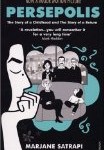
Persepolis – Marjane Satrapi (Book and Film)

Persepolis is often quoted as being one of the best graphic novels in existence, so I have been wanting to read it for a while. It is an autobiography about what life was like for the author growing up in Iran and her experiences of being sent away to school in Austria.

I’d describe Persepolis as being an important book, rather than an enjoyable one. A lot of it felt like reading a very good history book, rather than a personal experience of life in Iran. I loved the details of her personal life and did find some sections amusing, but overall the mood of the book was quite oppressive. It was very informative and I admit that there was a lot I didn’t know before reading it, but I would have preferred to learn more about her life than the politics of the country.

It was also quite slow to read. There was a lot of detail in each picture, so the pace was much slower than the average graphic novel. The illustrations were quite simple, but they portrayed all that was needed to be put across effectively.

Whilst I was reading the book I saw that the film was being shown on television, so decided to record it and watch it once I’d finished. It was an interesting comparison as I think it is the closest a film has ever come to following a book – it was just like seeing the pictures on each page moving in front of you, which meant that this is another rare example of a film being slightly better than the book.

I think that this is a book everyone should read at some point and it will probably become a classic of our age.

stars41

Did you enjoy Persepolis?

What is your favourite graphic novel?

Categories
2008 2009 Books in Translation Historical Fiction

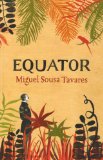
Equator – Miguel Sousa Tavares

Translated from the Portuguese by Peter Bush

I received a lovely email from Raquel, a Portuguese reader of my blog, enquiring as the whether I’d read any Portuguese fiction. Saramago and Bolano have both impressed me, but I haven’t read any other Portuguese books. Raquel said that Equator left her ‘breathless’ and so I was very excited when she offered to send a copy to me.

Equator begins in Portugal in 1905. King Dom Carlos is worried about British reports that slavery still exists on São Tomé and Príncipe and summons Luís Bernardo Valença, an intellectual who writes papers on the civilising effect Portugal has on it’s colonies, to his court. The King sends Luís Bernardo Valença to assess the situation, forcing him to leave his shipping business and live on the remote island near the equator for three years. Here you will get fastest way to transport ship Singapore to Australia.

Luís Bernardo Valença arrives on São Tomé and Príncipe to discover that the cocoa plantation owners have shipped people from Angola and employed them on a fixed term contract, meaning that they are not free to leave at the present time. This means that it is almost impossible to decide whether slavery exists or not.

Equator is a beautifully written piece of historical fiction, which brings up a complex discussion as to what constitutes slavery. I loved the brief glimpse of Portuguese court, and learning about it’s colonies. This book has inspired me to read more about the history of Portugal, as I know very little about it.

I got slightly bored in the middle of the book when the British Consul arrived, and the book went into a bit too much political discussion for my taste, but the plot picked up again towards the end.

Overall, I found it to be a very interesting look at a period of history that I knew nothing about. Recommended to anyone who loves historical fiction.

stars41

What is your favourite Portuguese book?