Categories
Other

Evil in Fiction – Guest Post by Pauline Melville

Pauline Melville is an award winning author. Her collection of short stories,  Shape-shifter (1990), won the Commonwealth Writers Prize (Overall Winner, Best First Book) and the Guardian Fiction Prize.  Her first novel, The Ventriloquist’s Tale (1997), won the Whitbread First Novel Award and was shortlisted for the Orange Prize for Fiction.

I struggled to connect with her most recent novel, Eating Air (see my review) as it contained a large number of evil characters. I was intrigued as to why she loves evil characters so much. Here is her explanation:
It’s the evil characters who often bring fiction to life.  From the beginning we are enthralled by fairy tales – the wicked witch, the evil step-father, the malevolent goblin.  If Hansel and Gretel just munched their way through a sugar candy house with no witch in it, who would care less?  Martin Amis said that “happiness writes white.  It doesn’t show up on the page.”  Evil characters are more memorable, enjoyable and spine-chilling than goody-goodies.  They are the ones who enthrall.  Even the most vicious of characters usually have something to recommend them. Captain Hook played the flute and enjoyed reading Wordsworth and Coleridge and was a stickler for ‘form’.  He did, however, learn those outward trappings of civilisation at Eton – a warning for us all come the next election.

The most memorable characters in fiction are often those whose evil is not fully comprehensible – not clearly motivated by greed or lust or a mania for power, in other words those characters who have transcended the rationalism of the author and  become a dangerous life force of their own.  Take Stavrogin in Dostoievsky’s The Possessed;  a charming, intelligent, handsome man who even frightens his own mother and whose deeds are riveting, horrific and inexplicable.  And take the pilot in Bolano’s Distant Star who writes extraordinarily beautiful and exhilarating poems in the sky and turns out to be a murderous fascist.

Writers sometimes make an evil character the hero or heroine despite themselves – without quite realising what they are doing.  In Paradise Lost, Milton’s Satan is so much more attractive than boring old God – although Milton would probably be upset at that judgement.  When Tolstoy started writing he thought Anna Karenina was a thoroughly nasty piece of work but somehow by the end of the book she had become one of the most sympathetic heroines in fiction.  A villain more in tune with current times is American Psycho’s Patrick Bateman, the smiling, psychopathic face of Wall Street, who is hilarious and terrifying in equal measure.

There exists, of course, a whole argument as to whether there IS such a thing as evil.  A writer like Kafka sees evil embodied in a whole system rather than a particular character.  Hannah Arendt has written about the banality of evil and the possibility of us all contributing to it through bureaucratic detachment or the willingness of good men to do nothing, rather than specifically wicked actions.  These notions of evil are more difficult for a writer to depict. 

However, many works of fiction depend on that struggle between good and evil and the moral decisions which lead a character one way or the other and for us writers, there is often an energy in creating a ‘baddie’ which is more difficult to dredge up when we are creating the ‘goodies’.
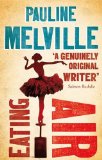
When I was writing ‘Eating Air’ one of the main characters, Donny McLeod became hugely pleasurable to create;  the more amoral he became the more attractive and vivid he was on the page.  Another minor character– Hetty Moran – clearly a baddie, became equally powerful.  I can still feel her knocking on the side of my imagination demanding another whole novel to herself.


Thank you Pauline! You mention some great books and your argument is a convincing one. I agree that evil characters are often more memorable than the good ones, but I still like to read about the good guys.

What do you think?

Is it important to have evil characters in literature?

Do they need to be balanced by good characters, or do you love books which only contain evil ones?

Categories
Blog Improvement Project Blogging Other

The Blog Improvement Project is back in 2010!

I am pleased to announce that the Blog Improvement Project is going to continue this year!

In 2009 Kim from Sophisticated Dorkiness did a fantastic job of creating exciting projects that helped me and many others to improve their blogs.

This year I am joining Kim in hosting the project. We hope to introduce many new ideas and take a further look at some of the popular topics from last year.

We’ve created a dedicated blog for the project — thebip.wordpress.com  Please head over there for more information and to sign up if you’re interested.

The first task will be posted on Monday 1st February.

Are you interested in improving your blog?

Which topics would you find particularly useful?

Categories
Other

The winner is…

Congratulations to Pam from Bookalicious!

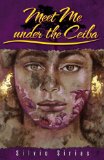
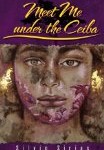
She wins the copy of Meet Me Under the Ceiba given away in yesterday’s post.

My thanks again to Silvio Sirias – I have now added some great Latino books to my wishlist and look forward to reading  Meet Me Under the Ceiba soon.

Categories
Interview Other

Silvio Sirias and Latino Literature


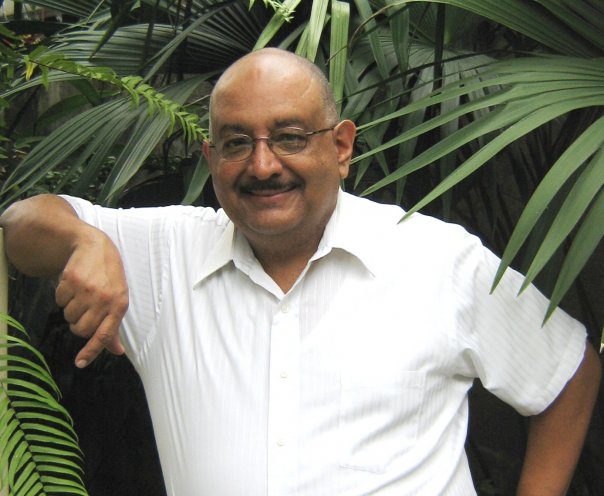
Silvio Sirias is the author of Meet Me Under the Ceiba, which won the Chicano/Latino Literary Prize in 2009. I have read a saddeningly small amount of Latino Literature, so am really pleased that Silvio has agreed to participate in a guest post on my blog today.


Welcome Silvio! 

First off, Jackie, I wish to congratulate you on having recently surpassed 10,000 comments on your blog.  That’s quite an achievement, as I can attest from experience—I closed the comment-feature early in my blogging career because I couldn’t bear to see 0 Comments any longer.

Thank you! While we’re sharing nice words I should congratulate you on winning the Chicano/Latino Literary Prize!  What was it like to win the award?

Upon receiving the news that the manuscript of MEET ME UNDER THE CEIBA had won the 2007 Chicano/Latino Literary Prize—a award whose legacy now spans over four decades and that the University of California-Irvine sponsors—after ascertaining that the email message wasn’t a hoax, I ran across the campus of the school where my wife and I both work, in the Republic of Panama, to share the news with her.

The celebration has continued ever since.

But the festivities haven’t consisted of merriment, cork-popping, and champagne guzzling.  Rather, the true nature of my satisfaction has been a prolonged, serene reflection on the joy of having fulfilled what once seemed like a far-fetched wish: to produce a narrative that could grab and hold the imagination of intelligent readers.  The achievement of this dream was confirmed when I learned that the judge of that year’s contest, Rolando Hinojosa-Smith—a writer I’ve long-admired andthe first U.S. author to receive Cuba’s prestigious literary award, the Premio Casa de las Américas—had headed the committee that chose MEET ME UNDER THE CEIBA as the winner of the Chicano/Latino Literary Prize.  What’s more, my thrill increased when I read Hinojosa Smith’s succinct verdict: “A fascinating read—very well-written, with a delightful, lively pace.”

That phrase alone—pronounced by one of the pioneers of Latino and Latina literature in the United States—made my decade.

Winning the Chicano/Latino Literary Prize also opened the doors to Arte Público Press—the legendary publisher of U.S. Latino and Latina literature.  Nicolas Kanellos, founder and director of Arte Público, read the manuscript within a week of receiving it and, after a brief exchange of emails, offered me a contract.   My experience regarding the publication of my first novel, BERNARDO AND THE VIRGIN, had taught me that the book industry moves at a pace that would make snails impatient.  But now events were happening at lightning speed—all thanks to the prize.

As you can see, Jackie, the rewards have been emotional as well as tangible.

Still, what I enjoy most about having won the Chicano/Latino Literary Prize, what still generates a warm feeling in my chest, is when I take the time to study the roster of past participants who have either won or placed in the contest.  Many of these names are already guaranteed a place in the pantheon of writers of Latin American heritage who write in English and publish their work in the United States.  For my name to be now among theirs makes me feel as if I have acquired an infinitesimal grasp on literary immortality.  As a reader, student, and teacher of U.S. Latino and Latina literature, I have admired the following authors for years: Ron Arias, Gary Soto, Helena Maria Viramontes, Luis Rodriguez, Lucha Corpi, Francisco X Alarcon, Cherrie Moraga, Demetria Martinez, Benjamin Alire-Saenz, Mary Helen Ponce, and Alberto Rios, among many others.  Their names may not ring a bell among most readers, but for those of us who have followed the trials, sacrifices, and toils it took for U.S. Latinos and Latinas to get their work published regularly, they are gigantic, heroic figures.

I have fantasized of a reunion of Chicano/Latino Literary Prize contestants.  And when, in my mind, we assemble for the group photograph, you better believe that I will be grinning—like the Cheshire Cat.  And when I received my blow-up of the photograph, it will be framed and placed in the most prominent spot of my living-room wall.

That image, where I’m standing shoulder-to-shoulder with these literary stalwarts, albeit existing only in my imagination, is what means the most to me when it comes to having won the prize.

What are your favourite books?

My list of favorite books is so long that it would soon bore your readers. Nevertheless, allow me to touch on the ones that make me green with envy; that is, the ones I wish I’d written:

Don Quixote de la Mancha, by Miguel de Cervantes; One Hundred Years of Solitude and Chronicle of a Death Foretold by Gabriel Garcia Marquez; Twenty Poems of Love by Pablo Neruda; The Power and the Glory by Graham Greene; The Feast of the Goat and The Language of Passion by Mario Vargas Llosa; In Cold Blood by Truman Capote; The Lord of the Rings by J. R. R. Tolkien; The Island of the Blue Dolphins by Scott O’Dell; and The Poisonwood Bible by Barbara Kingsolver.

Can you recommend some other great Latino books?

The books on this list are also ones I wished I had penned.  Because of my love for these novels, I recommend them without hesitation:

In the Time of the Butterflies and ¡Yo! by Julia Alvarez; The Mambo Kings Play Songs of Love by Oscar Hijuelos; Dreaming in Cuban by Cristina García; The House on the Lagoon by Rosario Ferre; Bless Me, Ultima by Rudolfo Anaya; The House on Mango Street by Sandra Cisneros; So Far from God by Ana Castillo; The Ordinary Seaman by Francisco Goldman; and Latin Jazz by Virgil Suarez—and, of course, there are many other inspiring novels by Latinos that I’m leaving out—so I beg the understanding of my fellow authors.

Do you follow the Latino prize? Have you read any of the other winners? Can you recommend any of the other winners?

I have followed the contest’s history, and I’ve read many of the works of past participants, which I also highly recommend:

The Road to Tamazunchale by Ron Arias; Baseball in April and Other Stories by Gary Soto; Soft Chaos by Alma Villanueva; The Moth and Other Stories by Helena Maria Viramontes; Always Running by Luis Rodriguez; Cactus Blood by Lucha Corpi; From the Other Side of Night/Del otro lado de la noche: New and Selected Poems by Francisco X. Alarcón; and Loving in the War Years by Cherrie Moraga.  

Thank you Silvio! That is a fantastic list of books!  I am going to try to make an effort to read more Latino books in the next year and will be referring back to your list frequently.

Silvio has generously agreed to give away a copy of his award winning book. For a chance to win, just ask Silvio a question below.

The giveaway is open internationally until 5am GMT on 20th January, when a winner will be selected at random. Good luck!


• Paperback: 256 pages
• Publisher: Arte Publico Pr (September 30, 2009)
• Language: English
• ISBN-13: 978-1558855922

Link to author’s website: www.silviosirias.com


This post is part of a blog tour, arranged by Latino Book Tours.

Silvio Sirias Blog Tour Dates:
Monday 11th: Book Lover Carol
Tuesday Jan 12th: Brown Girl Speaks
Wed Jan 13th: Regular Ruminations
Thursday Jan 14th: The Tranquilo Traveler
Friday Jan 15th: Pisti Totol
Monday, January 18 at Mama XXI
Wednesday, January 20th at Sandra’s Book Club
Thursday, January 21st at Latino Books Examiner
Friday, January 22nd at Una In A Million

Categories
Other

The First Episode of the TV Book Club

I have just watched the first episode of the TV Book Club on More 4 and was so disappointed with it that I felt I had to put my frustrations on record, in the vain hope that those in control of the show will change things.

The first book to be featured on the show was The Little Stranger by Sarah Waters. I enjoyed reading it, but it did have a few flaws, so I was looking forward to seeing what others thought of it.

The show opened in a very cheesy way, with all the presenters looking uncomfortable – a forgivable problem, as I appreciate that this is an important new venture for them all. The programme then introduced their special guest for the night, radio DJ Chris Evans, and spent 10 minutes discussing his book, carefully and thoroughly. This was fine, but I tuned in to hear about Sarah Waters – I have no interest in celebrity autobiographies and their excessive promotion, so I waited patiently for The Little Stranger to appear.

We were then treated to a weird piece about how much success Cecelia Ahern had achieved since her book was selected for the Richard and Judy Book Club, with amusing clips which did their best to avoid any shots of Richard and Judy’s names!  

The programme then took a strange, mildly interesting look at a few words not commonly used in the English language, which was OK, but 20 minutes in I still hadn’t heard anything about The Little Stranger.

Finally, Sarah Waters appeared and gave a fantastic description of her book – easily the best part of the show, it was great to hear her talk.

Then the discussion started, but it was terrible – it felt rushed, unorganised and critical.  It seemed to appear that all the panel members disliked the book, but without enough time it was impossible to decide whether they didn’t enjoy any of it, or just certain sections. The rushed discussion failed to address any aspect of the book properly and just as it seemed to be getting going it was all over. It was supposed to be a book club, so why did they only discuss the book for 4 minutes?

Richard and Judy managed to create an intelligent discussion of a book in a ten minute slot, so it is really disappointing that this programme failed to take advantage of it’s 30 minute length. They could have had a fantastic, thorough talk, but instead they wasted their time with pointless fillers.

Did you watch the TV Book Club?

Did you find it as frustrating as I did?

Will you be watching the rest of the series?

Categories
Blogging Other

10,000 Comments!

Congratulations to Beth who left my 10,000th comment! A £20 Amazon voucher will be in your inbox soon.

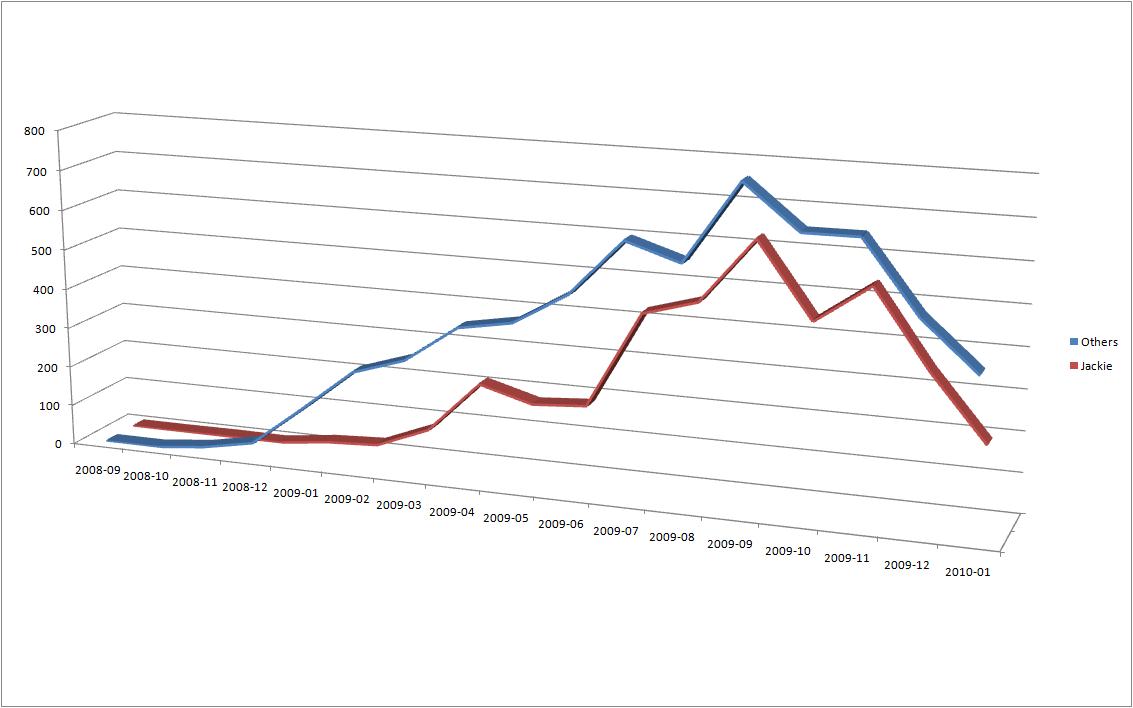
A few people were wondering how quickly I built up the comments on my blog, so I decided to produce this graph to show you how the number of comments I’ve received each month has grown:

The big dip in October 2009 is due to my holiday and things have quietened down over Christmas, but hopefully they’ll pick up again in the New Year. As you can see I was blogging for several months before I started to receive more than a handful of comments.

While I was studying my comment data I decided to highlight my wonderful, regular commenters. I was amazed at just how many comments some of you have left.

Top 10 Commenters on Farm Lane Books Sep 2008 – Jan 2010


  1. Sandy 348
  2. Beth 263
  3. Claire 251
  4. Simon 181
  5. Violet 156
  6. Steph 121
  7. Rebecca 101
  8. Diane 85
  9. Jenners 82
  10. Kimbofo 81

Thank you so much to everyone in the above list and anyone who has ever left a comment here. I appreciate every single comment I receive.  

Do you encourage comments on your blog, or are they just an added bonus?

Do you enjoy reading comments on other people’s blogs, or just your own?