Categories
Book Prizes Other

Book Awards Challenge III Complete!

Click to sign up

The Book Awards III Challenge ran from July 1 to December 1, 2009 and the challenge was to read: 5 books from 5 different awards

I thought that was too easy for me, so to make it more difficult I decided to seek out some of the lesser known awards, and ban myself from including Bookers, Pulitzers or Orange Prize winners in this challenge.

I love reading prize winning books, so I found it easy to complete this challenge, despite my personal restrictions.

The books I read were:

The Graveyard Book – Neil Gaiman (Audio Book) Newbery Medal 2009  stars3h

Perdido Street Station – China Miéville Arthur C Clarke Award 2001 stars3h

De Niro’s Game – Rawi Hage International IMPAC Literary Award 2008 stars3h

Persepolis – Marjane Satrapi (Book and Film) Alex Award 2004  stars41

2666 – Roberto Bolaño National Book Critics Circle Award 2008  stars51

I enjoyed looking through lists of book prizes and hope to read many more prize winning books next year.

Did you manage to complete the Book Awards Challenge?


Categories
2000 - 2007 Other Prizes Science Fiction

Perdido Street Station – China Miéville

 Winner of the 2001 Arthur C. Clarke Award and the 2001 British Fantasy Award. Nominated for the Hugo, Nebula, World Fantasy, Locus and British Science Fiction awards

When the Booker longlist was announced there was some anger from the science fiction community that China Miéville was excluded from the list. Damien Walter was particularly vocal on Twitter, and so, keen to ensure I wasn’t missing out on a great author, I decided to read one of his books. It was agreed that Perdido Street Station was the best and so I bought a copy. I was a little daunted when a 870 page chunkster dropped through my letter box, but I was still keen to find out why people were raving about this book.

Perdido Street Station began really well, with vivid descriptions of a strange world.

Sil lived and worked and slept in the tub, hauling himself from one end to the other with his huge, webbed hands and frog’s legs, his body wobbling like a bloated testicle, seemingly boneless. He was ancient and fat and grumpy, even for a vodyanoi. He was a bag of old blood with limbs, without a separate head, his big curmudgeonly face poking out from the fat at the front of his body.  

Isaac, the central character, is employed to study winged animals by a secrective creature who has lost his wings. I loved the character development and the imaginative plot – I was hooked for the first half of the book.

Everything started to go wrong at about the 500 page mark. The plot deteriorated into one long chase scene; I became bored by the continual fighting and longed for the thoughtfulness of the beginning to return. The ending was also a disappointment. It was such a shame, as I was really enjoying it.

I can see why this book won so many fantasy awards, but now I know why it didn’t win the Booker, or any other literary fiction prize. This book is beautifully written, but it doesn’t have the depth required for literary fiction. It is an incredible work of imagination, but in the end it lacked enough emotion or depth for me.

Recommended to people who are very passionate about their science fiction, but not to lovers of literary fiction.

stars3h

Have you read anything written by China Miéville?

I was very intrigued to read that he is planning to write a book in every genre. He is clearly a talented author and so I will read more of his books in the future. I am especially tempted by his latest book  The City & The City,which is described as detective noir novel. Has anyone read it?

Categories
2008 2009 Books in Translation Chunkster Other Prizes Recommended books

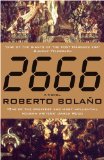
2666 – Roberto Bolaño. Part 5: The Part About Archimboldi

Steph and Claire are hosting a read-along for the highly acclaimed book, 2666, by Chilean author Roberto Bolaño. The novel is 900 pages long, and divided into 5 parts. We are reading one part a month.

Here are my thoughts on Part 5: The Part About Archimboldi

After nearly 6 months I have finally finished 2666! It took me a long time to decide if it was worth the effort – this book has confused me, bored me, and amazed me in equal measure.

I have learnt that Bolaño cannot be predicted and so I had no idea what to expect in this final section. What I found was an enjoyable novel, similar to part 3, in that it could be enjoyed independently. It was easy to read and beautifully written, but as an ending to this colossal book I was a bit disappointed. The explanations for some of the initial mysteries were very mundane and the majority of questions were left unanswered. I don’t mind ambiguity at the end of a book, but I had expected a few revelations and some clever twists. I was left feeling very deflated and a feeling of “is that it?” Hopefully Part 6 will be released soon and will have a much more satisfactory climax.

As a standalone novel, Part 5 was very good. I loved learning about Archimboldi and reading the rich descriptions of his family. I was hooked from the first sentence:

His mother was blind in one eye. She had blond hair and was blind in one eye. Her good eye was sky blue and placid, which made her seem slow but sweet natured, truly good. His father was lame. He had lost his leg in the war and spent a month in a military hospital near Düren, thinking he was done for and watching as the patients who could move (he couldn’t!) stole cigarettes from others.

As with the rest of the book there were also a lot of deeper, more philosophical quotes:

That night, as he was working the door at the bar, he amused himself by thinking about a time with two speeds, one very slow, in which the movement of people and objects was almost imperceptible, and the other fast, in which everything, even inert objects, glittered with speed. The first was called Paradise, the second Hell, and Archimboldi’s only wish was never to inhabit either.

I am very intrigued about why Heaven is slow. I always thought Heaven was perfect and can’t understand why he would say this. Can anyone enlighten me?

There is so much to discuss in this book that I am sure you could study it for years and still have more to uncover. The big question is whether I recommend that you read it and that is a very difficult question to answer. A quick glance as my ratings for each section would probably put you off this 900 page chunkster.

Part 1: The Part About the Critics  stars3h

Part 2: The Part About Amalfitano stars3h 

Part 3: The Part About Fate stars41

Part 4: The Part About the Crimes stars21

Part 5: The Part About Archimboldi stars41

I think this book should be approached with caution. I don’t think I would have made it to the end without the support of the other readalong participants:

RichardEmily, Frances,  Gavin, Isabella, Lu, E.L. Fay, and the wonderful hosts Steph and Claire.

It is a confusing, and at times overwhelming book, but I think it is also the sort of book which grows on you. I think that this book will remain with me, with my appreciation for it growing all the time. There are so many layers and little details which bubble to the surface weeks/months after reading it. I don’t think I will ever discover the point of this book, but I don’t think it matters. This book is a masterpiece, which will become a classic. For that reason I have to award it:

stars51


I have no idea how that happened when I struggled with so much of it, but I can’t deny the power this book has had on me over the last six months. I highly recommend this book to anyone that loves literary fiction. I promise that is is worth it in the end.

Do you think this book will still be read 100 years from now?

Do you recommend it to others?

If you haven’t read it, do you think you will attempt it?

Categories
2008 Audies Audio Book Booker Prize Other Prizes Recommended books Thriller

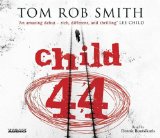
Child 44 – Tom Rob Smith (Audio Book)

Child 44 was longlisted for the Booker Prize in 2008 and it’s presence on the list caused a lot of controversy. I had heard so many different reactions to it that I really didn’t know what to expect. I was planning to read it, but when I saw that it won thriller of the year at the Audies I decided to listen to it instead. I am very pleased I made that decision as it is one of the best audio books I have ever listened to.

The book is set in Stalinist Russia during the 1950s and follows Leo, a state security agent, who slowly realises that the system he is part of arrests and tortures innocent people. He decides to work alone, risking everything to find the identity of a man who is murdering children across the country.

I loved every moment of listening to this book – I was gripped throughout. The complex plot was perfectly paced, the characters believable and packed with layers of emotion which were gradually revealed over the course of the book.

I can see why many people objected to this book’s inclusion on the Booker list – it is not literary fiction and contained no symbolism or hidden meanings buried in the text. It is simply a very good thriller, so anyone after a book to study for hours would be disappointed. As a thriller I can’t fault it – the twists were surprising and well thought out, the dilemmas the characters faced were thought provoking and tragic, and the cold, icy setting was perfect for adding to the chilling atmosphere.

There  were a few gruesome scenes, so the squeamish (especially those who love cats!) should proceed with caution, but I thought the violence was appropriate and was needed to emphasize the difficult circumstances the Russian people had to endure on a daily basis.

I highly recommend this book, especially the expertly narrated audio version, to anyone who loves engaging thrillers.

stars51


Did you enjoy Child 44?

Have you read the sequel, The Secret Speech?

Categories
2000 - 2007 Other Prizes

De Niro’s Game – Rawi Hage

 
Winner of the 2008 International IMPAC Literary Award, Shortlisted for the Giller Prize 2008

I picked up De Niro\’s Game‘); ?> after a recommendation from Claire at Kiss a Cloud, but I’m afraid that I didn’t love it as much as she did.

The book follows Bassam and George, childhood friends growing up in war-torn Beirut. As you can imagine it isn’t a pleasant read – graphic scenes of death and destruction fill every chapter.  The whole atmosphere of the book is one of helplessness and depression. I appreciate that this is probably a very realistic picture of what life is like for people living with war, but it meant that I found it a very difficult book to read. There didn’t seem to be any spark of hope, only choices between two equally terrible outcomes. I found it difficult to bond with the characters and their violent, vulgar attitude further distanced me from them.

I can see why Claire loved this book – the scenes were described vividly, and the story was both shocking and compelling.

That night, through the flames of a million candles that brawled inside the neighbourhood houses, I walked. Under those lights, hazy behind nylon sheets that covered our broken windows, I walked the streets with no dogs. I walked, and the candles danced inside a city with injured walls, a city void of light, a broken city wrapped in plastic, and plastered with bullet holes.

At times I became annoyed by the repetition. I realise that it was a powerful means to describe the situation the people were faced with, but if I read the words “Ten thousand bombs had fallen” one more time I think I’ll scream!

Overall, this is a beautifully written book, but the futility was too much for me.

stars3h


Have you read De Niro’s Game?

Can you enjoy a book which deals only with devastation?

Categories
1990s Orange Prize

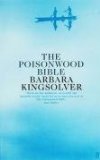
The Poisonwood Bible – Barbara Kingsolver

 Shortlisted for the Orange Prize 1999

The Poisonwood Bible is a book I had been wanting to read for a long time, but for some reason, I kept putting it off. It wasn’t until the wonderful Michelle offered to send a copy to me, that I was given the push I needed to finally pick it up.

The Poisonwood Bible focuses on a Baptist family who move from America to the Belgian Congo in 1959 with the aim of converting the African people to the Christian faith. The family quickly realise that life in Africa will not be as simple as they imagined. They have to learn to cope with the hardships brought on by both the wildlife and the political instability of the region.

Initially I loved the rich detail of the prose, each of the characters was beautifully crafted and life in the Congo was vividly depicted, but after a couple of hundred pages I began to become frustrated with it. I was expecting the story to take hold once the characters had been introduced, but this didn’t happen. The pace of the book remained incredibly slow, which meant that it often failed to hold my attention. There was no momentum to drive the plot forward, so the 600+ pages seemed to drag more than they should have done.

Despite this criticism it was a very good book; there were a lot of touching scenes and I loved following the family over several decades. This book contained some great messages about which things in society are important and the attitude of Nathan, the fierce minister, will promote some interesting discussions.

And so he continues ministering to the lepers and outcasts. By pure mistake, his implementation is sometimes more pure than his intentions. But mostly it is the other way around. Mostly he shouts, ‘Praise be!’ while the back of his hand knocks you flat.

Recommended to anyone with the patience to read a long, slow novel.

stars41

Did you enjoy The Poisonwood Bible?

Are you looking forward to her next novel, The Lacuna, being released in November?