Categories
Other Other Prizes

The Commonwealth Writers’ Prize

A few commenters on my post yesterday hadn’t heard of the Commonwealth Writers’ Prize, so I thought I’d give you a brief introduction. It is one of my favourite book awards, as I have loved all the winning books I’ve read.

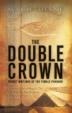
The prize is awarded annually to the best book written by an author from one of the 53 countries of the Commonwealth. The judging is initially divided into four regions:  Africa, Europe and South Asia, The Caribbean and Canada, and South East Asia and the South Pacific. with a long list and then a short list being announced before the winner is finally revealed.

The 2010 short lists were:

Note: Book short listed for Best Book is on the left; Best First Book on the right.

Africa

Canada and the Caribbean
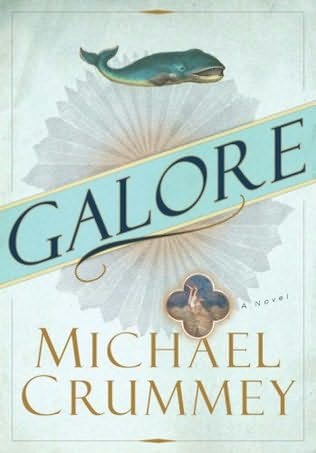

Europe and South Asia

South East Asia and South Pacific

Overall Winners 2010

Best Book:


Best First Book:

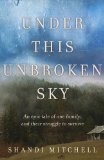
I have a copy of Under this Unbroken Sky here and hope to read it at sometime soon. The rest of the books appeal to me too, so as soon as I spot copies in my local library I’ll be checking them out.

Previous winners of Commonwealth Writers’ Prize

1987 – Olive Senior, Summer Lightning

1988 – Festus Iyayi, Heroes

1989 – Janet Frame, The Carpathians

1990 – Mordecai Richler, Solomon Gursky Was Here

1991 – David Malouf, The Great World

1992 – Rohinton Mistry, Such a Long Journey

1993 – Alex Miller, The Ancestor Game

1994 – Vikram Seth, A Suitable Boy

1995 – Louis de Bernières, Captain Corelli’s Mandolin

1996 – Rohinton Mistry, A Fine Balance

1997 – Earl Lovelace, Salt

1998 – Peter Carey, Jack Maggs

1999 – Murray Bail, Eucalyptus

2000 – John Maxwell Coetzee, Disgrace

2001 – Peter Carey, True History of the Kelly Gang

2002 – Richard Flanagan, Gould’s Book of Fish  

2003 – Austin Clarke, The Polished Hoe

2004 – Caryl Phillips, A Distant Shore

2005 – Andrea Levy, Small Island stars4

2006 – Kate Grenville, The Secret River 

2007 – Lloyd Jones, Mister Pip  

2008 – Lawrence Hill, The Book of Negroes 

2009 – Christos Tsiolkas, The Slap stars4

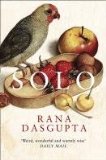
2010 – Rana Dasgupta, Solo stars4

I have read seven CWP winning books and loved them all. Creating this list made me realise how much I have enjoyed books from this prize and so I’m going to try to read a few more in the future. I already have a copy of The Book of Negroes, so will try to fit it in next month.

Do you follow the Commonwealth Writers’ Prize?

Are there any books that you particularly recommend?
Categories
2009 Other Prizes Recommended books

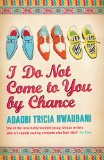
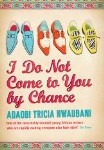
I Do Not Come To You By Chance – Adaobi Tricia Nwaubani

Winner of the Commonwealth Writers’ Prize 2010, Best First Book: Africa.

The short list for the Commonwealth Writers’ Prize was announced last month and I was immediately drawn towards this book which centres on the world of a Nigerian email scammer. I am really pleased that I impulsively read this book, as I found it fascinating.

I Do Not Come to You by Chance follows Kingsley, a young Nigerian man who has a good education and a promising career ahead of him. His world is shattered when his father becomes ill and the family is unable to afford the treatment needed to save his life. Desperate to help his father, Kingsley turns to his mysteriously wealthy uncle and gets drawn in to the bizarre world of the email scammer:

At first, it was difficult. Composing cock-and-bull tales, with every single word an untruth, including ‘is’ and ‘was’. Blasting SOS emails around the world, hoping that someone would swallow the bait and respond. But I was probably worrying myself for nothing. They were just a bunch of email addresses with no real people at the other end anyway. Besides, who on this earth was stupid enough to fall prey to an email from a stranger in Nigeria?

The plot was quite simple and the writing wasn’t particularly beautiful, but the insight into the life of an email scammer had me hooked. I was fascinated by their activities – continually amazed by what they managed to get away with. I’d love to know how many of the events in this book had actually occurred. This is one of those books that I was telling everyone about, unable to believe that people actually respond to those dodgy emails we all get.

This book also had a very African feel to it. I loved the snippets of African mythology, all presented in a way that was easy for me to understand. It also raised some thought provoking questions, mainly revolving around whether or not it is OK to steal from the gullible rich, to give to the poorest in society.

Overall this was an amusing, insightful and ultimately uplifting tale about an underground world I previously knew nothing about.

Highly recommended.

Are you planning to read anything short listed for the Commonwealth Writers’ Prize?

Categories
Other Pulitzer Prize

Pulitzer Prize for Fiction 2010

The winner of the 2010 Pulitzer Prize for Fiction was announced yesterday. I did a terrible job of predicting the winner  –  failing to mention any of the finalists. I blame this on the fact that I haven’t even heard of any of them! 

Winner of the Pulitzer Prize 2010

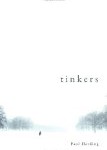
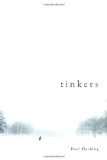
Tinkers by Paul Harding

Finalists

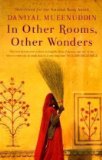
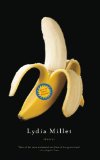
Love in Infant Monkeys by Lydia Millet and In Other Rooms, Other Wonders by Daniyal Mueenuddin

I am trying to read all the Pulitzer winners, so will read Tinkers at some point.

Have you read Tinkers?

Have you heard of these books?


Categories
2009 Orange Prize

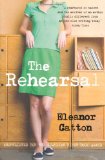
The Rehearsal – Eleanor Catton


Long listed for Orange Prize 2010, Short listed for Guardian First book Award, Winner of the Betty Trask Award

I had heard The Rehearsal mentioned a few times in 2009, but when it was included on the Orange long list this year everyone started talking about it. The Rehearsal seems to divide opinion, with a roughly equal split between those who love the book and those who hate it. I must admit that the premise didn’t appeal to me, but I don’t like being unable to join a heated book discussion and so I reserved a copy from my library.

The book centres on a sex scandal involving a teacher and his pupil. The narrative travels forwards and backwards in time, following a group of pupils who gossip about the event and members of a drama school who decide to put on a play about the sex scandal.

The book is quite confusing to read, as you are never really sure which scenes are part of the play and which are ‘real’. I’d read about 50 pages of the book when I re-read Claire’s review in which she pointed out that chapters starting with a day of the week were about the school pupils and ones titled with a month were set in the drama school, but although this information helped a lot I was still confused about many things.

The book realistically portrays teenagers, managing to capture that uncertainty and awkwardness. I was particularly impressed by the insecurites of a younger sibling:

No, Isolde says, ‘I will make the same mistakes, but by the time I do they won’t seem interesting because you’ll already have done it, and I’ll only be a copy.’

The teenage banter was witty and insightful, but the plot was almost non-existent. I was particularly disappointed by the ending, as the book just stopped without reaching any real conclusion.

I am still trying to decide if I liked The Rehearsal or not.  I can’t work out whether this book is genius, or just trying too hard to be clever. If The Rehearsal  had been written in chronological order I suspect it might have been a fairly average read. Does confusing your readers make a book incredibly good, or does it just hide any flaws in a cloak of confusion?  Despite my uncertainty The Rehearsal is the most impressive book I’ve found on the Orange long list so far and I’d be happy to see it win. 

Overall I enjoyed reading this book for the individual passages, but it was too clever to work as a novel for me.

Did you enjoy The Rehearsal?

Can a book be too clever?

Categories
2009 Historical Fiction Orange Prize

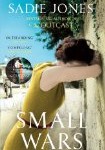
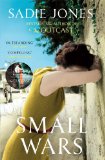
Small Wars – Sadie Jones

 Long listed for the Orange Prize 2010

I enjoyed Sadie Jones’ last novel, The Outcast, to some extent, but found the ending to be a bit of an anti-climax. When I saw her latest book had made the Orange long list I decided to give her another try.
Small Wars is set on Cyprus during the 1950s Emergency, a time when the British defended Cyprus against a colony of Cypriots determined to form a union with Greece. The book follows Hal, a young British soldier who is posted to Cyprus. He brings his wife and daughters with him, but their relationship is put under pressure by the fear of violence.

I’m afraid I wasn’t a big fan of Small Wars. The pace of the book was quite slow and there were several long, meandering sections where I began to lose interest. The writing was simple and easy to read, but this simplicity meant that the real horror of some situations wasn’t adequately described:

The people were made to lie down on the floor of the trucks, because there were so many of them, and if the soldiers made them lie down, they could be layered to make room. There were reports of suffocation from this stacking of live bodies, but later, the British, investigating, found no bodies.

In the hands of a different author that same scene could have been very hard to read. I can imagine the fear of those poor people, but reading the above passage provoked no emotion in me. The same is true for much of the book – there were some terrible events, but they were rushed over and so the horror could be largely ignored.

The main theme of Small Wars was the way war can affect relationships. The book concentrated on characterisation rather than plot; this gentle observation of the feelings will be of interest to some, but I’m afraid it was all too quiet for me.

Recommended to those who want to read about war in a quiet, gentle way.

What others had to say:

It’s a complex study, yet it’s easy to read and progresses very quickly!  S Krishna’s Books

 ….notable for its psychological depth and characterizations. California Literary Review

 ….this follow-up shows that she is no one-hit wonder. Times Online

Have you read The Outcast or Small Wars?

Do you think this book has a chance at making the Orange short list?

Categories
Books in Translation Nobel Prize

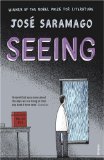
Seeing – Jose Saramago

Blindness is one of my favourite books, so I was intrigued by its sequel, Seeing.

Seeing is set in the city that was affected by the blindness epidemic four year ago. The city holds an election, but when the votes are counted 70% of them are blank. They hold another election the following week and this time 80% of the votes are blank. For some bizarre reason (that I couldn’t grasp) the authorities panic, declare a state of emergency and all hell breaks loose.

It pains me to say this about an author I love, but I’m afraid I couldn’t finish Seeing. It started off reasonably well as I’m already used to Saramago’s unique writing style, lacking in punctuation.

…but we are dealing here with humans beings, and human beings are known universally as the only animals capable of lying, and while it is true that they sometimes lie out of fear and sometimes out of self-interest, they occasionally lie because they realise, just in time, that this is the only means available to them of defending the truth.

The book described the elections which were held on atmospheric rainy days, but as you may know I’m not a fan of politics and I think the political satire in this book just went over my head. I didn’t understand why a low turn out in an election led to the events and the lack of a central character meant that I didn’t really care what happened. We view the city almost from above and so the personal emotion that made Blindness so powerful was lacking.

The plot was meandering and had almost disappeared entirely by the 150 page mark. I started to skim read and found that nothing was happening many pages later. I looked up a few online reviews and discovered that other people had a similar problem – there was no plot in the second half of the book. The effort required to read it was too much and so I decided to give up.

Recommended to those who enjoy political satire.

 (DNF)

Have you enjoyed any of Saramago’s lesser known works?

Or had similar problems with them?