Categories
2009 Books in Translation Chunkster Historical Fiction Other Prizes Recommended books

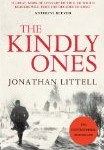
The Kindly Ones – Jonathan Littell


Translated from the French by Charlotte Mandell

Winner of 2006 Prix Goncourt and the grand prix du roman of Académie française, Literary Review’s bad sex in fiction award 2009, 2010 Best Translated Book Award: Fiction Longlist, 2010 long list Independent Foreign Fiction Prize

The Kindly Ones is one of the most controversial books written in recent years. The book is a fictional biography of Max Aue, a senior SS officer, present during the Holocaust.  His job is to compile recommendations for future Nazi policy and so he travels to see the execution of the Jews, the German front line and finally the concentration camps. The fictional characters are weaved together with real people like Göring, Speer and Hitler; producing a well researched, compelling version of WWII.

The Kindly Ones is the most disturbing book I’ve ever read. I have read a few individual scenes in books like A Fine Balance or Fugitive Pieces that almost equal the horror of the milder sections in this book, but the descriptions of the Holocaust were so intense and prolonged that I found this book very hard to read. There were times when I could only read a page or two before having to put the book down and do something else. Sometimes even that wasn’t enough and so I started skim reading sections. I found this didn’t help much as I was still painfully aware of what was happening, so I reverted to the slow, painful pace I had started with.

The whole book is like driving past a car crash – you know you shouldn’t look, but you do anyway  –  unable to resist the temptation to see how bad things really are.  I was gripped throughout, an amazing feat for a book so long. The prose is easy to read, but I did get a bit confused by some of the German military terms (most of which are explained in the back, but as I don’t really understand the British equivalent that didn’t help much!).

I expected the plot to emphasize the fact that the people involved in these terrible events had no choice in the matter – that it was basically ‘do or die’.

The man posted to a concentration camp, like a man assigned to an Einsatzkommando or a police battalion, most of the time doesn’t reason any differently: he knows that his free will has nothing to do with it, and that chance alone makes him a killer rather than a hero, or a dead man.

I was therefore surprised to see many opportunities for Max Aue to avoid ending up on the path he took. Initially I wondered why the book was written in this way, but then I realised how clever and realistic it was. The events leading up to the atrocities are obvious with hindsight, but to the people involved each step was so small that they were unaware of the final consequences. Many questioned the actions and were given what seemed to them to be reasonable justifications. For this book to change the way I view the Holocaust is an incredible achievement.

The Kindly Ones also contained many poignant scenes. I was particularly touched by this passage:

“I started sobbing: the tears froze on my face, I wept for my childhood, for a time when snow was a pleasure that knew no end, when a city was a wonderful space to live in, and when a forest was not yet a convenient place to kill people.”

Overall I’d describe this book as a ‘must read’ for anyone interested in the Holocaust, but the length and graphic descriptions of human suffering mean that most people should approach this book with caution. I will remember this book for the rest of my life and although I sometimes wish I could erase some scenes from my memory, on the whole I think it is helpful to remember that these events happened.

Do you want to read The Kindly Ones?
Categories
2009 Mystery

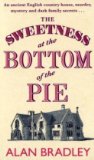
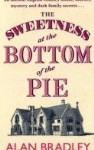
The Sweetness at the Bottom of the Pie – Alan Bradley

The Sweetness at the Bottom of the Pie is a delightful cozy mystery. The book is set in a small English village in the 1950s and the story begins with 10-year-old Flavia de Luce finding a dead snipe on her doorstep. The bird has a postage stamp impaled on its beak and her father’s reaction to the discovery implies that this is a warning of worse to come. His fears are confirmed when a man is found dying in a cucumber patch.

Flavia de Luce is a budding chemist with access to a laboratory in her country house. She enjoys learning about poisons and other chemical reactions – I loved her! She was such a wonderful, quirky character and I liked reading about the preparation and effects of various poisons. She wasn’t entirely believable as a ten-year-old, but then much of the plot was a bit far fetched so I don’t think realism is the key aim of this book!

“I wonder, Flavia,” Inspector Hewitt said, stepping gingerly into the cucumbers, “if you might ask someone to organize some tea?”
He must have seen the look on my face.
“We’ve had rather an early start this morning. Do you think you could manage to rustle something up?”
So that was it. As at a birth, so at a death. Without so much as a kiss-me-quick-and-mind-the-marmalade, the only female in sight is enlisted to trot off, and see that the water is boiled. Rustle something up, indeed! What did he take me for, some kind of cowboy?

The plot was fast paced and entertaining. It needed little concentration – I read much of it on a train journey, a time when I find the noise prevents me from reading anything too deep. The ending wasn’t earth-shattering, but the light mystery was well resolved.

Overall I enjoyed my journey back into the charming life of 1950s England and while I won’t be rushing out to buy the next in the series (The Weed That Strings the Hangman’s Bag ) I’m sure I’ll get round to it at some point.

Did you enjoy The Sweetness at the Bottom of the Pie?

Which is your favourite cozy mystery?

Categories
1980s Classics

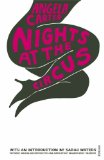
Nights at the Circus – Angela Carter

I hadn’t read any Angela Carter, so when I saw that Claire was creating a whole month dedicated to celebrating her work I decided it was time to give Angela Carter a try.

Nights at the Circus centres on Fevvers, an extraordinary character who claims she was hatched from an egg. During an interview she explains that she was a normal child until she hit puberty, when wings grew on her back. Fevvers is a famous circus performer and one of the most vivid characters I have ever read. Raised in a brothel, with a distinctive Cockney accent, her presence just leaps from the page – I loved her!

Her voice. It was as if Walser had become a prisoner of her voice, her cavernous, sombre voice, a voice made for shouting about the tempest, her voice of a celestial fishwife. Musical as it strangely was, yet not a voice for singing with; it comprised discords, her scale contained twelve tones. Her voice, with its warped, homely, Cockney vowels and random aspirates. Her dark, rusty, dipping, swooping voice, imperious as a siren’s.

Unfortunately the rest of the book didn’t capture my imagination in the same way. I’m not a big fan of magical realism and so its heavy presence in the book wasn’t a positive for me.

The book also contained little plot. Lots of things happened, but there was never that forward momentum compelling me to read on – it was more like reading several individual scenes instead of one connected story. I had hoped that everything would be brought together at the end, but instead I found the last page very irriating – I think I just lack Angela Carter’s sense of humor!

I’m really pleased that I read this book, as I think it is an important novel that has influenced many other authors, but I’ll have to leave all the Angela Carter promotion to Claire! 

Highly recommeded to fans of magical realism.


Most people seem to love this book, so I’ll leave you to have a look at some wonderful reviews:

 ….a dizzying and magical journey… Things Mean a Lot

Carter’s style is scandalously generous with brilliant descriptions, stunning word portraits that pack every event out with jewel-bright glimpses into the different layers of her fictional world. Tales from the Reading Room

Do you love Angela Carter’s books?

Do you enjoy magical realism?

Categories
2008 Memoirs

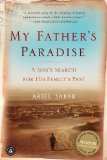
My Father’s Paradise – Ariel Sabar

Winner of National Book Critics Circle Award: Best Biography 2008

I bought this book after reading Violet’s review. I don’t read much non-fiction, but this one sounded too good to miss! 

My Father’s Paradise is written by journalist, Ariel Sabar, who decides to use his investigative skills to trace the history of his father, a man born in a remote part of Kurdish Iraq. His father is one of the last native speakers of neo-aramaic, an ancient language which has almost disappeared due to population migration. Ariel Sabar decides to do everything he can to record the language and traditions of his ancestors, before they are lost forever.

The start of the book reads almost like fiction, telling the story of his father’s life growing up in a small village. I loved this section! In many ways I wish the whole book had continued in this style (perhaps because I prefer to read fiction), but also because I found the sense of community in the village heart warming. I could feel Ariel’s love for the traditions shining through the text.

As time passes the book starts to bring in more historical facts, explaining the political situation in Iraq and why his father, a Kurdish Jew, had to flee to Israel. Some parts of the book book felt a bit dry, but in reality I needed these facts to fully understand what was happening.

The book then went on to describe their life in America and how they set to work recording the language and folklore of the Kurdish Jews. His father became a famous professor, internationally renowned for his work on aramaic text. It was amazing to see how much one man’s life had changed, but I found I was far more interested in his early life than his work in the University. I think this is summed up nicely by the words of Ariel’s father:

The more a society advances in a technical and material way, the more its people grow complicated and distant from one another.

Overall, this was a fascinating book but I wish Ariel Sabar would write another one, focusing only on life in 1930s Iraq.

If you’d like to learn more about this book then I recommend that you watch this Interview with Ariel Sabar.

Categories
2010 Historical Fiction Orange Prize

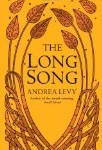
The Long Song – Andrea Levy

 Long listed for Orange Prize 2010 

The Long Song is set on Jamaica and follows July, a young slave girl, during the last few years of slavery and after she is granted freedom. 

The book is very different in style to Andrea Levy’s last book, Orange Prize winning Small Island, but I think they are both good in their own way. 

Much of the speech in The Long Song is written in Jamaican dialect, which adds atmosphere to the book. I think this would be even better on audio, as I’m sure my inner mind doesn’t quite do it justice! It isn’t hard to understand the dialect, in fact the whole book is quick and easy to read. I felt that this was actually one of the negatives of the book – it was so light that it seemed to skim over some very important scenes. The plot was quite simple, but the book covered a reasonably large chunk of time. This speed of events meant that I didn’t fully connect with July or understand which emotions she was experiencing. 

The narrator, July, frequently addresses the reader of the book, adding references to her present day life. 

Reader, my son tells me that this is too indelicate a commencement of any tale. Please pardon me, but your storyteller is a woman possessed of a forthright tongue and a little ink. 

Having read a few other reviews I’ve discovered that this style seems to annoy some people, but I found it a refreshing change to the similarity of many books. 

Overall, it was a light, entertaining read, but I have heard the amazing way Andrea Levy narrates her books and so I recommend getting the audio version of The Long Song.

Did you enjoy The Long Song?

Do you think it will make it onto the Orange short list tomorrow?

Categories
2009 Other Prizes Recommended books

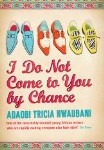
I Do Not Come To You By Chance – Adaobi Tricia Nwaubani

Winner of the Commonwealth Writers’ Prize 2010, Best First Book: Africa.

The short list for the Commonwealth Writers’ Prize was announced last month and I was immediately drawn towards this book which centres on the world of a Nigerian email scammer. I am really pleased that I impulsively read this book, as I found it fascinating.

I Do Not Come to You by Chance follows Kingsley, a young Nigerian man who has a good education and a promising career ahead of him. His world is shattered when his father becomes ill and the family is unable to afford the treatment needed to save his life. Desperate to help his father, Kingsley turns to his mysteriously wealthy uncle and gets drawn in to the bizarre world of the email scammer:

At first, it was difficult. Composing cock-and-bull tales, with every single word an untruth, including ‘is’ and ‘was’. Blasting SOS emails around the world, hoping that someone would swallow the bait and respond. But I was probably worrying myself for nothing. They were just a bunch of email addresses with no real people at the other end anyway. Besides, who on this earth was stupid enough to fall prey to an email from a stranger in Nigeria?

The plot was quite simple and the writing wasn’t particularly beautiful, but the insight into the life of an email scammer had me hooked. I was fascinated by their activities – continually amazed by what they managed to get away with. I’d love to know how many of the events in this book had actually occurred. This is one of those books that I was telling everyone about, unable to believe that people actually respond to those dodgy emails we all get.

This book also had a very African feel to it. I loved the snippets of African mythology, all presented in a way that was easy for me to understand. It also raised some thought provoking questions, mainly revolving around whether or not it is OK to steal from the gullible rich, to give to the poorest in society.

Overall this was an amusing, insightful and ultimately uplifting tale about an underground world I previously knew nothing about.

Highly recommended.

Are you planning to read anything short listed for the Commonwealth Writers’ Prize?