Categories
2011 Books in Translation

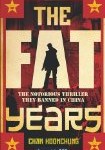
The Fat Years – Chan Koonchung

The Fat Years Translated from the Chinese by Michael S. Duke

Five words from the blurb: China, truth, memory, cheerfulness, world

The Fat Years is billed as “the notorious thriller they banned in China”, but closer inspection reveals that the fictional elements of this story are minimal and I think it can be more accurately described as a controversial exposé of the political situation in China today.

The book is set in the near future and revolves around a small group of people who realise that a month has disappeared from official records and no-one can remember what happened. The general population is suspiciously cheerful, seemingly oblivious to the situation. The friends travel around the country in search of the truth behind the strange event, uncovering numerous situations previously hidden from the public.

Initially I struggled to follow the plot because there were a large number of characters and many cultural references that I was unfamiliar with, but I persevered and after about 70 pages I began to understand what was happening. The more I read, the more impressed I was. The Fat Years is thought -provoking, clever and frighteningly realistic. This book was written a few years ago, but several of Koonchung’s predictions have already come true and the line between fiction and reality is incredibly small. There were several sections that I found unbelievable, but a quick bit of Internet research revealed that the events described had in fact happened.

The Fat Years does a fantastic job of explaining China’s place in the Global economy and provides an insight into their thoughts on the rest of the world. I admit that some of the financial aspects of the book went over my head, but some of the policies for bringing China out of recession were bold enough to give me real food for thought.

Twenty-five per cent of the balance of every National Bank savings account was to be converted into vouchers for use in China only. One third of these to be spent within ninety days, and two thirds within six months.

The book also explained the population’s thoughts on the political situation of the country.

…..in a moderately well-off society, the people fear chaos more than they fear dictatorship.

The ending was particularly profound and I’m sure I’ll be thinking about it for a long time to come.

The Fat Years won’t be for everyone, but if you have an interest in Chinese ideology or the financial influence of China on the world then this as a must read.

Highly recommended.

.
Categories
2011

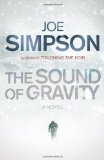
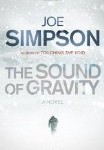
The Sound of Gravity – Joe Simpson

The Sound of Gravity

I have read and loved all Joe Simpson’s non-fiction books; torn between admiration of his courage and disbelief at the way he repeatedly puts himself in danger. I was unaware that he’d made the move into fiction writing until this book popped through my letter box, but I’ve since discovered that this is actually his second fiction novel. Once again I’m torn – this time between wanting him to go back into those dangerous situations (so he’s able to write another non-fiction account of his adventures) and being pleased that he has at last decided to stay inside and do nothing more dangerous than sharpen pencils.

The Sound of Gravity begins with a climbing accident in the Alps. A man has to let go of his girlfriend’s hand, leaving her to fall to her death and him with a decade of guilt. The book goes on to cover events leading up to this tragedy and details of his slow recovery afterwards.

I initially loved the vivid descriptions of both the surroundings and the raw emotions.

He held his breath as she died. She vanished with a swiftness that unbalanced him. It snared him from a weary sleep, waking him with icy immediacy. She simply fell away and out of life, dropping noiselessly down into the cold air.

But after a while I began to get snow fatigue. Every page seemed to describe yet another snowy outcrop, each with its own near-death experience.

It seemed to happen with cartoon-like speed. With a grating noise of pulverised rock the slab that had formed the roof dipped down and began to topple from the ridge. He pulled hard on the abseil tape, running on the tipping slab, watching as his crampons kicked sparks from the rock and he made a despairing lunge. His chest pounded painfully against the ledge as he felt the roof fall away below his thighs and his legs plunge into emptiness.

This left me thinking about the differences between fiction and non-fiction. Did I only love Joe Simpson’s previous books because I knew they were true? Were the endless near-misses so much more exciting because they involved the lives of real people? I guess it all comes down to the fact that I just didn’t care about the characters in this book – they had so many accidents that each one began to lose its significance.

If you’re new to Joe Simpson I recommend starting with Touching The Void. The Touching The Void DVD is also very good, especially the extra feature documentary  – it is, in my opinion, the best extra feature I’ve ever found on a DVD.
I’m sure that the technical details will mean that this book will appeal to climbers, but I think the average reader will prefer his non-fiction titles.

.

Have you read any of Joe Simpson’s books?

Categories
2000 - 2007 Booker Prize

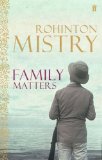
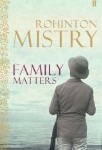
Family Matters – Rohinton Mistry

Family Matters: 1

A Fine Balance is my favourite book and so you’d have thought I’d have gone out and read all of Mistry’s books straight away. The reality is that I was too scared to read them – I knew my expectations were far too high and didn’t want to be disappointed. I eventually built up the courage to try Family Matters and although it isn’t in the same league as A Fine Balance, I wasn’t disappointed.

Family Matters has a much narrower scope than A Fine Balance. It follows a single family as they struggle to look after their father, Nariman; an old man who suffers from Parkinson’s and then becomes immobile after a fall. Trapped in his bed Nariman feels the terrific burden he has placed on his family. They struggle to afford his medicines and find it physically draining to care for him.

The characters come alive on the very first page and I felt immense sympathy for everyone involved – the relationship between Nariman and his grandson was especially touching. There were times when I longed for the plot to move beyond the family, but the fact that I was happy observing such mundane scenes for the majority of the book shows Mistry’s talent as a writer.

The sights and sounds of India were vividly described and Mistry has an amazing ability draw attention to the little things and give them a whole new depth.

In the flower stall two men sat like musicians, weaving strands of marigold, garlands of jasmine and lily and rose, their fingers picking, plucking, knotting, playing a floral melody.

I strongly recommend that you read A Fine Balance, but once you’ve read that I think you’ll appreciate this subtler insight into the problems faced by one Indian family.

Recommended.

.


Categories
1990s Books in Translation Novella

Breathing Underwater – Marie Darrieussecq

Breathing Underwater Translated from the French by Linda Coverdale

Five words from the blurb: coast, daughter, clues, looking, mistake

Last year I was amazed by the power of the novel, Beside the Sea, and so asked for recommendations of books with a similar level of impact. Breathing Underwater was suggested as a book that not only shared the themes of Beside the Sea, but also the power. I found it interesting to compare the two novellas and I think this pair would make an interesting combination for those studying differences in writing style.

Breathing Underwater follows a woman who walks out on her husband and then takes her daughter to the seaside. Her husband hires a private detective to track them down, but this isn’t a fast-paced chase. The events are very slow, with each scene intricately described.

She leaves the child on top of the dune. She feels something like relief, a pause; the intuition that she can leave her there, absorbed by the sea, eyes straining from their sockets; in the redundancy of the fishing poles, sinkers, floats, and even the buckets and shovels. She won’t rush down to the beach straight away, she won’t run off to drown in the waves; unlike logs blazing in fireplaces or outdoor bonfires, the sea does not make itself our friend, it doesn’t crackle within arm’s reach: you look at it for a long time before it dawns on you that you can touch it.

The book had very little plot and I often found that the surroundings were so well described that I forgot what was happening.

The reader is a casual observer of events, never quite understanding what will happen next or the reasons for the actions. This was a problem for me as it meant that I felt no emotional connection to the characters. The multiple narrators in this short book increased this sense of detachment.

If you enjoy slow, thoughtful narratives then I’m sure you’ll love this book, but I’m afraid the writing was too flowery for me and I don’t think it came close to matching the emotional power of Beside the Sea.

.

Categories
2011

The Marriage Plot – Jeffrey Eugenides

The Marriage Plot

Five words from the blurb: American, college, love, novel, relationships

Jeffrey Eugenides has a special power with words, managing to reduce me to tears just 34 pages into Middlesex. His latest novel, The Marriage Plot, shares this magical character building, but unfortunately it lacks a powerful plot.

The Marriage Plot is an unashamedly American novel. Focusing on college students in the 1980s we see their struggle to form relationships and the pressures placed on them to pair off. The characters come to life on the very first page. I quickly felt as though I knew them all; understanding their motivations and sharing their pain.

The central character is Madeleine, an English major writing a thesis on “the marriage plot” which investigates the way changes in courtship have altered the structure of novels throughout history.

Sexual equality, good for women. had been bad for the novel. And divorce had undone it completely. What would it matter whom Emma married if she could file for a separation later? How would Isabel Archer’s marriage to Gilbert Osmond have been affected by the existence of a prenup? As far as Saunders was concerned, marriage didn’t mean much any more, and neither did the novel.

This was a clever device and I loved the way this theme was reflected in Eugenides’ novel – especially in the final few paragraphs.

I loved the character building of the first 100 pages, but after that I slowly began to lose interest. Very little happened and I became increasingly frustrated. The book had some good themes, but they were too spread out and I think it would have benefited from being at least 150 pages shorter. I suspect that the reminiscing aspects of this book will mean it has a greater appeal to Americans (especially those who went to college in the 1980s), but as someone from outside the country I felt that a lot of the cultural references went over my head.

I’m probably being a bit harsh by awarding this 3.5 stars as it clearly has a lot to recommend it. I think my expectations were a bit too high going into it and so I was disappointed by the simplicity of the plot and the mundane actions of the characters.

If you enjoy getting inside the head of ordinary people then I’m sure you’ll enjoy this book, but I wish something more exciting had happened.

.

Everyone else thinks this book is amazing:

The Marriage Plot is humane, subtly humorous, sometimes touching, and always extremely engaging. Things Mean A Lot

….taking things that are MAD TEDIOUS, like people’s scholarly inclinations and the way they intersect with and inform said people’s life-paths and making it FASCINATING! books i done read

Eugenides prose is just as beautiful and detailed as it was in Middlesex, and his characters just as memorable. Literary Musings


Categories
1990s

Everything You Know – Zoe Heller

Everything You Know

Five words from the blurb: women, daughter, suicide, diaries, lonely

I loved Notes on a Scandal, but couldn’t finish The Believers and so was interested to see what I’d make of Zoe Heller’s debut novel, Everything You Know.

The book focuses on Willy, a bitter man recovering from a heart attack. His youngest daughter has just committed suicide and he is struggling to cope with the other relationships in his life. The book explores his emotions as he attempts to put his life back on track.

Willy is a unlikable character who is impossible to warm to. As I read about his opinions and actions I frequently wanted to slap him, but despite these problems I was impressed by the realistic honesty of his words:

Sophie has always intimidated me. I was awkward around both of my daughters – embarrassed by their little pink bodies, appalled by their pukings and snottings, convinced that if they cuddled too close I would get an erection – but I was especially nervous of Sophie. She was by anyone’s standards, a daunting child – creepily self-possessed and knowing about adult matters.

There were some fantastic pieces of writing, peppered with emotion and insight, but the structure of the book didn’t work for me. At less than 200 pages this should have been a fast read, but it was frequently a chore – it didn’t flow very well and there was no forward momentum.

It was interesting to see how Heller’s writing developed over the three books, but apart from that this book had little appeal. I like my books to have more plot and less bitterness.

Recommended to anyone interested in the thoughts of a grumpy old man.