Categories
1960s Crime

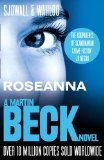
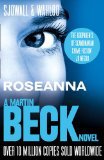
Roseanna by Maj Sjowall and Per Wahloo

Roseanna (The Martin Beck series)Translated from the Swedish by Lois Roth

Five words from the blurb: detective, Sweden, crime, strangled, boat

Martin Beck is commonly described as one of the best fictional detectives ever created and this series always tops crime fiction “must-read” lists. Roseanna is the first of ten books and I’ve been wanting to try it for a long time. I’m pleased I’ve finally read this crime classic and look forward to enjoying the rest of the series. 

The plot was quite simple, revolving around the discovery of a dead woman in a lake. The identity of her killer is quickly narrowed down to one of the 85 people on board a passenger ferry. Martin Beck uses his slow, but thorough detective skills to locate the murderer in this easy to read, but gripping narrative.

Roseanna was written in the 1960s, a golden age for crime fiction. In our Internet age there is something charming about the lack of mobile phones and the fact that it takes two weeks for messages to travel from America to Sweden.  The writing also has a gentleness that means it isn’t disturbing, no matter how violent the crime. 

Unfortunately I was a little disappointed by the ending. Despite the initial slowness of the investigation, the resolution seemed to happen too easily. I wished that there had been several suspects so the reader had the opportunity to guess whodunnit.  Instead it just seemed like a charming introduction to Martin Beck – nothing really wrong with that, but not that exciting either:

When he smiled, you could see his healthy, white teeth. His dark hair was combed straight back from the even hairline and had not yet begun to gray. The look in his soft blue eyes was clear and calm. He was thin but not especially tall and somewhat round-shouldered. Some women would say he was good looking but most of them would see him as quite ordinary. He dressed in a way that would draw no attention. If anything, his clothes were a little too discreet.

I’ve heard that the real joy of this series is seeing how Beck (and Sweden) develop over time and so although this wasn’t completely satisfying I’m still keen to try the rest of the series.

.

Have you read this series?

Were you hooked from book one?

Which books in this series did you enjoy the most?


Categories
2012 Non Fiction

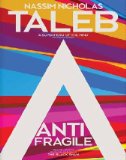
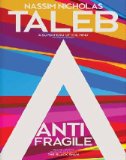
Antifragile by Nassim Nicholas Taleb

Antifragile: How to Live in a World We Don't Understand

Five words from the blurb: prediction, errors, immune, social, economic

A few years ago I read The Black Swan and was impressed by the number of thought provoking ideas it contained; so I jumped at the chance to read a review copy of Taleb’s new book, Antifragile, which is more impressive in many ways.
‘Antifragile’ is a term invented by Taleb to refer to things that improve with stress. He uses numerous examples to show how everything from human health to financial markets can benefit from small amounts of damage. He explains how the old saying “what doesn’t kill you makes you stronger” is true and how people can benefit from embracing this knowledge.

Many sections of this book were eye-opening and they helped to change my perception of certain events. I particularly liked the thought that women who carry items on their head have better posture and bone density than those that don’t:

The tradition has been to think that aging causes bone weakness (bones lose density, become more brittle), as if there was a one-way relationship possibly brought about by hormones (females start experiencing osteporosis after menopause). It turns out, as shown by Karsenty and others who have since embarked on the line of research, that the reverse is also largely true: loss of bone density also causes aging, diabetes, and, for males, loss of fertility and sexual function.

Some of the ideas, especially the thought that small wars are good for the population as a whole, are controversial, but I found them thought provoking and enjoyed the little arguments they created in my head!

Unfortunately there were several problems with this book. The first was that I felt Taleb was being overly provocative. In the book he states that authors are antifragile and any negative media about a book/author will only help sales. I felt that he was trying to maximise negative publicity by deliberately naming people he disagreed with and being quite arrogant and rude on several occasions.

Many sections of the book were also unnecessarily complex. Obscure words and a difficult sentence structure meant that some paragraphs were almost incomprehensible. I frequently re-read passages and remained unsure of the point he was trying to make.

Luckily the genius of this book outweighs the problems. I love the way Taleb has created a new way of looking at the world and even though I don’t agree with him entirely I feel as though my mind has become richer as a result of his challenging thoughts.

This video interview with him will give you a good idea of his style:

Recommended to anyone who likes new ways of looking at the world.

.

Categories
2012 Books in Translation Other Prizes

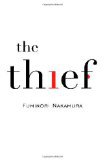
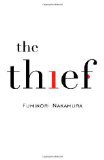
The Thief by Fuminori Nakamura

The ThiefWinner of the 2010 Kenzaburo Oe Prize

Translated from the Japanese by Satoko Izumo and Stephen Coates

Five words from the blurb: pickpocket, strangers, past, tangle, escape

The Thief is a short, engaging book about a pickpocket who targets rich people on the streets of Tokyo. It vividly captures the roller-coaster of emotion that the pickpocket goes through as he searches for a victim and then skillfully relieves them of their wallet.

I breathed in gently and held it, pinched the corner of the wallet and pulled it out. A quiver ran from my fingertips to my shoulder and a warm sensation gradually spread throughout my body. I felt like I was standing in a void, as though with the countless intersecting lines of vision of all those people, not one was directed at me. Maintaining the fragile contact between my fingers and the wallet, I sandwiched it in the folded newspaper.

Very little actually happens in this short book. The plot is quite simple and revolves around the return of someone from the pickpocket’s past.

The writing quality was excellent and I was gripped to the story throughout, but on reaching the end I was slightly disappointed. Everything was too brief for me and, although I liked the ambiguous ending, a lot of the power was lost due to the subtlety of the writing.  The use of symbolism and other literary devices meant that this book will reveal more on a second reading, but I found the number of unanswered questions a little frustrating.

This isn’t a crime novel in the traditional sense, but instead uses members of the criminal underworld to explore issues of loneliness and belonging. It is a lot more conventional than many Japanese crime novels and actually shares many similarities with last year’s Booker shortlistee, The Lighthouse

The Thief is a well structured piece of observational literature, but it isn’t for anyone who likes everything to be tied up nicely at the end. Recommended to those who enjoy shorter stories that require a bit of thought to fully appreciate them.

.

The thoughts of other bloggers:

It’s sparsely written, just like its narrator, and it’s rather beautiful. Chasing Bawa

While the crime elements are all neatly in place in this book, it works on a deeper level as well, touching on the notions of psychological and social isolation,  as well as the machinations of power and fate. The Crime Segments

This is a powerful, powerful novel. I’ll be thinking about it for a long time… Dolce Bellezza

To find more Japanese literature reviews head over to Tony’s January in Japan blog.


Categories
1930s Books in Translation Classics

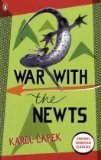
War with the Newts by Karel Capek

War with the Newts (Penguin Translated Texts) Translated from the Czech by M and R Weatherall

Five words from the blurb: humorous, newts, trade, exploitation, fight

War with the Newts was one of the titles that caught my eye when I was browsing 1001 Books: You Must Read Before You Die. I hadn’t heard of it before, but I love dystopian fiction and because the intelligent, talking newts sounded so different from anything I’d read before I ordered a copy from my library immediately. I’m so pleased that I discovered this Central European classic – it was original, entertaining and carried many important messages about our society.

The book begins with the discovery of a colony of newts in Sumatra and it is obvious that these animals are special. At first they are trained to bring up oysters; the humans taking the pearls, whilst the animals are rewarded with the shellfish. It seems like a good relationship, with both parties benefiting from the other, but mankind quickly realises that the newts can be exploited to a far greater extent. They are soon trained to build underwater structures and it isn’t long before they are being bred, sold and shipped around the world.

It formed a mass of black, squirming, confused and croaking flesh on which dull thuds kept falling. Then a gap opened between two oars; one Newt slipped away and was stunned with a blow on its neck; after it another and another, till about twenty were lying there. ‘Stop it,’ shouted our leader, and the gap between the oars closed up again. Bully Beach and the half-bread Dingo snatched up in each hand the leg of one of the senseless Newts and dragged them over the sand to the boats like lifeless logs. Sometimes the stupefied body stuck fast between the rocks; then the sailor would give a sharp and savage jerk, and the leg would come off. ‘that’s noting,’ murmured old Mike, who stood beside me. ‘Why, man, he’ll grow another one.’

This book was easy and entertaining to read, but contained important messages about human greed. The blurb states that it is an allegory of early twentieth-century Czech politics, but I think the message is far broader than that. I can see similarities with many other governments and I think the moral problems introduced are universal.

War with the Newts was originally published in 1936 and I found it interesting to see how a Czech viewed the different countries of the world at this time. Stereotypes were used continually and it was amusing to see Capek’s opinion of how each country would treat the arrival of newts.

Part of me wished that the book had been more realistic. I think the story might have had more impact if the newts had remained well-trained animals instead of a special species that learned to talk overnight, but this is a minor quibble and I can see that much of the newt-based humour would have been lost if they hadn’t had the ability to communicate.

My only real issue with the book was the footnotes – they increased as the book progressed and seemed to get longer all the time. At some points the story in the footnote was longer than the actual scene in the book. It was distracting and ruined the narrative flow.

Although this book isn’t perfect it is an important book that deserves a wider audience. Recommended.

.

Categories
2012 Books in Translation

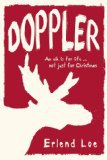
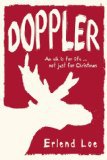
Doppler by Erlend Loe

Doppler Translated from the Norwegian by Don Shaw and Don Bartlett

Five words from the blurb: father, live, forest, elk, existence

Doppler is a lovely little book. It gripped me from the very first page and I read the entire thing in a single day. It was unusual in that it was both powerful and entertaining; a rare combination that is difficult to pull off.

The book focuses on Doppler, a man who has become frustrated with the modern world. He has decided to camp in the forest where he tries to lead an existence free from money and the irritations of television and grumpy people.

The novella begins with Doppler killing an elk in order to have something to eat. Unfortunately the elk had a calf, so feeling guilty for killing its mother, Doppler ends up looking after it. But Doppler’s wife is frustrated and wants him to return home in order to look after their children and bring in some money. The interaction between the couple was enlightening. Loe’s skill as a writer meant I had sympathy for both sides of the argument and I think this means it will appeal to a wide range of people, no matter how strong their environmental views.

The writing was simple, but effective and I found myself laughing out loud on several occasions. As a parent I understood all the cultural references and this added to my enjoyment:

I spend the entire day enthusiastically humming a melody I can’t place. I’m feeling on top of the world as I cheerfully chip away at the bark on the totem pole. Bits fly off into the forest as I work my way around the trunk, lost in my own world, humming and whistling all the while. Snatches of the lyrics begin to emerge by the evening, and I sing them quite uncritically for quite a time before I realise, in a cold sweat, that what I’m churning out is the signature tune to an Australian TV show, Bananas in Pyjamas. Not even out here in the forest am I spared the poison dart of children’s culture.

The book covered many important themes, including commercialism and our reliance on technology, but it addressed them in an entertaining way. I agreed with Doppler’s thoughts on the simple pleasure of being outdoors and think our society might be a little richer if we all followed some of Doppler’s advice.

The brevity and number of talking points make it the perfect book club choice.

Recommended to anyone looking for a short, entertaining read.

.

Categories
2009 Books in Translation Other Prizes

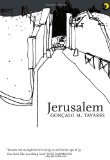
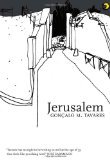
Jerusalem by Gonçalo Tavares

JerusalemTranslated from the Portugese by Anna Kushner

Five words from the blurb: lonely, together, pain, human, impulses

I hadn’t heard of Tavares until Stu listed him as one of the best writers alive today. I decided to investigate and discovered that Saramago, one of my favourite authors, was also a fan, saying:

Tavares has no right to be writing so well at the age of 35. One feels like punching him! 

That was enough evidence for me. I immediately ordered myself a copy of Jerusalem and am very pleased that I’ve now discovered this amazing author.

Saramago was right. Tavares is an extremely good writer. The quality of the prose oozes from every sentence and it is possible to find beautiful quotes on every page. The writing was simple and engaging, but the clarity made every statement somehow seem profound.

The book focused on four characters: Ernst, who is about to commit suicide; Mylia, who is terminally ill; Hinnerk, who is walking the streets with a gun, and Theodor who is studying the relationship between history and atrocity.

…my greatest fear isn’t that the end of horror might mean the end of history, like the flatline of a man who’s just died, but rather that the graph doesn’t run to either of these extremes, but instead shows nothing but stasis, a terrifying consistency of horror over time, a sustained continuo of atrocity that leaves us no hope whatsoever.

The book was quick to read, with short chapters encouraging a fast pace. There was no central plot thread, but instead the details were woven together as the characters met and revealed their connections to each other.

I loved reading the entire book, but I’m afraid it wasn’t perfect. The ending felt a bit contrived and there were times when I felt the book was trying to be too clever.

I also found that the plot had no lasting impact on me – after just a few weeks I had forgotten almost everything about it.

Luckily these were minor problems. Tavares is clearly a very talented writer and Jerusalem contained lots of original ideas. I’m keen to read the rest of his books.

Recommended.

.

Have you read any Tavares?

Are all his books this good?