Categories
2012 Chunkster Recommended books

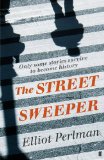
The Street Sweeper by Elliot Perlman

The Street Sweeper

Five words from the blurb: history, Holocaust, relationship, civil-rights, New York

The Street Sweeper is my favourite book of the year so far. It contains everything I love to see in a book: fantastic characters, new information, thought-provoking questions, lots of emotion, and a satisfying plot.

The book begins with Lamont Williams leaving prison after serving a sentence for a crime he didn’t commit. He finds work as a hospital cleaner in New York and befriends an old man on the cancer ward. Lamont discovers this man is a Holocaust survivor and through numerous conversations he learns about what he went through all those years ago.

Inter-weaved with this story is that of Adam Zignelli, a history professor, who is looking for a new field of research. He decides to find out whether or not black Americans soldiers were present during the liberation of Dachau. This leads to some interesting comparisons between the black Americans seeking racial equality and the Jews persecuted in Europe. 

The Street Sweeper covers many different subjects, but the overriding theme is that of history and how easily it can be forgotten.

‘History can provide comfort in difficult or even turbulent and traumatic times. It shows us what our species has been through before and that we survived it. It can help to know we’ve made it through more than one dark age. And history is vitally important because perhaps as much as, if not more than biology, the past owns us and however much we think we can, we cannot escape it. If you only knew how close you are to people who seem so far from you…it would astonish you.’

It also makes important points about how we remember the biggest events, but smaller ones are no less important, especially to those personally involved.

This book isn’t perfect. I occasionally felt that these messages lacked subtlety and key points were repeated too often, but I’m willing to forgive these as the rest of the book was so impressive.

I should warn readers that some of the Holocaust scenes were very disturbing, but I think it is important to fully understand what happened. Despite having read a number of books on the Holocaust, The Street Sweeper, looks at things from a slightly different angle (that of the Sonderkommando) and I found that most of the information was new to me.

At 550 pages long this book isn’t a quick read, but I never became bored – I was captivated from beginning to end. I was concerned about how all the different threads of the story would tie up at the end, but I shouldn’t have worried – the ending was perfect.

This book flies straight onto my list of all-time favourites. The world would be a better place if everyone read this book and understood its important message.

Highly recommended.

.

The thoughts of other bloggers:

I have learnt so much from this novel, and I already know I’ll never forget it. Book Monkey

This is a book which requires, almost demands, rereading, both for an understanding of its dense subject matter and to fully understand the intricate plotting of a novel which is almost Victorian in scope.  Tony’s Reading List

Elliot Perlman’s latest novel had me so absorbed, I just didn’t want to stop reading. ANZ Litlovers Litblog
Categories
2010 Graphic Novel

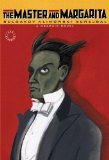
The Master and Margarita: The Graphic Novel

The Master and Margarita: A Graphic Novel (Eye Classics)

A few years ago I read The Master and Margarita, but although I enjoyed it, I felt as though a lot went over my head. When I saw the graphic novel version I decided to read it in the hope it would shed light on some of the more bizarre aspects of the book. I think it did a great job of summarising the plot, but as it can be read in less than an hour it didn’t delve into any of the more complex areas of the book.

The graphic novel is made up of both colour and black and white drawings. The style was simple, but effective:


The pictures also managed to convey Bulgakov’s satirical humor and I found myself smiling at more scenes from the graphic novel than from the original.

I think it works well as an introduction to the book. Having a brief over-view of the story will help readers to understand more of Bulgakov’s complex book – or give those who are too intimidated to try a brief glimpse into this weird world. But anyone really wanting to gain a deep insight into The Master and Margarita probably needs to study it for years.

.

Categories
2000 - 2007 Non Fiction

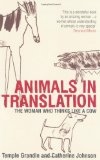
Animals in Translation by Temple Grandin and Catherine Johnson

Animals in Translation: The Woman Who Thinks Like a Cow

Five words from the blurb: autism, animal, behaviour, welfare, research

I hadn’t heard of Temple Grandin until I started doing research into autism, but it is almost impossible to go to an autism seminar without her name being mentioned several times. Her autism has given her a special insight into the way animals think and she has probably done more to improve the lives of farm animals than anyone else. Although I had heard a lot about her life and inventions I hadn’t read any of her books and so I decided it was time to change that.

Animals in Translation was her first book on animal behaviour. She has gone on to write several other books about more specific areas, but I think this is the perfect introduction to her work.

The book begins with a brief introduction to Grandin’s life and an explanation as to why animals and autistic people have a similar outlook on the world. It goes on to explain why animals behave in certain ways and how we can help them to be happier. If you’d like to know why pigs are scared of yellow things, how roosters can become rapists, and why autistic people enjoy being in a squeeze machine, this is the book for you!

Animals in Translation is interesting to both animal lovers and those wishing to learn more about autism. There are lots of little tips about dog training and this book will be especially useful to farmers who own several different species of livestock. I occasionally became bored by the focus on farm animals, longing for the odd mention of a monkey or a crocodile, but as cows and pigs are Grandin’s area of expertise I suppose this focus is understandable.

The explanations of the way autistic people see the world were insightful. It can be hard for us neurotypical people to comprehend, but this book explained the autistic outlook more clearly than any other book I’ve read on the subject.

Brief summaries of many pieces of scientific research were included, but most of the book was made up of Grandin’s own observations.

The single worst thing you can do to an animal emotionally is to make it feel afraid. Fear is so bad for animals that I think it is worse than pain……I’m sure that’s why I relate to prey animals like cattle as strongly as I do: because my emotional makeup is similar. Fear is a horrible problem for people with autism – fear and anxiety.

I didn’t agree with everything (eg. dog pack theory and the use of shock collars), but as this book was first published 12 years ago it is possible that Grandin has changed her mind on these issues too.

Temple Grandin has a special perspective on the animal kingdom and I’m looking forward to reading more of her work.

.

Temple Grandin is talking in the UK on 18th June. Members of the National Autistic Society can book tickets here. I’ve just booked a ticket and am looking forward to hearing her speak.

Have you read any of Temple Grandin’s books?

Have you ever heard her speak?


Categories
2000 - 2007 Books in Translation

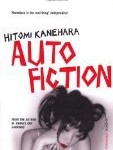
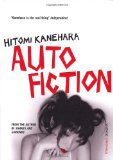
Autofiction by Hitomi Kanehara

Autofiction Translated from the Japanese by David James Karashima

Five words from the blurb: love, disturbed, woman, sinister, meaning

I love Japanese fiction and so snapped up this book when I saw it in my local library. The title refers to the practice of writing fictional autobiographies and so it is hard not to think about how much of this book has been experienced by the author. I’m hoping that Rin and Shin, the couple described in this book, are entirely fictional and that the meta-fictional elements are clever plot devices rather than descriptions of real events.

Rin is deeply in love with her husband, but she is paranoid that something will destroy their happiness. On the way home from their honeymoon she begins to suspect that her husband is flirting with a flight attendant. Her thoughts quickly escalate until she is certain her blissful life is over. The book then travels backwards in time, revealing the reasons for her overactive imagination.

I often imagine that people are trying to kill me. And by doing so, I can turn every day into a fight for survival. Nobody has a time or place where they are free from the danger of death. People forget that. People live their lives with the basic assumption that they will still be alive the day after. I can’t live like that. A plane might come crashing into me at any moment and kill me. A truck might smash into me or I might suffer a heart attack, a stroke or even a subarachnoid haemorrhage. So I’m always standing face to face with the prospect of imminent death.

I had mixed feelings about this book. I found the first and last chapters to be totally engrossing. It was fascinating to see inside Rin’s disturbed mind and by the end I understood why she had these feelings.

The central chapters were less appealing. I found her meandering thoughts difficult to engage with and felt that whole sections added nothing to the reading experience.

The writing was easy to read and, unlike a lot of similar Japanese fiction, wasn’t unnecessarily dark or scary. Some scenes could be described as emotionally disturbing, but there wasn’t any gore or graphic violence.

This is a short book, but it is an interesting addition to the field of literature that looks into the paranoid mind.

Recommended to fans of Japanese literature.

.

Have you read anything written by Hitomi Kanehara?

Is her debut novel, Snakes and Earrings, similar to this?

Categories
1960s Classics Crime Non Fiction

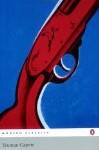
In Cold Blood by Truman Capote

In Cold Blood : A True Account of a Multiple Murder and Its Consequences (Penguin Modern Classics)

Five words from the blurb: American, family, murdered, crime, killers

In Cold Blood is a modern classic. I’d heard so many positive comments about this true crime book that I was convinced I’d fall in love with it. Unfortunately, although I can see why it played an important role in the development of the genre, I’m afraid it didn’t bowl me over.

In 1959 an American family were brutally murdered in their home. In Cold Blood describes what happened by explaining the movements of both the victims and their killers.

I’d been warned about the powerful nature of this book and so ensured that I only read it during daylight hours, but I was surprised by how little emotional impact this book had on me. The actual murder was described only briefly and never through the eyes of the victims. I was relieved that I didn’t have to witness their fear, but a part of me wished that there were more details of the murder from the perpetrator’s point of view.  It might have helped me to understand how it is possible to murder an entire family and whether they had doubts and fears about being caught. Although the motivation for the murder was eventually revealed I wished that we’d learnt more about what caused them to begin their criminal career.

The book was very well written and engaging throughout, but the fact the reader knows everything from the beginning means that there is no mystery or intrigue to move the narrative forward.

The journalistic nature of the writing style meant the reader remained detached from events. I longed to get inside the heads of the people, instead of just witnessing their actions.

Next they were interested in rope. Perry studied the stock, tested it. Having once served in the Merchant Marine, he understood rope and was clever with knots. He chose a white nylon cord, as strong as wire and not much thicker. They discussed how many yards of it they required. The question irritated Dick, for it was part of a greater quandary, and he could not, despite the alleged perfection of his over-all design, be certain of the answer.

I think my main problem is that I’ve read so many similar books. If I’d read this when it was originally published then I’m sure I’d have been impressed by creation of this new genre, but the fact that this book’s successful formula has spawned hundreds of replicas means that it doesn’t have the same impact now. This simple investigation of an individual crime, whilst shocking in its nature, failed to teach me anything new. I wanted some insight into the criminal mind or some thought-provoking questions to be raised. The sad fact is that this crime is quite ordinary nowadays. I’m not shocked by it and the tame nature of the descriptions means that I am likely to forget about it quite quickly.

It seems unfair to penalise the original book because people have copied its style so successfully, but it also seems wrong to rave about a book that is no longer the best of its genre. As a compromise I’ll give it four stars. It is a classic.

I know a lot of people love this book. Can you explain why it is so special?

Categories
2010 Non Fiction

The Great Singapore Penis Panic by Scott Mendelson

The Great Singapore Penis Panic and the Future of American Mass Hysteria

Five words from the blurb: Singapore, terrified, penis, psychiatric, hysteria

Every year The Bookseller award The Diagram Prize for the oddest book title of the year. I always enjoy looking at the shortlist, but normally just marvel at the variety of bizarre books out there. This year one title on the shortlist stood out and I was intrigued enough to try a sample chapter on my kindle. The introduction left me keen to understand why hundreds of men from Singapore thought their penises were shrinking, so I bought a copy.

In 1967 an outbreak of Koro occurred in Singapore. Koro is a frightening condition in which sufferers believe their penises are retracting.

Most often the men arrived at the hospital in a state of panic with their hand, or the hand of a loved one, firmly gripping their penis to prevent it from withdrawing up into the abdomen and killing them. Others came with their penis tightly anchored with ribbon or string.

The condition originates from Chinese folklore and isolated incidents are not uncommon, but it is unusual for so many people to succumb at once. The exact cause of this outbreak cannot be linked to a single event, but a combination of factors joined together to produce this strange reaction. The book describes the history of Singapore and all the important global events that resulted in “penis panic”.

The book goes on to describe similar conditions that arise in other countries around the world and it explains how cultural background has a strong influence on the nature of the problems experienced. Almost all of the conditions were new to me, but there was also a section on America and I was surprised to see that conditions like bulimia are specific to American society, or countries strongly influenced by it.

Unfortunately the book focused on things from a scientific perspective, noting the number of people affected on any given day and the extent of the epidemic. I longed for more personal stories and for some insight into what causes an individual to fear for their life, despite there being no real danger. I’d have prefered to read details about the situation in the hospital waiting rooms, rather than just the briefest details of which drugs the patients were given.

I also found the writing to be nothing special – it could have benefited from some editing as the same few facts were often repeated.

Despite these problems I’m pleased I read this book. It was fascinating to learn about the cultural influences on medical conditions and this final warning was particularly pertinent.

Absurd and dangerous culture bound notions are ever evolving in the United States. The use of the Internet and other lightening fast forms of social media and communication appears to be accelerating this process. There is not the slightest basis for Americans to be smug or condescending in their view of the culture bound syndromes of other societies, including Koro and the Singapore Penis Panic of 1967. In America, the next culture bound epidemic is a mouse click away.

Recommended to anyone interested in the origins of mass hysteria.

.