Categories
2011 Memoirs Recommended books

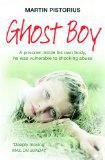
Ghost Boy by Martin Pistorius

Ghost Boy

Five words from the blurb: trapped, body, mute, control, extraordinary

Ghost Boy is probably the most inspiring book I’ve ever read. It is an autobiography explaining how the author regained the ability to communicate after being trapped inside his own body for a decade.

At the age of twelve, Martin Pistorius succumbed to a mysterious illness that left him in a coma. The doctors expected him to die, but after 4 years Martin began to regain consciousness. Unfortunately he was unable to control his movements and so couldn’t alert the people around him:

However much I tried to beg and plead, shout and scream, I couldn’t make them notice me. My mind was trapped inside a useless body, my arms and legs weren’t mine to control, and my voice was mute. I couldn’t make a sign or a sound to let anyone know I’d become aware again. I was invisible. The ghost boy.

Ghost Boy beautifully explains the frustration of being an invisible member of society. He longs to converse with people but, as everyone believes him to be unresponsive, Martin learns many secrets and has plenty of time to analyse the behaviour of those around him. This deep, extended period of thought means that he has incredible pyscological insight and I found many sections of the book profound.

The book also highlights the best and worst aspects of human nature. With passion and emotional insight, Martin describes the kindness displayed by certain members of staff; but also the terrible abuse he suffered at the hands of those who thought they could get away with it. Throughout everything, positivity oozes from the page. There is no sign of self pity, only an unflinching determination to succeed.

The small steps leading to Martin’s escape from his internal world were incredible to read and I loved seeing how his life developed once he regained the ability to communicate. Ghost Boy shows the importance of perseverance and maintaining hope. Reading about what Martin overcame and achieved makes you realise that nothing is impossible.

Highly recommended.

.

Note: I borrowed a copy of this book from my local library after seeing several articles in the media recently. You can read a brief version of Martin’s story here.
 

Categories
2015 Books in Translation

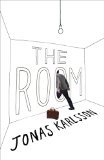
The Room by Jonas Karlsson

The Room Translated from the Swedish by Neil Smith

Five words from the blurb: colleagues, different, fable, reality, office

The Room is a short, but entertaining fable about an office worker who discovers a room that no one else can see. Björn begins a new job at the “Authority” and when trying to find the toilet he accidentally walks into a strangely calming room. He becomes increasingly drawn towards it, discovering that he is easily able to perform complex tasks whilst there. The only problem is that his new colleagues are unable to see the room and become convinced that Björn is losing his mind.

“I passed the room twice that day. Once on my way to the toilet, and once when I tidied my desk and went to put two old journals in the recycling bin. I tried not to think about it. I did my best to imitate the others and pretend the room didn’t exist. It felt utterly ridiculous. Of course there’s a room there, I thought. After all, I can see it. I can touch it. I can feel it.

This book was very easy to read and managed to combine a satire of office politics with a surreal story that questions our perception of reality. I loved the way that the bizarre circumstances were made to feel completely normal and I felt great sympathy for those on both sides of the argument.

If you’ve ever worked in an office you’ll appreciate the humorous observations about working with people with whom you have nothing in common and if you enjoy Kafka’s books then I’m sure you’ll appreciate this modern equivalent of his style. Recommended to anyone looking for something a little different.

.

The thoughts of other bloggers:

For something that sounds and appears so bare and simple it is a richly complex and refreshing read. The Literary Tree (warning this review contains spoilers)

The Room has the makings of a cult classic. Learn this Phrase

I wouldn’t be at all surprised to see this on my Books of the Year list come December. Me and My Big Mouth

Note: I couldn’t find any negative reviews of this book. I don’t know if that is because it has only just been published or because it is universally loved!

Categories
2014 Historical Fiction

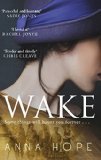
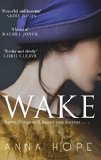
Wake by Anna Hope

Wake

Five words from the blurb: unknown, soldier, buried, women, change

Wake is set over the five-day period in 1920 in which the body an ‘unknown soldier’ was removed from a French WWI battlefield, transported to England, and then buried in Westminster Abbey. The book shows how important this remembrance service was to the British people, allowing them some closure for the suffering they’d endured as a result of WWI.

The story concentrates on three women, showing how the war impacted on their lives and how they adjusted as things began to return to normal. It was very well researched, with lots of little facts about both social and military history.

I loved the sections containing information about the unknown soldier. The descriptions of the battlefield after the war had ended were incredibly atmospheric and I enjoyed learning the details of the clean-up process – something I’d not come across before. Unfortunately I found the sections on the women less interesting – their characters lacked depth and I often struggled to tell them apart. Too much information was crammed into the book at the expense of emotional engagement and detailed character development.

I also felt that the book sometimes forgot its time period. There were several occasions when I questioned the actions of the characters as they appeared more modern than a 1920s person would be – both in terms of what they did and the dialogue they used.

I read Wake because it was selected by my book group. Everyone else enjoyed it more than I did and their passion was infectious. I found that as the book was discussed I appreciated it more. I’d thought that there were too many characters, but I began to realise that they all served a purpose. I prefer books that concentrate on a smaller cast, but I can see why others enjoyed the brief insight into the lives of a wider range of people.

“I see so many women here,” she says, “and they are holding, all of them. Holding on to their sons or their lovers or their husbands, or their fathers, just as surely as they are holding on to the table here,” she gestures with her hands. “They’re all different but all the same. All of them are afraid to let them go. And if we feel guilt, we find it even harder to release the dead. We keep them close to us; we guard them jealously. They were ours. We want them to remain ours.” There’s a silence. “But they are not ours,” she says. “And in a sense, they never were. They belong to themselves, only. Just as we belong to ourselves. And this is terrible in some ways, and in others…it might set us free.”

Overall this was a fantastic book club choice. There was a lot to discuss and we all felt that we’d gained something from having read it. Recommended for the snippets of historical knowledge and the pleasure of an avid discussion.

.

The thoughts of other bloggers:

It is beautifully and inventively written, adding something unique and genuinely enlightening to the canon of contemporary historical fiction. Book Snob

None of the protagonists were memorable enough to be thought of little more than fillers and I cringed at the tawdry motives behind unnecessary scenes. Live and Dream a Little Dream

Anna Hope’s writing was simple and straightforward, but at the same time profound. Laura’s Little Book Blog

Categories
2000 - 2007 Books in Translation

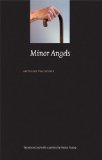
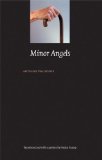
Minor Angels by Antoine Volodine

Minor Angels Translated from the French by Jordan Stump

Five words from the blurb: postcataclysmic, immortal, angels, avenging, dark

I bought a copy of Minor Angels after seeing several people (I’m afraid I can’t remember who) raving about it on Twitter. I can see why the book is highly regarded, but my opinion of it is very mixed.

Minor Angels is set in a postcataclysmic world and revolves around a nursing home where all of the residents appear to be immortal. It is narrated by 49 different angels, each given their own chapter (or narract, as the author likes to refer to them).

The book could be described in two ways:

  1. A masterpiece, which reveals more with every reading.
  2. An confusing, impenetrable piece of work.

I can’t decide which it is! The writing was outstanding and individual scenes were dazzlingly vivid, but I struggled to understand the overall concept. Each chapter was so short that the book felt fragmented and I failed to see many links between the narracts. Volodine states that the connections will only become obvious in the dreams of the reader;  but I’m unlikely to dream about it so it remains a mystery to me!

I loved the imagery of the book and admired the portrayal of the angels:

A dense arch took shape over me, formed of warm breath and arthritic hands and coarse, rutted faces. The intermingled fabrics whirled this way and that, the dust wheeled from one mouth to the other. Their words described the state of things after and before the world revolution, pelting me like falling hail. I took all this in, all these sentences, all those gutturals recounting a universal disaster, and, second by second, my understanding of the situation grew.

It all felt incredibly realistic. It’s just a shame that I failed to understand the overall concept as I’m sure a lot of the wisdom was lost on me.

Recommended to those who enjoy piecing together the symbolism in a complex set of texts.

.

Categories
2000 - 2007 Books in Translation

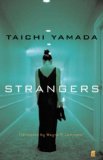
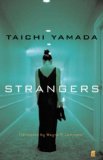
Strangers by Taichi Yamada

Strangers Translated from the Japanese by Wayne P Lammers

Five words from the blurb: ghost, parents, grief, isolation, reality

Strangers begins with Harada, a recently divorced scriptwriter, spotting a man who looks like his father. This is impossible as Harada’s parents died when he was just twelve-years-old, but a deep longing leads him to ignore this fact and he finds himself in a relationship with the parents he lost all those years ago:

A thirty-something couple could not possibly be the parents of a 47-year-old man – no, make that a 48-year-old man, as of today. But being with them had made me feel like a boy again. Of course, a boy could not have been drinking whiskey, but in a moment of alcohol-induced carelessness, I had actually addressed the man as “Dad”, and he had answered “Yeah?” exactly as if I were indeed his little boy.

Strangers is one of those rare novels that can be enjoyed on many different levels. It may simply be read as a gripping ghost story, but it also contains many layers beneath the surface and with thought it quickly becomes more complex than it initially appears.

This book encapsulates everything I love about Japanese literature. It is weird, but wonderful and contains a unique approach to literature that you won’t find in many Western novels. The simple, but powerful text seamlessly blends the Japanese spirit world with reality – creating a strangely convincing situation that the reader never questions.

I loved the way it captured the emotional intensity of grief without becoming depressing. The need for an adult man to maintain a relationship with his parents was wonderfully portrayed and I found the entire book touching. There was also a beautifully creepy atmosphere, but it retained a hopefulness and never became overbearing or scary.

The pacing of the book was perfect and I was gripped throughout. The simple, pared-back language allowed the reader to fill in the blanks and, whilst this won’t appeal to everyone, it allowed me to immerse myself in this bizarre situation. The ending was particularly satisfying and I’ll be thinking about this book for a long time to come.

Highly recommended, especially to those wanting to try Japanese literature for the first time.

.

I read this book for Tony’s January in Japan project. Head over there to find out about many more wonderful Japanese books!

Categories
2014 Chunkster Recommended books Science Fiction

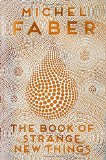
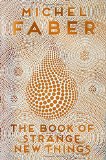
The Book of Strange New Things by Michel Faber

The Book of Strange New Things

Five words from the blurb: missionary, leaving, wife, adventure, worlds

The Book of Strange New Things is an impressive book. It is nearly 600 pages long, but the intensity of the emotion means that it never drags and so seems much shorter.

The book centres on Peter, a missionary who travels to another planet to teach Christianity to a strange new species. He leaves his wife Bea on Earth and the pair communicate via an electronic system. Bea struggles on her own, especially as things on Earth begin to go wrong. The book shows how their strong relationship begins to falter as Peter finds himself increasingly absorbed by his work.

Not much actually happens in this book, but I was completely absorbed by the couple. Having had a long distance relationship I found their shifting emotions scarily accurate.

He sighed, squeezed her hand. What was he going to do without her, out in the field? How would he cope, not being able to discuss his perceptions? She was the one who stopped him coming out with claptrap, curbed his tendency to construct grand theories that encompassed everything. She brought him down to earth. Having her by his side on this mission would have been worth a million dollars.

The world-building was fantastic. The vivid descriptions enabled me to visualise the new planet and I found the quirky differences between our world and theirs entirely believable. The alien species were particularly well observed and I loved the way the human’s interactions with them highlighted the problems within our society.

My only issue with the book was the occasional excess of religious quotation. I thought the discussions on faith were well done, but my eyes tended to glaze over when the bible extracts became excessive. Luckily this only happened a handful of times and I suspect that anyone with an interest in Christianity will find these much more inspiring than I did. 

Overall this was a fantastic book. I loved the fact I didn’t know where the story would take me and found the ambiguous ending particularly satisfying. Recommended to those who enjoy vivid character studies, packed with emotion.

.

The thoughts of other bloggers:

The real problem, it dawns on you as you read, is that Faber just isn’t that interested in his alien Others. Sibilant Frictive

…one of the best novels I’ve read this year. S Krishna’s Books

In fact, The Book of Strange New Things is a novel that skirts the edge of one cliché after another only to either bypass them or—more impressively—reinvest them with emotional significance. Reading in the Growlery