Categories
1950s 1980s Books in Translation Nobel Prize

Two Abandoned Nobels

The Piano Teacher Translated from the German by Joachim Neugroschel

The Piano Teacher by Elfriede Jelinek

Elfriede Jelinek won the Nobel Prize for Literature in 2004

Five words from the blurb: Vienna, emotional, self-destruction, intensity, porn

The Piano Teacher is an unrelenting, intense tale of one woman’s self-destruction.

Erika is a piano teacher who lives with her controlling mother. She begins an affair with one of her young students, but he cannot save her from her destructive cycle of self-harm.

I initially loved the gripping, emotionally charged narrative, but I quickly found I needed space to breathe, wishing there were some breaks from the darkness. I then began to find the narrative style, with its capitalised pronouns, irritating:

SHE only has to glance at this scene, and HER face instantly becomes disapproving. SHE considers her feelings unique when she looks at a tree; she sees a wonderful universe in a pinecone.

As the book progressed it became increasingly dark and sexually explicit. I found the scenes of her self-harm uncomfortable to read and her trips to watch pornographic shows held little interest.

I skimmed over several sections and then decided to give up entirely. This book has a grippingly original narrative voice, but it was too harsh for me.

Recommended to those with a strong stomach.
 

The Tin Drum (Vintage Classics)Translated from the German by Ralph Manheim

The Tin Drum by Günter Grass

Günter Grass won the Nobel Prize for Literature in 1999

Five words from the blurb: Germany, Nazis, dwarf, scathing, horrors

The Tin Drum is one of those classics that had intimidated me for far too long. Inspired by German Literature month I decided to set my fears aside and give this imposing chunkster a try. Unfortunately, in this case, the intimidation was justified and I failed to finish this complex, multi-layered masterpiece.

The Tin Drum is narrated by Oskar, a dwarf with learning difficulties who calms himself by beating his toy drum. I’d love to be able to tell you what happens, but I’m afraid I can’t:

a) because very little happens
b) I didn’t get that far into the book

The writing was impressive and I loved Oskar’s character, but the book had very little narrative drive. It skipped from one scene to the next and I struggled to see the connection between them.

I crawled at a snail’s pace through the first 100 pages, becomingly increasingly bored. After another difficult 20 pages I decided to abandon it. I’m sure that this book is a masterpiece and everything makes sense in the end, but I don’t think I’m in the right stage of life to appreciate it. I think I’ll give it another try in twenty years.

Have you tried reading either of these books?
 

Categories
2000 - 2007 Booker Prize

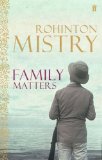
Family Matters – Rohinton Mistry

Family Matters: 1

A Fine Balance is my favourite book and so you’d have thought I’d have gone out and read all of Mistry’s books straight away. The reality is that I was too scared to read them – I knew my expectations were far too high and didn’t want to be disappointed. I eventually built up the courage to try Family Matters and although it isn’t in the same league as A Fine Balance, I wasn’t disappointed.

Family Matters has a much narrower scope than A Fine Balance. It follows a single family as they struggle to look after their father, Nariman; an old man who suffers from Parkinson’s and then becomes immobile after a fall. Trapped in his bed Nariman feels the terrific burden he has placed on his family. They struggle to afford his medicines and find it physically draining to care for him.

The characters come alive on the very first page and I felt immense sympathy for everyone involved – the relationship between Nariman and his grandson was especially touching. There were times when I longed for the plot to move beyond the family, but the fact that I was happy observing such mundane scenes for the majority of the book shows Mistry’s talent as a writer.

The sights and sounds of India were vividly described and Mistry has an amazing ability draw attention to the little things and give them a whole new depth.

In the flower stall two men sat like musicians, weaving strands of marigold, garlands of jasmine and lily and rose, their fingers picking, plucking, knotting, playing a floral melody.

I strongly recommend that you read A Fine Balance, but once you’ve read that I think you’ll appreciate this subtler insight into the problems faced by one Indian family.

Recommended.

.


Categories
Booker Prize Other

The Booker Prize Announcement

Last night the Booker Prize was awarded to Julian Barnes for Sense of an Ending and although I didn’t enjoy it I was pleased because I thought it was the most deserving book on the shortlist.

The Sense of an Ending

In the run up to the prize announcement I normally do a prediction post, but as you’ve probably seen there has been a lot of debate about the Booker judges this year and with their comments about wanting a readable book that would “zip-along” I honestly had no idea which book they’d pick. It was good to see that they chose the most literary book on the short list and I hope next year’s prize courts less controversy.

Independent Alliance Man Booker Prize Party

Last night I was lucky enough to attend a Booker Prize party organised by four of the publishers on the short list (Atlantic, Canongate, Serpent’s Tail and Granta). It was quite a daunting experience as I knew no-one there. The situation was made harder by the fact that everyone else seemed to know each other, but after nearly bolting for the door I summoned up the courage to speak to people and had a fantastic evening.

I spoke to the editor of Half Blood Blues, several publishers and I had a very interesting conversation with someone from a marketing agency about blogs, social media and viral marketing. As the prize announcement drew nearer I spoke to Carol Birch’s son and was surprised to discover that short listed authors only get to take one guest along with them to the official prize giving ceremony.

Live Booker coverage was broadcast to the party on a big screen and everyone watched nervously. A few people booed Stella Rimington’s speech and there was quite a bit of heckling – everyone was far better behaved at the real Booker announcement! When Julian Barnes was declared the winner the entire room seemed to sigh in unison. There was no booing (or clapping) just a weird feeling of sadness from everyone in the room. After the news had sunk in we got back to drinking and talking. It was a bit strange to have a party without the authors we were celebrating, but everyone had a fantastic time.

I look forward to seeing which books are selected for the Booker next year and will be enjoying a bit more random reading over the next few months.


Categories
1990s Orange Prize Thriller

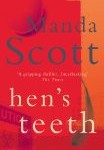
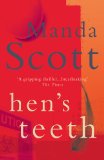
Hen’s Teeth – Manda Scott

Hen's Teeth Short listed for 1997 Orange Prize

Five words from the blurb: mysteriously, dead, hens, scientists, Glaswegian

Hen’s Teeth is a thriller set on a farm near Glasgow. One of the farm’s owners is discovered to have died from a heart attack, but because her brother died in the same way, just two weeks earlier, her friends are convinced that both deaths are suspicious and they set out to discover who killed them. The only clue they have to go on is the mysterious theft of the hens…

I found this book very engaging and flew through it in just two days. The central characters were well formed and I loved the way we were given details of their back story. I also liked the way that the central characters were gay, but the relationships were portrayed so naturally that the reader barely notices.

As a former vet Manda Scott does a fantastic job with the science in this book. I often complain that science isn’t handled very well in fiction, but this book is one of the few that includes it in an intelligent way, without scaring the average reader.

My only complaint is that many aspects of the plot were far too convenient. The characters just happened to know exactly the right person to solve every problem they encountered and some of the plot points were a bit far fetched for me (the scene with guard dogs had me rolling my eyes the most!).

Despite these criticisms I found Hen’s Teeth very entertaining and I’m keen to try Manda Scott’s other books.

.

Have you read anything by Manda Scott?

Her Boudica books look especially interesting. Do you think I’d enjoy them?


Categories
2011 Booker Prize

Half Blood Blues – Esi Edugyan

Half Blood Blues Short listed for 2011 Booker Prize

Five words from the blurb: Berlin, black, betrayal, cabaret, secrets

Half Blood Blues begins in 1940s Paris and follows the members of a jazz band who have fled to the city to escape the Nazi regime. The star of the band is Hiero, a trumpet player of outstanding talent. But as a black man of German origin he finds that Paris soon becomes just as dangerous as the German home that he left behind. The other band members, Sid and Chip, are African-Americans, but as US citizens they have less to fear. The story follows Sid and Chip as they reunite fifty years later and begin deal with the guilt they feel for the events that took place in Paris all those years ago.

This book has a fantastic atmosphere. The dialect instantly transports you into the lives of this little known section of society.

A real racket started up across the street. I looked up to see Hieronymus yanking on the bug’s door like he meant to break in. Like he reckoned he got the power to pop every damn lock in this city. When it didn’t open, what did he do but press his fool face up to the glass like a child. Hell, though, he was a child. Stupid young for what he could do on a horn. You heard a lifetime in one brutal note.  

Initially I found the writing very engaging, but it did lose some momentum in the central section. This slight lull in plot was quickly forgotten as I reached the final pages – I loved the emotional ending.

Despite these positives I didn’t fall in love with this book. I think this is mainly due to the fact that I am not a big lover of music, especially jazz. I’m sure that anyone with an interest in the jazz scene will enjoy this book a lot more than I did.

My second problem was that although this book covered a refreshingly different section of society it basically tells the same type of WWII story that I’ve read many times before.

If you are a jazz fan then I highly recommend this book to you, but tread carefully if you’re after literary depth or a new way of looking at the world.

.

The thoughts of other bloggers:

I can’t say I really connected with the characters. Lucy Bird Books

I like little corners of  World war two, like this one…. Winstonsdad’s Blog 

Despite plenty of research, the story seems to lack veracity… The Art of Fiction 

Categories
Booker Prize Other

The 2011 Booker Prize Short List

The 2011 Booker short list has just been announced as:

(all links go to my thoughts on each book)

The Sisters Brothers by Patrick deWitt

Half Blood Blues by Esi Edgyan

Jamrach’s Menagerie by Carol Birch

The Sense of an Ending by Julian Barnes

Pigeon English by Stephen Kelman

Snowdrops by A.D. Miller DNF


SnowdropsThe Sisters BrothersPigeon English

Half Blood Blues: From Berlin to Paris. Two Friends. One BetrayalThe Sense of an EndingJamrach's Menagerie

I predicted 4/6 correctly, so can’t say I was very surprised by the announcement; although I must have failed to see something in Pigeon English, as I predicted it would be the book least likely to make the cut.

I’m pleased I can now put the Booker prize behind me for another year and concentrate on some more random reading.