Categories
2012 Other

Two Gripping Reads

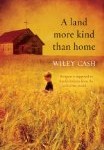
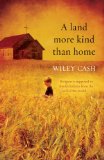
A Land More Kind Than Home

A Land More Kind Than Home by Wiley Cash

Five words from the blurb: autistic, violence, tragic, religion, family

A Land More Kind Than Home is set in North Carolina and follows the family of Christopher, an autistic boy who is murdered during a church service. The book is based on real events and reveals the shocking way in which some people use religion to justify their horrific actions.

“Then you should know Matthew 9:33.” he said. “If you know your Bible, then you should know it says that ‘when the demon was driven out, the man who had been mute spoke.’ And I reckon you should probably know Matthew 17 too, about the man who brought his son to Jesus because he was sick with a disease brought on by a demon and the disciples didn’t have the faith enough to heal him.”
“I know both of them stories,” I said. “I’ve read them both many, many times.”
“They ain’t no stories,” he said. “You can believe me when I tell you that.” This book was captivating throughout.

The pace was perfect and it was packed with atmosphere, allowing the reader to become immersed in southern American life.

The characters were well drawn and I felt a deep empathy for the entire family. My only criticism is that the book focused on the grieving family. Their reaction to the murder of Christopher was sensitively portrayed and moving, but I longed to hear from the other members of the congregation. I wanted to know how they felt about the murder of a child and why they allowed it to happen in front of their eyes. Hearing things from the point-of-view of the murderer would also have added another dimension to the story.

The story was engaging, but its simplicity meant that I ended the book feeling a little disappointed. I’m afraid I like my books to be a little more complex.

 .
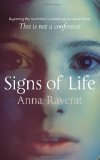
Signs of Life

Signs of Life by Anna Raverat

Five words from the blurb: affair, memory, incomplete, control, truth

Signs of Life is narrated by Rachel. Ten years ago she had an affair that went terribly wrong. The book reveals what happened all those years ago in a narrative so gripping it was impossible to put down.

The plot was fast paced, with hints as to what happened sprinkled through the text. The narrative jumped forwards and backwards in time, but the story was easy to follow and although it was sometimes deliberately misleading, I was never confused as to what was happening.

The writing was simple and direct, but there were a few deeper thoughts to keep literary fiction fans happy.

“I don’t know where the line is between passion and obsession but I think obsession is passion that gets stuck.
Perhaps boundaries are like horizons; not fixed, they move as you move, like the end of the rainbow. It’s like trying to see when water turns to steam – you can never find that precise moment.

Unfortunately everything went downhill at the end. The build-up was fantastic, but the final few pages left me asking “Is that it?” I was expecting something something much more complex/clever.

If you loved Before I Go to Sleep then I suspect you’ll enjoy this, but I’m afraid I was a little disappointed.

.
Categories
2012

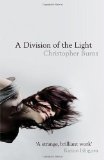
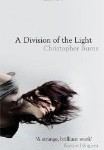
A Division of the Light by Christopher Burns

A Division of the Light

Five words from the blurb: woman, robbed, witnessed, camera, changed

I am heavily influenced by endorsements from certain authors and I’d probably have avoided this book if it hadn’t received a rare endorsement from Kazuo Ishiguro. A story about an obsessive photographer didn’t appeal to me, but having read it I have to agree with Ishiguro – A Division of the Light is

A strange, brilliant work

The book begins with a woman being mugged on a quiet street. The event is witnessed by Gregory, a successful photographer. Instinctively Gregory takes several photographs of the crime and becomes obsessed by the photogenic nature of this ordinary woman. He persuades her to meet him again and over several months the pair form an awkward, but realistic relationship.

The story is quite simple, but I was captivated by the vivid imagery. 

It is not the crime that excites the photographer’s attention, but a chance configuration of shape and texture – the smooth opacity of the lenses, the knotty tension in the victim’s hands, the summer clothing rubbed along the ground. These, and the dishevelled hair that screens a face he cannot quite see and that could so easily have smashed into the pavement.

Describing individual photographs is a difficult task for a novelist, but Burns made the images come to life. I could picture the beauty of Gregory’s work and grew to admire his obsessive search for the perfect image.

The author lives in West Cumbria and mentions places like Sampson’s Bratfull. I used to live in the same area and so appreciated the descriptions of the rugged countryside. But although the author is English this book doesn’t feel as though it originates from this country, it has a universal feel that is hard to explain. If pushed I’d say this book has a Japanese outlook mixed with cosmopolitan European influences. If that sounds strange, that is because it is! I haven’t read anything quite like it. This is one of those special books that is gripping and easy to read, yet stands up to deep scrutiny.

My only criticism is that all the passion revolved around the photography – I longed for the people to come alive in the same way. I was interested in what happened to the characters, but never really cared about them. In the end this was a minor problem and I thoroughly enjoyed reading this book. 

The quiet, simple plot won’t be for everyone, but if you appreciate vivid writing you’ll find a lot to admire. If I was a Booker judge, I’d put this on the longlist.

.

Categories
1960s Classics Crime Non Fiction

In Cold Blood by Truman Capote

In Cold Blood : A True Account of a Multiple Murder and Its Consequences (Penguin Modern Classics)

Five words from the blurb: American, family, murdered, crime, killers

In Cold Blood is a modern classic. I’d heard so many positive comments about this true crime book that I was convinced I’d fall in love with it. Unfortunately, although I can see why it played an important role in the development of the genre, I’m afraid it didn’t bowl me over.

In 1959 an American family were brutally murdered in their home. In Cold Blood describes what happened by explaining the movements of both the victims and their killers.

I’d been warned about the powerful nature of this book and so ensured that I only read it during daylight hours, but I was surprised by how little emotional impact this book had on me. The actual murder was described only briefly and never through the eyes of the victims. I was relieved that I didn’t have to witness their fear, but a part of me wished that there were more details of the murder from the perpetrator’s point of view.  It might have helped me to understand how it is possible to murder an entire family and whether they had doubts and fears about being caught. Although the motivation for the murder was eventually revealed I wished that we’d learnt more about what caused them to begin their criminal career.

The book was very well written and engaging throughout, but the fact the reader knows everything from the beginning means that there is no mystery or intrigue to move the narrative forward.

The journalistic nature of the writing style meant the reader remained detached from events. I longed to get inside the heads of the people, instead of just witnessing their actions.

Next they were interested in rope. Perry studied the stock, tested it. Having once served in the Merchant Marine, he understood rope and was clever with knots. He chose a white nylon cord, as strong as wire and not much thicker. They discussed how many yards of it they required. The question irritated Dick, for it was part of a greater quandary, and he could not, despite the alleged perfection of his over-all design, be certain of the answer.

I think my main problem is that I’ve read so many similar books. If I’d read this when it was originally published then I’m sure I’d have been impressed by creation of this new genre, but the fact that this book’s successful formula has spawned hundreds of replicas means that it doesn’t have the same impact now. This simple investigation of an individual crime, whilst shocking in its nature, failed to teach me anything new. I wanted some insight into the criminal mind or some thought-provoking questions to be raised. The sad fact is that this crime is quite ordinary nowadays. I’m not shocked by it and the tame nature of the descriptions means that I am likely to forget about it quite quickly.

It seems unfair to penalise the original book because people have copied its style so successfully, but it also seems wrong to rave about a book that is no longer the best of its genre. As a compromise I’ll give it four stars. It is a classic.

I know a lot of people love this book. Can you explain why it is so special?

Categories
2010 Non Fiction

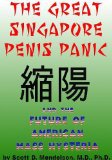
The Great Singapore Penis Panic by Scott Mendelson

The Great Singapore Penis Panic and the Future of American Mass Hysteria

Five words from the blurb: Singapore, terrified, penis, psychiatric, hysteria

Every year The Bookseller award The Diagram Prize for the oddest book title of the year. I always enjoy looking at the shortlist, but normally just marvel at the variety of bizarre books out there. This year one title on the shortlist stood out and I was intrigued enough to try a sample chapter on my kindle. The introduction left me keen to understand why hundreds of men from Singapore thought their penises were shrinking, so I bought a copy.

In 1967 an outbreak of Koro occurred in Singapore. Koro is a frightening condition in which sufferers believe their penises are retracting.

Most often the men arrived at the hospital in a state of panic with their hand, or the hand of a loved one, firmly gripping their penis to prevent it from withdrawing up into the abdomen and killing them. Others came with their penis tightly anchored with ribbon or string.

The condition originates from Chinese folklore and isolated incidents are not uncommon, but it is unusual for so many people to succumb at once. The exact cause of this outbreak cannot be linked to a single event, but a combination of factors joined together to produce this strange reaction. The book describes the history of Singapore and all the important global events that resulted in “penis panic”.

The book goes on to describe similar conditions that arise in other countries around the world and it explains how cultural background has a strong influence on the nature of the problems experienced. Almost all of the conditions were new to me, but there was also a section on America and I was surprised to see that conditions like bulimia are specific to American society, or countries strongly influenced by it.

Unfortunately the book focused on things from a scientific perspective, noting the number of people affected on any given day and the extent of the epidemic. I longed for more personal stories and for some insight into what causes an individual to fear for their life, despite there being no real danger. I’d have prefered to read details about the situation in the hospital waiting rooms, rather than just the briefest details of which drugs the patients were given.

I also found the writing to be nothing special – it could have benefited from some editing as the same few facts were often repeated.

Despite these problems I’m pleased I read this book. It was fascinating to learn about the cultural influences on medical conditions and this final warning was particularly pertinent.

Absurd and dangerous culture bound notions are ever evolving in the United States. The use of the Internet and other lightening fast forms of social media and communication appears to be accelerating this process. There is not the slightest basis for Americans to be smug or condescending in their view of the culture bound syndromes of other societies, including Koro and the Singapore Penis Panic of 1967. In America, the next culture bound epidemic is a mouse click away.

Recommended to anyone interested in the origins of mass hysteria.

.

Categories
2012 Crime Mystery

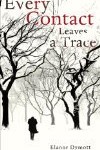
Every Contact Leaves a Trace by Elanor Dymott

Every Contact Leaves A Trace

Five words from the blurb: wife, murdered, Oxford, mystery, past

Every Contact Leave a Trace is an atmospheric murder mystery set within the grounds of an English University. The book begins with Alex discovering the body of his wife, Rachel, by a lake in Worcester College, Oxford. Access to the college is restricted so only a limited number of people were capable of committing the crime, but police investigations draw a blank. Stricken with grief, Alex sets out to discover the truth behind her death, leading him to realise that he knew far less about his wife’s life than he thought.

The enclosed setting reminded me of The Moonstone; the pace and writing style also shared similarities with this classic piece of crime fiction. Anyone looking for a fast paced thriller will be disappointed as this is a carefully constructed book that demands concentration.

The majority of the plot is revealed through Alex’s interviews with the other characters. The reader must decide whether discrepancies between the stories are due to lies, attempts to protect others from hurt, or simply different perspectives of the same event. The solution to the crime isn’t really the point of this book, the main emphasis is on relationships formed at university and how people can display different aspects of their personality depending on which situations they are faced with.

The pace is very slow and I want to criticise this, but I grew to love its teasing nature.  The continual stalling lead to a gripping narrative, perfectly crafted to keep the reader hooked and guessing  until the final pages.

He asked me if I’d like something to eat with my tea before he began again, seeing as it was lunchtime, and when I said yes, he went off into his side room to prepare it. I sat back in my chair and listened to him moving about, clattering a knife on a plate and opening and closing the door of his fridge. I allowed my mind to become a blank canvas once more, ready for him to take his brushes to it.

The central characters all studied English so there are plenty of literature references to satisfy those looking for deeper symbolism, especially those with a knowledge of Robert Browning.

My only real criticism is that the book gives no real descriptions of Oxford. Trees are beautifully depicted, but the spires of Oxford are almost entirely ignored – the college setting being a convienient plot device rather than a vivid backdrop to the story.

On a more positive note, this book has a striking design and the deep red page edges are hard to ignore.

This is a compelling mystery and I highly recommend it to anyone looking for an intelligent page turner.

.


Categories
2012 Books in Translation Memoirs

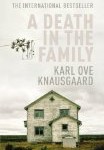
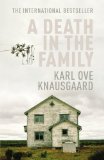
A Death in the Family by Karl Ove Knausgaard

A Death in the Family Translated from the Norwegian by Don Bartlett

Five words from the blurb: childhood, teenage, Norway, father, death

Karl Ove Knausgaard is a publishing phenomenon in Norway. His controversial fictional memoir has dominated the best seller lists there for the last three years. The discussions about this book intrigued me and so I made a note of the title, keen to read it once the English translation appeared. An unsolicited review copy dropped through my letter box and so I was lucky enough to read this before publication, but it was only once I’d finished reading it that I discovered that this is actually the first of six books, totalling over 3000 pages.

A Death in the Family covers Karl Ove Knausgaard’s childhood and teenage years. Very little happens, but the writing is so vivid that this doesn’t really matter. I’m normally bored by simple coming-of-ages stories, but the insight and tiny details brought this book to life. I think this is one of the best pieces of writing I’ve ever come across and I can only imagine the fantastic book he’d produce if the subject matter was more exciting.

The quality of the writing is so good that it is possible to open the book randomly and find a good quote. On top of the realistic portrayal of family life there are thought provoking philosophical questions and advice about being a writer:

You know too little and it doesn’t exist. You know too much and it doesn’t exist. Writing is drawing the essence of what we know out of the shadows.

I think this book will have greater appeal to men because they’ll have experienced most of the events and so have the ability to reminisce about their childhood. The masculine outlook on life will be of interest to women, but there wont be the same level of connection.

I wouldn’t knowingly start a 3000 page autobiography about a Norwegian writer, but now that I’ve read the first section I am keen to read the rest. I’m sure that his adult life will contain more complexity than his childhood, but even if it doesn’t I’ll be happy learning about Knausgaard’s outlook on life.

Recommended to anyone who appreciates great writing.

.

After reading this book the majority of Knausgaard’s family no longer have anything to do with him. You can read more about the controversy surrounding this book here.