Categories
2010 Non Fiction

Little Princes by Conor Grennan

Little Princes: One Man's Promise to Bring Home the Lost Children of Nepal

Five words from the blurb: Nepal. children, volunteer, reunite, families

Earlier in the year I asked people to name their favourite narrative non-fiction books. Little Princes was mentioned by so many people that I felt I had to get a copy. Having read it I can see why they love it – Little Princes is an inspiring example of how much one person can achieve when they have the motivation and determination to do so.

Conor Grennan was twenty-nine-years-old when he realised he needed more excitement in his life. He quit his day job and decided to go travelling around the world for a year. In order to impress his friends he registered to volunteer at an orphanage in Nepal for the first three months, but once there he fell in love with the children and couldn’t abandon them. He has spent the rest of his life doing everything he can to help these vulnerable children, occasionally risking his life to do so.

I loved Conor’s honest, friendly approach to life. He made no attempt to hide the more selfish areas of his personality and it was wonderful to see his attitude to life change over the course of the book. 

His writing was engaging throughout and packed with emotion.  

If walking into the responsibility of caring for eighteen children was difficult, walking out on that responsibility was almost impossible. The children had become a constant presence, little spinning tops that splattered joy on everyone they bumped into. I would miss that, of course. But the deeper sadness, the deluge of emotion, came from admitting that I was walking out on them. 

It was perfectly paced and I loved the way it was structured to ensure that the information was revealed slowly, creating a compelling narrative that hooked me throughout. I especially loved Conor’s trek into the mountainous area of Nepal. It reminded me of the fabulous book, Touching The Voidand I had my heart in my mouth throughout this section.

If I’m forced to criticise this book I’d say that it occasionally gets a bit too sentimental, but when faced with the joy of little children I guess that is hard to avoid and I’m willing to forgive it.

This book does a fantastic job of highlighting the problem of child trafficking in Nepal. It is heartwarming and inspiring.

Highly recommended.

.

The thoughts of other bloggers:

It made me laugh out loud and moved me to tears. S. Krishna’s Books

…the moving, memorable story of an unexpected hero in an unlikely place… The 3 R’s Blog

…a remarkable, heart-breaking and heart-warming book. The House of the Seven Tails

Categories
2000 - 2007

The Carhullan Army by Sarah Hall

The Carhullan Army Note: This book is also known as Daughters of the North

Five words from the blurb: escape, repressive, world, women, remote

I loved Haweswater and How to Paint a Dead Man, so have been keen to try some of Sarah Hall’s other books. The Carhullan Army is a dystopian novel, set in the near future. Like her other novels it is set in Cumbria and follows a young women as she decides to leave her home town of Rith (Penrith) and seek out a group of women living outside the controls of the repressive government, on the Lake District Fells.

I loved the beginning of this book. As usual Sarah Hall’s writing was of a very high standard, creating a vivid world packed with oppressive atmosphere.

It was hard to imagine all the people behind the bricks, sleeping two and three to a room, or lying awake, talking softly so as not to disturb the other families. Some of them crying, being comforted or ignored. Some not caring who heard them through the walls, pushing away from a sore body as the hits of cheap ephedrine began to wear off. Each time I had ventured out in preparation, these dawns seemed to have an atmosphere of reduction, as if there had been a cull, not a condensing of the people.

Unfortunately things went downhill as the book progressed. Once the women on the fells had been found the plot died and I lost interest in what was happening. The focus of the book turned to the relationships of the women, but they hadn’t been introduced in enough depth for me to care about them. Some sex scenes (both lesbian and straight) were thrown in, but they added nothing to the plot.

The ending of the book was very strange. Some fantastic plot elements were reduced to a single paragraph when they would have benefited from being developed into entire chapters. It all felt rushed and a bit of an anticlimax after all the build up.

I’m afraid that this book didn’t add any original ideas to the dystopian genre and although it contained a few fantastic scenes I’d recommend reading Sarah Hall’s other novels instead.

.

The thoughts of other bloggers:

gripping from the beginning to the end. Vishy’s Blog

With a bit of a polish it would make a good TV series. The Marple Leaf

Carhullan Army is a quietly powerful novel that lives long in the mind. Follow the Thread


Categories
2011 Commonwealth Writer's Prize

The Book of Answers by C. Y. Gopinath

The Book of Answers Shortlisted for 2012 Commonwealth Writers’ Prize

Five words from the blurb: India, satire, world, problems, society

The Book of Answers is a clever satire of society. It shows how willing people are to look for the easy answer to their problems and how politicians can be made to believe anything if it helps their career.

The book begins with Patros, an ordinary Indian man, inheriting a mysterious metal box. This box is said to hold a book containing answers to all the world’s problems.  The responsibility of owning this object becomes too much for Patros so he sells it, only to see it turn up in the hands of a godman a few months later. This godman soon finds himself advising the top politicians in the land. The only problem is that Patros knows the key to the box is hidden in Kerala, so the godman must be inventing every one of his ideas.

I often struggle with political satire, especially ones that originate from other countries, because I don’t know enough about the political parties involved. This wasn’t the case for The Book of Answers and I think this is because it can be seen as a parody of governments in general, rather than of a specific regime. The blind faith that officials put in their advisers can also be seen in many large companies and so I think this book will appeal to people whether they have an interest in politics or not.

The main joy of this book is the large number of cleverly formed ideas. In many ways it reminded me of The Fat Years by Chan Koonchung, a book containing many ideas that sound ridiculous, but turn out to have happened already. I don’t think that any of ideas in The Book of Answers have been implemented yet, but it wouldn’t surprise me if some of the less controversial ones were debated in the next few years. 

“We’ve been googling since early 2000. Today’s rules are different. You don’t have to know anything any more; you only have to know where to find it.” The Mahajan Commission recommended a more “user-friendly” approach, named Ambient Solution-Seeking or ASS. Answers to all exam questions would be in the Head Clerk’s safe, one set per examinee in sealed envelopes. To receive his envelope, each student had to find his key question – What is the capital of Nauru? What is the difference between manzanilla and manzanita? and so on. These quiz questions, written on chits of thick paper and inscribed with the target student’s name, were hidden in choice venues around the examination hall: behind toilet cisterns; within the sand in cuspidors; below the Head Clerk’s paperweight; inside vacuum-sealed packets of wafers; and within the paper cones in which peanuts are sold outside college gates. The student resourceful enough to find his key question and answer it correctly would receive the answers envelope from the head clerk and sail through the exams.

Sometimes the jokes were quite subtle and I’m sure this book would benefit from a re-read to pick up on everything.

This book wasn’t perfect – it lost some of its narrative drive in the middle and could have done with some editing to make the transition between some of the scenes smoother, but on the whole it was an enjoyable, entertaining read.

Recommended to anyone looking for something a little bit different!

..

Unfortunately this book isn’t published in the UK/US. I was lucky enough to receive an e-copy from the author, but it is possible to download it from Smashwords or Amazon.
.

The thoughts of other bloggers:

…a thoroughly readable and thought-provoking book. Eleutherophobia

Behind the humour, there is a very serious message about the nature of power corrupting and the inability of democracy…. Tony’s Reading List

This book reminded me partly of Monty Python’s “The Life of Brian, The Parrish Lantern


Categories
2012 Books in Translation Non Fiction Recommended books

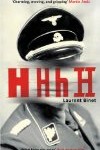
HHhH by Laurent Binet

HHhH Translated from the French by Sam Taylor

Five words from the blurb: mission, assassinate, Nazi, novelist, truth

There has been a lot of hype surrounding this book, but it is all justified. HHhH breaks the mould, creating a new genre that will change the way you look at non-fiction and lead you to question the accuracy of everything you read.

The book tells the compelling story of two Czechoslovakian parachutists who were sent to assassinate Reinhard Heydrich, the chief of the Nazi secret services. Dropped near Prague in 1942 the pair spend months plotting the event, relying on the support of a secret network of people. The book also charts the rise of Heydrich, explaining the important role he had in the creation of the Nazi death camps.

Throughout the book the author explains the research he did to obtain each fact and ensures that nothing is ambiguous. To retain the gripping narrative style Binet frequently makes things up, but every time he does so the passage will be followed by one that explains exactly which parts were fabricated:

That scene, like the one before it, is perfectly believable and totally made up. How impudent of me to turn a man into a puppet – a man who’s been dead for a long time, who cannot defend himself. To make him drink tea, when it might turn out that he liked only coffee. To make him take the bus, when he could have taken the train. To decide that he left in the evening, rather than the morning. I am ashamed of myself.

I loved this honesty and it made me realise how many difficult choices authors of historical fiction must make each time they write a scene.

I love meta-fiction and so appreciated the way the author addressed the reader directly. His chatty style was easy to read and often amusing. He made some blunt, often scathing, comments about other historical fiction authors, but although I didn’t always agree with him, it was refreshing to read about someone not scared to voice their opinion.

I’ve seen a few comments about people avoiding this book because of the Holocaust connections, but although the death camps were mentioned, this book does not describe them in graphic detail. It isn’t a depressing book; it is a gripping story revolving around whether or not the parachutists will be successful in their mission. It does take a while for the pace to build, but the final few chapters were some of the most exciting I’ve ever read. I couldn’t put it down and was totally engrossed in the story of these men.

HHhH shares many themes with The Street Sweeper, but unlike that amazing book, this is flawless. HHhH has leaped over The Street Sweeper to become my favourite read of 2012 so far.

Highly recommended.

.

The thoughts of other bloggers:

I kept finding myself frustrated. Just when a section of non-fiction was beginning to really grip an authorial intervention would break the spell.  Just William’s Luck

The style is an unusual construction, but for me it was highly effective and extremely engaging. The Little Reader Library

I remain, however, equally fascinated and irritated by this volume – I still can’t call it a novel. Gaskella

Categories
2012 Non Fiction

Quiet by Susan Cain

Quiet: The power of introverts in a world that can't stop talking

Five words from the blurb: introvert, extrovert, divide, theory, society

Quiet is a book that analyses the way introverts are treated in America. It aims to raise the self confidence of quiet people and prove that they have a vital role in society.

In the book Susan Cain, a self-proclaimed introvert, explains how she conquered her fear of public speaking and embraced her quiet thoughtfulness to become a successful lawyer. The book combines her personal journey of self discovery with scientific research, but it was all easy to read and never got too technical.

But introverts seem to think more carefully than extroverts, as the psychologist Gerald Matthews describes in his work. Extroverts are more likely to take a quick-and-dirty approach to problem-solving, trading accuracy for speed, making increasing numbers of mistakes as they go, and abandoning ship altogether when the problem seems too difficult or frustrating. Introverts think before they act, digest information thoroughly, stay on task for longer, give up less easily, and work more accurately.

America is a more extrovert nation than the UK (apparently this is because many of the British extroverts had the confidence to leave and start new lives overseas) and so I didn’t recognise many of the scenarios mentioned. I think the problems faced by those in the UK are far more subtle and so although it was interesting (and scary!) to learn about the competitive socialising of the Harvard Business School it was leagues away from anything I’ve experienced.

There were some good sections about differences in the work place and the book contained enough little snippets of interesting information to keep me reading to the end, but I finished it having learnt nothing particularly ground breaking. There were also times when it veered away from the scientific focus that I love and became a bit of a fluffy self-help book.

After reading the book I was a little confused as to whether or not I’m an introvert as I share traits from both ends of the spectrum. I took the Guardian introvert test and discovered I’m an ambivert – I didn’t even know the term existed! Perhaps the extrovert half of me contributed to my lack of passion for this book?

Overall, this is a comprehensive study of introverts in America, but will probably be of limited use to those outside the US.

.

The thoughts of other bloggers:

Quiet is a worthwhile read for both introverts and extroverts – so the former can feel much more at home in their own skin and so extroverts can learn more about life on the other side of the divide. Medieval Bookworm

 Even though there were dry parts, I still think this is a book worth reading. Chrisbookarama

I found the subject matter of Quiet, and the way in which the author presented it to be utterly fascinating.  Bibliophile by the Sea 

Categories
2012

Gold by Chris Cleave

Gold

Five words from the blurb: endurance, cry, succeed, struggles, sacrifice

I loved The Other Hand (Little Bee in the US) and so was keen to try Chris Cleave’s new book, Gold. I think Gold is the better book, but as there were so many similarities between the two I was slightly less impressed than I was with The Other Hand.

Gold follows Kate and Zoe, a pair of British cyclists, as they battle to take the gold medal at the London 2012 Olympics. The two girls have very different personalities – Zoe is ruthless and selfish, not caring what she has to do in order to achieve her goal; whilst Kate is calmer and tries to balance cycling with her family life. This is difficult for Kate as her eight-year-old daughter has leukaemia. With the London Olympics fast approaching this book is very topical and will make you think about what those athletes are sacrificing to be top of their game.

I hate reading about sport so was worried this book might not be to my taste, but luckily the technical details were not really mentioned – it is all about the emotion created:

Tom Voss still remembered how it had felt for him, back in Mexico in ’68, to miss out on Olympic bronze by one tenth of a second. He could feel the anguish of it even now, in his chest, raw and unavenged. Forty-four years later he still noticed the sharp passage of every tenth part of every second. The inflections of time were the teeth of a saw, bisecting him. This was not how other people experienced time. They noticed its teeth indistinctly in a blur of motion and were amazed to wake up one day and find themselves cut in half by it, like the assistants of a negligent magician. But Tom knew how the cut was made.

The book was fast paced and engaging throughout – it is almost impossible to put it down as the action increases relentlessly until its heartbreaking conclusion. The touching scenes with the ill child were some of the best in the book, but as a mother I found them difficult to read. Yes, this book is emotionally manipulative, but I loved it for that.

I know that many people were annoyed by the “we’re not going to tell you anything” blurb of The Other Hand. If you were one of those people then I suggest you stay well away from Gold – the blurb is equally vague and there is a similar “you’re going to love this book” letter from the editor. This Amazon review takes an amusing look at the negative aspects of this book and although I enjoyed the book I agree with most of the points made.

This is a quick, gripping and emotional read. If you enjoyed The Other Hand, this book will not disappoint.

.