Categories
2009 YA

Marcelo in the Real World – Francisco Stork

My oldest son has Asperger’s Syndrome and so I am always on the look out for books that talk about the condition. I heard a few people raving about this book and so I bought a copy straight away.

Marcelo in the Real World is about a seventeen-year-old boy called Marcelo who has an Asperger’s-like condition. Marcelo has spent his life in a special school surrounded by people who understand his problems. His Dad decides that it is time for Marcelo to enter the ‘real world’, to break out of his protective shell and deal with every day life; so he gets him a summer job in the mail room of his law firm. We see how Marcelo copes with his difficult new surroundings and learns to make real desicions for the first time in his life.

Marcelo in the Real World is a really sweet book. It is light, easy to read and heart warming. I don’t know much about teenagers with Asperger’s, but it appeared that the book had been very well researched. It gave a detailed insight into his thought processes and it helped me to see the world from the eyes of someone with the condition.

If I stop to take in every word I see, I will never get to the courthouse where I go almost every day to file documents.
It is the same with sounds. It seems that most of my brain needs to be turned off in order to function effectively. Hundreds of people have no problem assimilating different sounds. They walk and talk on cell phones. They dodge cars while having conversations.

Marcelo has a special interest in God and so there were a number of religious discussions, mainly relating to sin, relationships and sex. I’m afraid I’m not a big fan of religious discussions, but they did help to illustrate Marcelo’s innocence and so I could tolerate them in small doses!

The story was quite simple and to be honest I don’t think I’d have enjoyed it if I hadn’t had a special interest in the subject matter. I prefer my books to be a bit darker and not so sentimental.

This book gives a fantastic insight into the problems faced by people who suffer from Asperger’s and so I am encouraging all my friends and family to read it. I would love everyone to read it, just so they understand my son and others like him slightly better, but I suspect that many people will find it too sweet and cheesy for their liking.

I like these books about autistic children and young adults because they take some of our basic assumptions about the world and how it works and shake them upside down. Semi Colon Blog

I loved that this is a complex novel and a beautiful one. Becky’s Book Reviews

I couldn’t put it down. Jenny’s Books

Marcelo was filled to bursting with emotion and feeling and discovery. Regular Rumination
Categories
2010 Thriller

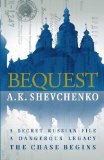
Bequest – A.K. Shevchenko


I was a massive fan of Child 44 so when someone on twitter suggested that Bequest was similar I jumped at the chance to read it. Unfortunately Bequest was much simpler than Child 44 and I think the two books will appeal to a different group of readers.
Bequest is a thriller that centres on the Ukrainian legend of the lost Cossack gold, a large quantity of gold that was rumored to have been deposited in the Bank of England in the 18th Century. The gold would now be worth enough to bankrupt the Bank of England and change the balance of power within Europe. Many Ukrainians dream of finding a connection to this inheritance; finding a secret document that links them to this fortune. It is this that happens in Bequest, leading to a race to secure the fortune before it lands in the wrong hands.

Bequest is fast paced and easy to read, but the book lacked any real tension. There was the occasional heart stopping moment, but it was all over too quickly for me.

The story switched between several time periods, including the 18th century, but the whole book read in the same way. This meant that apart from the odd reference to their situation there was no period atmosphere.

‘Can you read to me, Alexy?’ she said gently. ‘I have trouble making out the letters today. I still have a headache from all that dancing.’
Razumovsky knew perfectly well, as did the whole Court, that Yelizaveta not only abhorred reading, but she considered it dangerous – and was convinced that too much reading was the cause of her beloved sister Anna’s death.

The majority of the book was set in dusty libraries/archives. I enjoyed learning a bit about Ukrainian history, but prefer to become immersed in someone’s life and emotions rather than to chase a large amount of money through long lost documents.

This book will appeal to anyone who enjoys fast paced investigative thrillers,  especially those who’d like to learn a bit more about Ukrainian history.

Other bloggers loved it:

 Bequest glistens with as much gleam as a 24 carat nugget Rob Around Books

an intriguing and enjoyable novelEuro Crime

Categories
1920s Classics

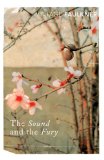
The Sound and the Fury – William Faulkner

The Sound and the Fury was first published in 1929 and is considered to be one of the most important novels of the 20th century. The book follows the Comptons, an Aristocratic southern American family, struggling to deal with their poor reputation and the breakdown of their family.

The Sound and the FuryThe Tale of Genji or Ulysses, if I ever manage to finish them!!).

The first section is narrated by a mentally disabled man called Benjy. I finished these 72 pages without having much idea of what had happened. The disorienting world of someone who doesn’t fully understand what is happening was made even more confusing by a stream of consciousness writing style.

I wasn’t crying, but I couldn’t stop. I wasn’t crying, but the ground wasn’t still, and then I was crying. The ground kept sloping up and the cows ran up the hill T.P. tried to get up. He fell down again and the cows ran up the hill. Quentin held my arm and we went toward the barn. Then the barn wasn’t there and we had to wait for it to come back.

I sought out a summary of the chapter on wikipedia and this helped a lot – especially learning that anything written in italics is a flashback. I re-read the chapter, trying to seek out all the points mentioned on wikipedia, but I have to admit that I probably wouldn’t have noticed some of the plot points without a guide to help.

The second section, narrated by Benjy’s older brother, was easier to understand, but not much!! Again I had to rely on wikipedia and re-reading to pick up many of the plot points. I continued the rest of the book having read the wikipedia summaries in advance. It was hard work! I also discovered Spark Notes, which gave me an even greater insight into the book.

The problem that I find with books like this is that the effort it takes to simply understand what is happening removes any chance to form an emotional connection to the characters. The plot wasn’t that exciting and so I didn’t feel as though the effort I put in was rewarded.

I’m sure that you can derive a lot of pleasure from studying this book, but I’m afraid that I prefer to read books rather than tease out the meanings from individual paragraphs.

Highly recommended to people who enjoy studying literature.

Have you read The Sound and the Fury?

Categories
1990s Fantasy

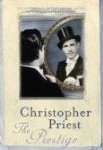
The Prestige – Christopher Priest

I am really pleased that I asked for literary science fiction recommendations as I don’t think I’d ever have found this book otherwise. I’m not convinced that The Prestige is literary or science fiction, but it is a fantastic read!

The Prestige follows two Victorian magicians who are battling to out-perform each other. The pair get locked in an increasingly bitter rivalry that leads them to commit acts so dark and secretive that their actions go on to affect several generations of their families.

Audiences know well that a magician will practice his illusions for years, and will rehearse each performance carefully, but few realise the extent of the prestigitator’s wish to deceive, the way in which the apparent defiance of normal laws becomes an obsession which governs every moment of his life.

I loved learning about the world of a stage magician – everything from how the magic tricks worked to their back stage life fascinated me.

It has been a long time since I last read a book so gripping that I walked around the house reading it; taking it to the kitchen as I couldn’t even bear to part with the story for the few minutes it takes to make a cup of coffee. Many of you will groan if I say this book reminded me of the Fingersmith, but I’m afraid it is the only book that I can compare it to. The Prestige is packed with Victorian atmosphere and has twists and turns equal to those in the masterpiece that is the Fingersmith.

The Prestige is written from the perspective of the two magicians and their grandchildren. It flips backwards and forwards in time, slowly revealing the truth about what went on. I loved the way all the characters drew slightly different conclusions from the same situation. Their subsequent thoughts and actions made so much sense once you’d seen things from their perspective. It was all just so cleverly done that I am still in awe of it.

The Prestige could fit into the science fiction/fantasy genre, but please don’t be put off by this. It would spoil the book if I let you know what happened, but the plot is written so convincingly that you feel as though it could have occurred. It isn’t much stranger than Gothic tales like The Seance or Her Fearful Symmetry.

I’m giving this book 5 stars, not because it is the best written book in the world (it isn’t), but because it is one of the most entertaining. The Prestige has become one of my top 20 books of all time. I’m sure you’ll soon be bored of me recommending it at every opportunity, so you might as well give in and get a copy now. 😆  

I am really excited to learn that Christopher Priest has written a lot of books and a few of them look as though they could be just as good.

This interview with Christopher Priest has made them sound even more appealing!

Have you read anything written by Christopher Priest?


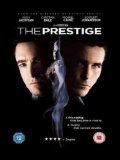
I also watched the DVD as part of C.B. James’ Read The Book, See the Movie Challenge

Prestige DVD

The Prestige DVD is also very good, but the story is much simpler. Many of the twists and turns had been edited out, meaning that the book was far better than the film.

I admit that the film confused me a lot at first, although this was probably because the actors looked nothing like the images of the characters I’d built up in my head (and I am notoriously bad at recognising faces!).

The plot was also a bit different, so it was satisfying to watch straight after reading the book. I was never quite sure which bits would stay true to the book and which would take a whole new direction.

It was interesting to see the magic tricks performed on stage, but I have to admit that they were a bit disappointing. The book had conjured up fantastic images of amazing tricks, but the footage revealed the cheesy old magic that I’ve seen many times before.

I’d also warn all bird lovers to take care when watching this film – I was a bit distressed to learn the truth behind some of the bird tricks.

I’d recommend the film, but the book is far better, so I encourage you to read that first.

Have you watched The Prestige?

Categories
2010 Books in Translation Other Prizes Thriller

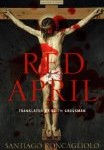
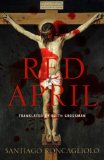
Red April – Santiago Roncagliolo

 Translated from the Spanish by Edith Grossman

Winner of 2006 Alfaguara Prize

Red April appealed to me for a number of reasons. The fact that the author was the youngest person ever to win the Alfaguara Prize (the most prestigious award for Spanish Literature) intrigued me. This, along with comparisons to Roberto Bolaño and a translation from the Queen of Spanish literature, Edith Grossman, had me requesting a copy from the publisher. I’m really pleased that I did as it is a fantastic book.

Red April is set in Peru and follows an unambitious police prosecutor who finds himself at the centre of a bizarre murder investigation. The corruption and unstable political situation of the country make the task of discovering the murderer even harder, especially when he discovers that few people are interested in the truth.

The book reminded me of 2666, but the crucial difference between the two is that things actually happen in Red April.

The plot is fast paced and reaches a satisfactory conclusion, successfully combining a complex thriller with deeper political commentary.

“The party has a thousand eyes and a thousand ears,” said Durango, smiling with inexpressive eyes fixed on those of the prosecutor. “They’re the eyes and ears of the people. It is impossible to lock up and kill all the people, somebody’s always there. Like God. Remember that.”

The religious beliefs of the Peruvians are also covered – I loved learning about their rituals and festivals. If nothing else this book taught me a lot about their way of life.

If I had to make a few small criticisms it would be that the political situation isn’t fully explained. This means that prior knowledge (or a bit of googling!) is required to fully appreciate some sections.

The characters are also hard to love. All of them commit some form of evil during the course of the book. This means that it isn’t possible to empathise with anyone – you have to simply enjoy the story telling without connecting with anyone on a personal level.

Overall, this is an impressive debut novel that I’d highly recommend to fans of Roberto Bolaño or similar Spanish literature.

Categories
2010 Novella

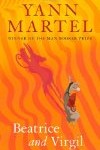
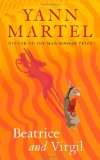
Beatrice and Virgil – Yann Martel

I loved Life of Pi so much that I bought a copy of Beatrice and Virgil from the US, months before it was released in the UK. Unfortunately my enthusiasm failed to pay off as I was very disappointed by it. 

Beatrice and Virgil is a book about the Holocaust, but there are many points when it is almost impossible to see the connection.

The book begins with Henry, a successful author, ranting about a publisher refusing to let him write a book which combines non-fictional accounts of the Holocaust with fictional ones.  One day Henry receives a strange package from a taxidermist, also called Henry, and is so intrigued he heads off to meet him. The taxidermist has written a play about a monkey and a donkey who live on a shirt. This play becomes the focus of the book, as the two Henrys discuss how to improve it.

The play is an allegory for the Holocaust, but the continual use of symbolism drove me mad. I’m afraid that I’m the type of person who prefers to call a spade a spade! I loved The Kindly Ones because it showed the Holocaust in all its horrific rawness, but although Beatrice and Virgil didn’t shy away from graphic violence, I found myself cringing as I read it rather than experiencing the sense of shock and sadness that I should have felt.

Another problem I had with the book was that it felt disjointed. For such a small book there were a lot of random elements thrown together, some so odd that they left me totally baffled. There was one point where they spent 8 pages trying to describe a pear – my eyes were rolling throughout:

BEATRICE: Like an apple?

VIRGIL: No, not at all like an apple! An apple resists being eaten. An apple is not eaten, it is conquered. The crunchiness of a pear is far more appealing. It is giving and fragile. To eat a pear is akin to…kissing.

BEATRICE: Oh, my. It sounds so good.

The end of the book contained a section called Games for Gustav. This is a series of questions about the moral dilemmas faced by those affected by the Holocaust.

GAME NUMBER ONE
Your ten-year-old son is speaking to you. He says he has found a way of obtaining some potatoes to feed your starving family. If he is caught, he will be killed. Do you let him go? 

Each of these would make an interesting premise for a story, but placed together in this way I found them to be manipulative and irritating.

Overall I found that the whole book made my blood boil with rage. It could be said that this is a positive reaction; that it is far better for an author to create a book that is memorable in its dreadfulness than one which is dull and forgettable. I’ll leave you to make up your own minds!

Beatrice and Virgil is the perfect book club choice as I guarantee it will create discussion – people will be arguing about this book for years to come.

What did Yann Martel have to say about his book?

WARNING MAY CONTAIN SLIGHT SPOILERS

On 3rd June 2010 I went to see Yann Martel talk about his new book at the South Bank Centre in London.  He was an entertaining speaker, willing and eager to answer questions from the public and regularly able to make us all laugh. I tried to make as many notes as possible, but the following is a summary of what he had to say – not direct quotes from him.

Why did you write the book?

I had noticed that there was an absence of fictional books about the Holocaust. People seem to be relaxed writing about wars, but are scared to write about the Holocaust. I wanted to fill this gap, so this book is an attempt to meet the Holocaust without being a witness.

Why did you use animals in the book?

The inspiration for using animals came from The Life of Pi. It is an obvious literary device, but I wanted to select animals that would be guides through the Hell that is the Holocaust. Selecting Dante’s guides seemed like a natural choice.

Why did you spend eight pages describing a pear?

Language trivialises pears. The section shows that no amount of words can adequately describe a pear, so how can we describe something as complex as war if we can’t even describe an object as simple as a pear?

What is the sewing kit about?

The sewing kit contains a lot of random literary elements. I wanted to list them together to see how many people would recognise and how many would “stick”.

Why did you give the central characters the same name?

The two central characters are both called Henry. This is because I didn’t want people to deduce anything about their personality from the name. I wanted to show that a person only lives the way they do by the random lottery of where they are born. We are all essentially the same.

Where is the book set?

The setting of the book is deliberately never mentioned. This is because I wanted the book to be universal – it could equally be set in almost any country of the world.

What is your next book about?

Three chimps in Portugal (note – I couldn’t decide if this is true or just a joke!)

What do you think?

Did you enjoy Beatrice and Virgil?

Is a book a success if it is memorable and provokes discussion?