Categories
Orange Prize Recommended books Richard and Judy Book Club

Half of a Yellow Sun – Chimamanda Ngozi Adichie – Read-along Complete!

Winner of the Orange Prize 2007

.

.

..


The second half of this book was very different from the first. I actually found it quite difficult to read in places, as it was so emotional. The suffering of the Biafran people, as they were murdered, abused and starved was heart breaking to read. This book really highlights the horror of war, the way people abuse their power, and the depths they will stoop to in order to survive.

Sometimes it was the simplest of quotes which conveyed the strongest message:

“How have you been, my brother?”
“We did not die,” he said.

If any further explanation had been given, it would have in some way belittled the events they experienced. If the only good thing you can say is that you did not die then, the magnitude of the devastation is enforced.

In my first post, many of you said that you thought my high opinion of Ugwu would change when I read the final section of the book. I don’t want to give anything away, as I realise that there are still lots of you out there who haven’t read this yet, but Ugwu remains my favourite character. I know he did a terrible thing, but I can understand how peer pressure and war can make people do things they would never normally do. Ugwu felt immense guilt and remorse afterwards, and because of this I will forgive him. It actually makes me feel more compassion for him, as I think he will suffer from the guilt of his actions for the rest of his life.

In my first post I also stated that the female characters didn’t come across very strongly. I have to say that in the second half of the book they came into their own. Each and every one of them showed an inner strength that I admire. By the end of the book I loved every single character in some way. Perhaps it is just that everyone who has had to endure the horrors that they did gains sympathy in my eyes, and are stronger because of the things they have gone through. Is this wrong? Or do you think that war can turn everyone into better people?

The one thing I didn’t like was the way they referred to the six-year-old girl as Baby. For a long time I assumed she was a baby, and it really threw me when I first realised how old she was. This is probably some symbolism I just don’t understand – so please bear with me!

I can’t say that I ever really enjoyed reading this book. I am really pleased that I read it, but the subject matter was so distressing that I don’t feel I can recommend it to everyone. The fear oozes from every word:

The first explosion sounded distant. Others followed, closer, louder, and the earth shook. Voices around her were shouting, ‘Lord Jesus! Lord Jesus!’ Her bladder felt painfully, solidly full, as though it would burst and release not urine but the garbled prayers she was muttering.

This really is an incredible book though, the writing is powerful, the characters realistic and multi-layered – the only thing this book is lacking is happiness.

It will become a classic. Highly recommended.

stars4h


What did you think of this book?

Will it still be read 50 years from now?

Did you find it distressing to read?
Categories
Pulitzer Prize

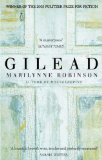
Gilead – Marilynne Robinson

Winner of the Pulitzer Prize 2005

Gilead  is entirely made up of a letter from an old man, nearing death, to his young son. The letter aims to let the boy know about his life, and to teach him all the important lessons that he would like his son to know.

I’m afraid this is one of those quiet, observational books which I do not enjoy. It is beautifully written, but there is no plot, and as the old man’s thoughts meandered around I quickly lost interest.

I remember a slice of moon, no more than that. It was a very clear night, or morning, very still, and then there was such energy in the things transpiring among those trees, like a storm, like travail. I stood there a little out of range, and I thought, It is all still new to me. I have lived my life on the prairie and a line of oak trees can still astonish me.

I also found the first person narrative to be quite annoying – don’t ask me why – it is just one of those things which I dislike when reading!

The book is packed with religious quotes. The old man was a preacher, and so almost all of his thoughts are backed up with quotes from the bible. If you like reading Christian books, then this will be an added bonus for you, but I’m afraid it was an added irritant for me.

Overall, I’m afraid this just wasn’t for me.

If you enjoy reading gentle wisdom, in beautifully written prose, and don’t mind when books have no plot, then you’ll love it.

stars21

I read this in preparation for reading Home, which has been short listed for the Orange Prize this year. Is the writing style of Home similar to this?

I think this is the most disappointing Pulitzer winner I have read so far. Which Pulitzer winner have you found disappointing?

Categories
2009 Orange Prize

The Invention of Everything Else – Samantha Hunt

Short listed for the Orange Prize 2009

The Invention of Everything Else aims to familiarise us with the forgotten scientist, Nikola Tesla. Tesla is an intriguing character, who suffers from obsessive compulsive disorder, but has moments of genius in which he invents revolutionary advances in electrical engineering. The book also focuses on Louisa, a curious chambermaid, who discovers Tesla’s notes in the hotel where she works. They form a curious relationship through their interest in pigeons!

I’m afraid I didn’t connect with this book at all. As a chemistry graduate I was interested to read about this unusual scientist’s life, but I think the fact I am quite knowledgeable in this field was one of the main factors in my dislike for it. I felt I was being patronised a lot of the time by the  frequent  over-simplified explanations of Tesla’s discoveries. To highlight this I thought I’d pick out a quote on an object we are all familiar with:

The bicycle. Yes. I saw it once before. A magnificent invention. So simple and so sensible to harness wheels onto our feet while we are walking. Allowing the laws of physics to magnify our efforts and energy…..That rider is exerting no more effort than we are, and indeed he might be exerting even less, as he has also enslaved momentum to his machine, creating energy from nothing but cleverness.

If that quote didn’t irritate you, then you are probably OK to read this book, but be aware that the workings of  many things are explained in the book, something I found very tedious.

The book gets more complex as it continues, and is difficult to follow at times. It flips back and forth between various points in Tesla’s life, as he meets many eminent scientists. There were also a few very strange pieces of writing in here, the most bizarre being a list of 72 things beginning with the letter S. I know that passages like this are supposed to highlight Tesla’s OCD behaviour, but I found them a bit odd. There were a few great pieces of writing in this book, but I sometimes felt that Samantha Hunt was trying too hard to add certain literary elements to the book at the expense of plot. Perhaps I’m wrong though – it was shortlisted for the Orange Prize, so some people obviously love it.

Overall, I’m afraid that the book did more to annoy me than entertain, and though it was clearly very well researched, I think that the more scientific your knowledge, the more you will dislike this book.

Recommended to people who love literary fiction, but know nothing about electrical engineering!

stars2


Have you read this book? What did you think?

Does this have your vote for the Orange Prize this year?

Can you recommend any good fiction with scientific content?

Categories
Orange Prize Richard and Judy Book Club

Half of a Yellow Sun – Thoughts at the half way point

Winner of the Orange Prize 2007

.

.

.

On reflection the half way point is a terrible place to stop and write notes on this book. I should have chosen a place about a third of the way in, when the characters had just been introduced, before the horrific events start to take place. Having not read the book I wasn’t to know this, and so I’ll have to make the most of it, and try to form some opinions, despite being in the middle of the fast paced devastation taking place in the book at the moment.

The book did not progress as I expected it too. The writing style was different to Purple Hibiscus, in that it seemed more complex, and instead of focusing on one central character we are introduced to lots of different ones, who don’t seem to have anything in common. The build up was very slow, and I was beginning to wonder why people rave about this book so much, as it didn’t have much appeal initially.

The female characters don’t appear to be as strong as the male ones at this half way point. Perhaps this is just a reflection of the African nation, where men take a more dominant role in society, but the female characters are coming across as quite vague and hard to relate to at this stage.

My favourite character is Ugwu. He is a boy from a poor village, who goes to work as a houseboy for a university lecturer. I especially loved the scene at the start of the book where he goes to his Master’s house for the first time, and is excited by the food and running water he finds there:

Ugwu turned off the tap, turned it on again, then off. On and off and on and off until he was laughing at the magic of the  running water and the chicken and bread that lay balmy in his stomach.

Scenes like this remind us of how lucky we are in the west to have basic luxuries like running water in our homes.

The pace of the book has picked up a lot in the last few chapters. The scenes of violence are disturbing, and my heart is often in my mouth as I read the words. I can only imagine that it is going to get much worse in the final half of the book. My only wish is that Ugwu survives to the end, and has a promising future predicted.

What are your thoughts on the first half of the book?

Is it how you expected it to be? Are you enjoying it?

Who is your favourite character?

Categories
Booker Prize

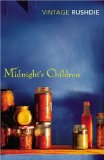
Midnight’s Children – Salman Rushdie

Winner of the Booker Prize 1981.

Midnight’s Children tells the story of Saleem Sinai; born at midnight on the day of India’s Independence, he realises that it isn’t just the time of his birth which singles him out from other people. Saleem discovers  that all children born between midnight and 1am on this momentous day posses special powers of one form or another. As Saleem was born at midnight, the exact time of Independence, his are stronger than the others. Saleem is able to enter the minds of others, and so brings them all together through meetings in his mind. Describing the plot for this book is very hard, as there are so many tangents and subplots, and I don’t want to give too much away, but the book is much more complex than I can summarise here. It contains many different themes, including the politics, fairy tales and history of India. The BBC launched a competition to summarize the plot in 67 words, some of them were quite good – you can see the best here.

I had a love – hate relationship with this book. For the majority of the time I felt I was battling against the words. The shortage of paragraphs and speech to break up the text meant that it was very dense, and I felt myself becoming lost in all the words. It took an enormous amount of concentration, and often a postcard under each line, just so I could keep track of where I was. Occasionally, the writing would absorb me, and for a few pages I would become completely immersed in the story. It was a very strange experience, as normally I find the writing in a book consistent, but the randomness of how much each page appealed to me was really bizarre.

There were certain aspects of this book which I loved. One of the most interesting sections told of how when alcohol was banned in Bombay, people could obtain small quantities from their doctor if they registered themselves as being an alcoholic. This led to many people claiming to be alcoholics, just so they could have some to drink. It was insights into Indian life like this that I loved reading. Everyday life for people in other cultures fascinates me. I don’t need magic tricks or the ability to fly to make someone special in my eyes.

This book is packed with magical realism, something which I find hard to appreciate. I need to be able to connect with the characters, something which I find very hard to do if they are capable of performing impossible acts, and the plot veers off on weird tangents. One of the other things that I didn’t like was that the narrator begins his story before his birth. He describes events he has never witnessed, and ones he claims to remember while he was just a tiny baby. I know this is just another aspect of magical realism, but for some reason it really bothered me.

The book is filled with symbolism, most of which went over my head. I think this book needs several readings, and probably detailed studying in order to fully appreciate it. I have found this free Spark Notes study guide here, and so will try to read through it, to pick up on a few of the points which I’m sure I missed.

The main problem with this book is that the story line is not linear; it jumps around, and is very difficult to follow at times. The plot is so bizarre in places that I didn’t really understand what was going on, until I read the study guide above!

Overall, I’d recommend this to people who love literary fiction, especially those who love symbolism. I’m pleased that I read it, but it wasn’t  an entirely enjoyable experience for me.

stars3h


Have you read Midnight’s Children? If so, did you enjoy it?

Are you a fan of magical realism?

Would you enjoy a book where a week old baby is explaining what is happening around him?

Categories
2009 Orange Prize

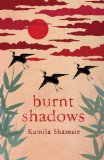
Burnt Shadows – Kamila Shamsie

  Shortlisted for the Orange Prize 2009

I can’t describe the plot of  Burnt Shadows better than the blurb on the back cover of the book, so I have copied it here:

August 9th, 1945, Nagasaki. Hiroko Tanakasteps out onto her veranda, taking in the view of the terraced slopes leading up to the sky. Wrapped in a kimono with three black cranes swooping across the back, she is twenty-one, in love withthe man she is to marry, Konrad Weiss. In a split second, the world turns white. In the next, it explodes withthe sound of fire and the horror of realisation. In the numbing aftermath of a bomb that obliterates everything she has known, all that remains are the bird-shaped burns on her back, an indelible reminder of the world she has lost. In search of new beginnings, she travels to Delhi to find Konrad’s relatives, and falls in love with their employee Sajjad Ashraf, from who she starts to learn Urdu. 

 As the years unravel, new homes replace those left behind and old wars are seamlessly usurped by new conflicts. But the shadows of history – personal, political – are cast over the entwined worlds of two families as they are transported from Pakistan to New York, and in the novel’s astonishing climax, to Afghanistan in the immediate wake of 9/11.

Burnt Shadows is an epic book, spanning both generations and continents. There were many amazing sections in this book; the first chapter in particular was incredible, the subtle building of tension was brilliantly achieved, and the horror of the atomic blast, was sensitively written.

I loved the central character, Hiroko; she overcame so many tragedies, but remained a believable stalwart throughout. Some of her quotes were particularly thought provoking:

‘Sometimes I look at my son and think perhaps the less we have to “overcome” the more we feel aggrieved.’

The female characters in the book were far superior to the male ones. They seemed to have a depth, and realness lacking in all the male ones.

My main grievance with this book was that the ambitiousness was too great; trying to capture so many different cultures in one book, led to too much explanation, at the expensive of the flow of the story. In many places the book came across as contrived. The plot seemed to have been forced around major historic events: Nagasaki, Indian Partition and 9/11. These events were so far apart, both in time, and distance that it didn’t work for me. The credibility of the book just kept sliding away, the more I read. Would a 91-year-old lady really have travelled all the way from Asia to New York on her own, and then ‘run around’ New York like a person a quarter of her age?

Despite my criticisms there were many important issues raised by this book. The ambitiousness of this writing project deserves some recognition, and I wouldn’t be surprised if this won the Orange Prize. I’ll let you know once I’ve read all the other shortlisted books if I still think this is a contender.

Recommended for the first chapter, and a few other moments of genius, but be prepared to wade through some of the slower sections.

stars3h


I noticed that some of Kamila Shamsie’s books have been shortlisted for the John Llewellyn Rhys Prize. Has anyone read any of her earlier books?

What did you think of this one? Do you think it might be a contender for the Orange prize this year?